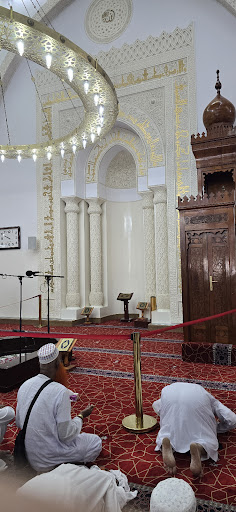
The Masjid al-Qiblatayn (Arabic: مسجد القبلتين, lit. 'Mosque of the Two Qiblas'), also spelt Masjid al-Qiblatain, is a mosque in Medina believed by Muslims to be the place where the final Islamic prophet, Muhammad, received the command to change the Qibla (direction of prayer) from Jerusalem to Mecca. The mosque was built by Sawad ibn Ghanam ibn Ka'ab during the year 2 AH (623 CE) and is one of the few mosques in the world to have contained two mihrabs (niches indicating the qibla) in different directions. The mosque is among the earliest mosques in Medina and was built by Sawad ibn Ghanam ibn Ka'ab al-Ansari in the Islamic year 2 AH, and the name of the mosque goes back to the lifetime of Muhammad, when his companions named it after an event that took place on the 15th of Sha'baan the same year, when Muhammad received revelation from Allah instructing him to take the Kaaba as the qibla during the Dhuhr prayer, instead of the qibla of the Jews, which was the Temple Mount in Jerusalem. He later announced this to his companions in his own mosque, after which the news began to spread. Many pilgrims who go to Mecca for Hajj often visit Medina, where some visit this mosque because of its historical significance.
Indeed, We see you ˺O Prophet˺ turning your face towards heaven. Now We will make you turn towards a ˺direction of prayer˺ that will please you. So turn your face towards the Sacred Mosque ˺in Mecca˺—wherever you are, turn your faces towards it. Those who were given the Scripture certainly know this to be the truth from their Lord. And Allah is never unaware of what they do. – Quran 2:144 (translated by Mustafa Khattab)
A hadith from Sahih Bukhari says:
Narrated Ibn Umar: While some people were offering Fajr prayer at Quba' (mosque), some-one came to them and said, "Tonight some Qur'anic Verses have been revealed to the Prophet and he has been ordered to face the Kaaba (during prayers), so you too should turn your faces towards it." At that time their faces were towards Shaam (Jerusalem) so they turned towards the Kaaba (at Mecca).
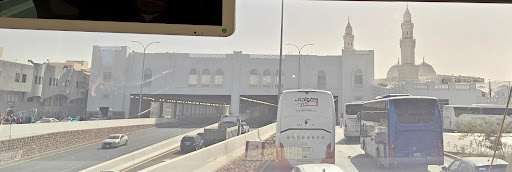
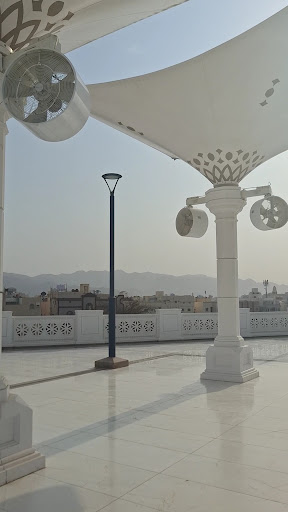
The main prayer hall adopts rigid orthogonal geometry and symmetry which is accentuated by the use of twin minarets and twin domes. Living accommodations for the Imam, the Muezzin and the caretaker are discretely grouped in one block to the west of the main structure. The difference in level at the southeast corner of the site has been exploited to incorporate a sub-basement level which serves as the ablutions area for worshippers. To the north, where the ground level is lower, the prayer hall is raised one-storey above ground level. Entry to the prayer hall is from the raised courtyard, also to the north, which can be reached by stairs and ramps from the main directions of approach. The prayer hall consists of a series of arches which support barrel-vaults running parallel to the qibla wall. These vaults are interrupted by two domes which establish an axis in the direction of Mecca. The main dome to the south is raised on a drum of clerestory windows which allow light to filter into the interior directly above the mihrab. The second, false dome is linked to the first by a small cross-vault to symbolise the transition from one qibla to another. Below it, a replica of the mihrab found in the lower chamber of the Dome of the Rock in Jerusalem reminds onlookers of the oldest extant mihrab of Islam. Externally, the architectural vocabulary is inspired by traditional elements and motifs in a deliberate effort to offer an authentic image for the historic site. The mosque is located on the north-west of the city of Medina, on Khalid ibn al-Walid Road. The mosque was initially maintained by Caliph Umar ibn al-Khattāb. The last pre-modern renovation was by Suleiman the Magnificent who...
Read more9/2/25, Sunday, 9am:
Masjid Al-Qiblatain (مسجد القبلتين) is a historically significant mosque in Madinah, Saudi Arabia. It is famous for being the site where the direction of prayer (Qibla) was changed from Masjid Al-Aqsa (Jerusalem) to Masjid Al-Haram (Kaaba in Makkah).
Historical Background During the second year of Hijrah (624 CE), Prophet Muhammad ﷺ was leading Dhuhr or Asr prayer (scholars differ on the exact prayer) when Allah revealed the command to change the Qibla. The Prophet ﷺ immediately turned 180 degrees mid-prayer, and the companions behind him followed. Since this mosque witnessed the event, it was named Masjid Al-Qiblatain, meaning "The Mosque of Two Qiblas."
Quranic Revelation About the Qibla Change The change in Qibla is mentioned in the Quran:
"We have certainly seen the turning of your face, [O Muhammad], toward the heaven, and We will surely turn you to a Qibla with which you will be pleased. So turn your face toward Al-Masjid Al-Haram. And wherever you [believers] are, turn your faces toward it." (Surah Al-Baqarah 2:144)
This verse marked the permanent direction of prayer toward the Kaaba.
Significance of Masjid Al-Qiblatain Spiritual Landmark – It symbolizes obedience to Allah’s command and marks an important turning point in Islamic history.
Architectural Uniqueness – Historically, it had two Mihrabs (prayer niches), one facing Jerusalem and one toward Makkah. However, the old Qibla Mihrab was later removed.
Popular Pilgrimage Site – Many Muslims visit it during their journey to Madinah.
Hadith About Masjid Al-Qiblatain and the Qibla Change While there is no direct hadith solely about Masjid Al-Qiblatain, the Qibla change is well-documented in authentic hadith sources:
Hadith from Al-Bukhari (Book 8, Hadith 392)
Narrated Al-Bara’ bin ‘Azib:
“When the Prophet ﷺ came to Madinah, he prayed facing Jerusalem for sixteen or seventeen months but wished to face the Kaaba. Allah then revealed (2:144), and he turned toward the Kaaba. Some people in Quba were still praying when they were told of the change, so they turned toward the Kaaba.”
Hadith from Sahih Muslim (Book 5, Hadith 209)
Narrated Ibn Umar:
"While some people were praying Fajr at Masjid Quba, a man came and said, 'The Qibla has been changed toward the Kaaba!' They immediately turned while still in prayer."
This confirms how Masjid Al-Qiblatain and Masjid Quba were the first places to experience the shift in Qibla.
Present-Day Masjid Al-Qiblatain
Today, Masjid Al-Qiblatain is a beautifully renovated mosque with modern facilities while preserving its historical essence. The original second Mihrab (toward Jerusalem) was removed to avoid confusion.
Visiting Masjid Al-Qiblatain
Located in Madinah, about 7 km from Masjid An-Nabawi
Easily accessible for visitors and Umrah pilgrims
A key stop in Ziyarah tours of Madinah
Masjid Al-Qiblatain is a powerful symbol of obedience and unity in Islam, reminding Muslims of the pivotal moment when the prayer direction was set toward the...
Read moreMasjid al-Qiblatain, meaning "Mosque of the Two Qiblas," holds a significant place in Islamic history. On the 2nd of Rajab in the 2nd year of Hijrah, a crucial revelation changed the direction of the Qibla from Masjid al-Aqsa in Jerusalem to the Ka’bah in Makkah. This mosque is especially important as it is where the first congregational prayer was held after this divine command.
While in Makkah, the Prophet Muhammad (ﷺ) prayed towards Bait al-Maqdis with the Ka’bah in front of him. After migrating to Madinah, he continued to pray towards Jerusalem for 16 months, hoping for a change. This change occurred during a Dhuhr prayer (or possibly Asar) when he was instructed by a revelation from Surah al-Baqarah. The verse expressed, “Verily, We have seen the turning of your face towards the heaven. Surely, We shall turn you to a Qiblah that shall please you” [2:144]. The Prophet (ﷺ) then turned towards the Ka’bah, and his companions followed his lead, establishing it as the new Qibla for Muslims.
Masjid al-Qiblatain was unique in that it featured two mehrabs: one directing towards Masjid al-Aqsa and the other towards the Ka’bah. Although the older mehrab is now covered, this architectural feature reflects its historical significance during the Qibla transition.
The day of this revelation was one of joy for Muslims, but it also marked a moment of sorrow for the Jewish community, as it signified a complete independence from them. This change fulfilled a prophecy in their scriptures about the last great prophet altering the direction of prayer from Jerusalem to the Ka’bah. In an attempt to persuade the Prophet (ﷺ) to revert to Jerusalem, Jewish elders approached him, but Allah (ﷻ) revealed, “And even if thou broughtest unto those who have received the Scriptures all kinds of portents, they would not follow thy Qibla” [2:145]. This shift underscored the emergence of a distinct Muslim identity, as some Jews began to align themselves with hypocrites and polytheists.
As the Muslim community established its unique identity, Imam Ahmed reported that the Prophet (ﷺ) remarked on the envy felt by the People of the Book. They longed for the Friday prayer, the exclusive Qibla given to Muslims, and the practice of saying “Aameen” behind the imam. This jealousy highlighted the distinctive standing of Muslims in their faith and practices, setting them apart in an evolving...
Read more