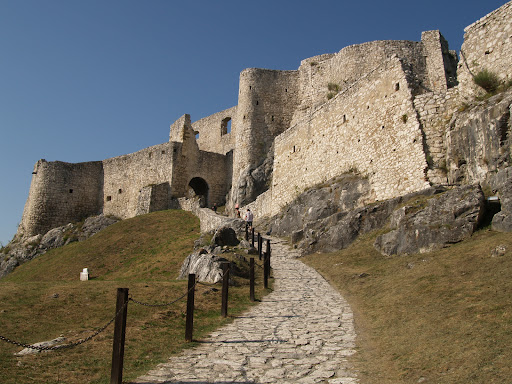
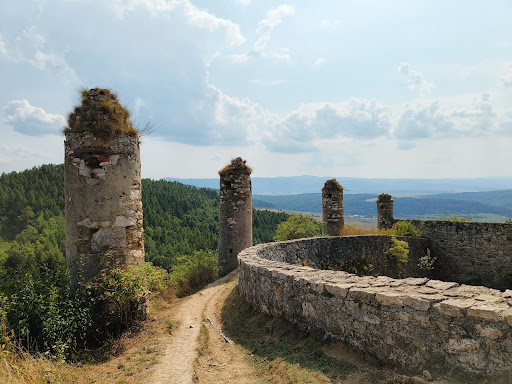
In the eastern horizon of Spišské Podhradie towers the Spiš Castle. As a National Cultural Monument, Spiš Castle with its area of more than four ha, and partially in ruins, is one of the largest castle compounds in Central Europe. Spiš Castle was included in the UNESCO World Heritage List in 1993.
Construction of the medieval castle on a travertine hill (at an altitude of 634 m) dates back to the beginning of the 12th century. The oldest written reference to the castle is from 1120. At the beginning it was a boundary fort placed at the northern frontier of an early feudal Old Hungarian state.
Afterwards, it became the seat of the head of the Spiš region for many centuries. In the second half of the 15th century the reconstruction of the castle fell upon its new owner Štefan Zápoľský whose intention was to remake it into a stately aristocratic residence. He had made a palace, a knight hall and chapel of St Elisabeth in the castle. His son Ján, later King of Hungary was born at the Castle.
The last building works at the Upper Castle were made under the orders of the Thurzos' and the Csákys'.
In 1780 the castle compound was destroyed by fire and the proud Spiš Castle gradually fell into ruins. The total decay of the castle was prevented only through the intervention of conservationists who in 1970 got down to the difficult job of preserving the walls and palaces threatened by the instability of its rocky base.
At present there are the collections of the Spišské múzeum placed in the castle documenting its history, along with medieval arms and feudal jurisdiction.
The landscape around the village of Spišské Podhradie can be seen comfortably by using the instructive footpath Sivá Brada – Dreveník, which has eight information boards along its route guiding the visitor through the travertine hills and natural phenomena in this part of the region.
Due to its historical appearance, several films were made at the castle, such as Dragonheart, Phoenix, Kull the Conqueror, The Lion in Winter or The Last Legion...
Access: driving to the parking lot under the castle, then walking about 10 minutes. Or on foot from the village Spišské Podhradie in about an hour.
Opening: November – March: Closed May – September: Open daily 09:00 - 18:00 April and October: Open daily 09:00 - 16:00
Ticket for the whole castle: 08.00 € adults 06.00 € students (19-26 years) and pensioners 04.00 € children (6-18 years) 19,00 € family (max. 4 persons, e.g. 2 adults + 2 children)
Some photos courtesy of...
Read moreI have some mixed feelings about this castle, as I really wanted to visit for years, and from the outside, the castle ruin is really picturesque. You could make awesome photos from the surrounding roads/fields, and also the mountain road that we took from Kosice was a joy to drive on! Oh also, there is free parking at the castle, a bit Balkans (a big free for all), but it's not too bad. The view from the castle is also excellent, although you really mostly see the same things as you see from the castle gate, so not sure if there is much point to go inside.
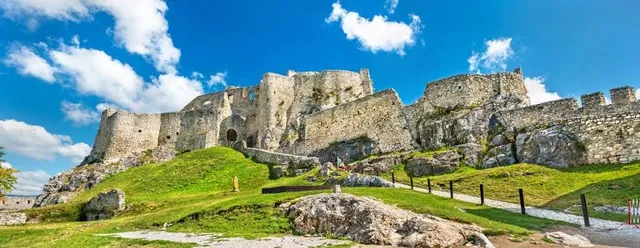
But if you want to go in.... First of all, be prepared to pay 10 EUR per adult (would be 16 if the upper parts of the castle were not under renovation), for what exactly again? Two souvenir shops where you cannot pay by card. A small shop where you could buy beverages and strudel for 2.5x the normal price. A free toilet. A huge, empty lower castle courtyard. A super slippery, straight out dangerous walkway leading to the upper parts of the castle (seriously we had to wait until the people coming down passed, only so we could find some handholds to go up. People kept slipping on the "pavement" even in proper shoes.) If you go to the upper castle, you will get a slightly better view of the surrounding countryside, and that's pretty much it. No exhibition, no big spectacle, just the opportunity to see the inside of a ruin, for a hefty price.
I am not sure what will be added when the upper castle is finally finished, maybe the former president of Slovakia will sing and dance to the visitors to justify the high entry fee. But until that is confirmed, I really highly recommend that you carefully consider spending your money here. Go to the parking, sure. Walk up to the castle gates, sure. Take photos of the view from there, for absolutely free, and then go down to the village and enjoy a good meal, while also taking photos of the castle looming over, sure. You will probably feel that you miss out if you do not go in, but trust me... you will not miss out on...
Read moreThe ruins of Spiš Castle in eastern Slovakia form one of the largest castle sites in Central Europe. The castle is situated above the town of Spišské Podhradie and the village of Žehra, in the region known as Spiš (Hungarian: Szepes, German: Zips, Polish: Spisz, Latin: Scepusium). It was included in the UNESCO list of World Heritage Sites in 1993 (together with the adjacent locations of Spišská Kapitula, Spišské Podhradie and Žehra). This is one of the biggest European castles by area (41 426 m²).
Spiš Castle was built in the 12th century on the site of an earlier castle. It was the political, administrative, economic and cultural centre of Szepes County[1] of the Kingdom of Hungary. Before 1464, it was owned by the kings of Hungary, afterwards (until 1528) by the Zápolya family, the Thurzó family (1531–1635), the Csáky family (1638–1945), and (since 1945) by the state of Czechoslovakia then Slovakia.
Originally a Romanesque stone castle with fortifications, a two-story Romanesque palace and a three-nave Romanesque-Gothic basilica were constructed by the second half of the 13th century. A second extramural settlement was built in the 14th century, by which the castle area was doubled. The castle was completely rebuilt in the 15th century; the castle walls were heightened and a third extramural settlement was constructed. A late Gothic chapel was added around 1470. The Zápolya clan performed late Gothic transformations, which made the upper castle into a comfortable family residence, typical of late Renaissance residences of the 16th and 17th centuries. The last owners of the Spiš Castle, the Csáky family, abandoned the castle in the early 18th century because they considered it too uncomfortable to live in. They moved to the newly built nearby village castles/palaces in Hodkovce near Žehra and...
Read more