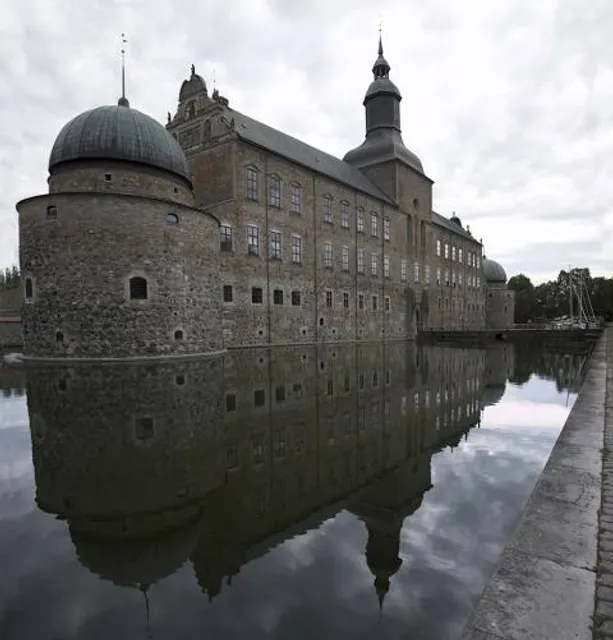
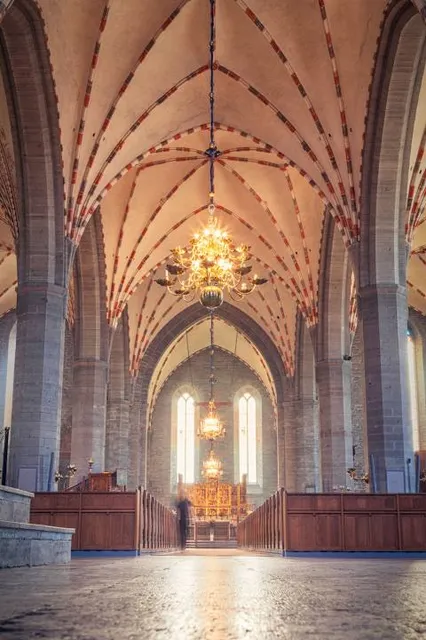
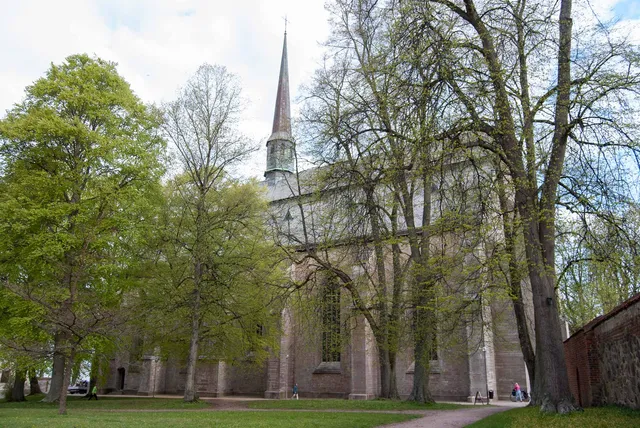
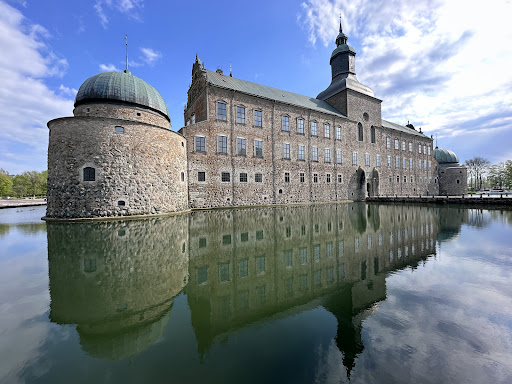
During the Middle Ages (1050-1520 AD), Vadstena was a town of considerable importance for the kings of Sweden. It was here that the House of Bjälbo erected the royal palace that later became the seat of the influential Birgittine Order. Vadstena was also on the route to Southern Sweden and the Danish border. The harbour was busy. Many pilgrims visited the church and the abbey. Vadstena Castle is considered one of the finest early-Renaissance buildings in the Nordic region. Building work commenced in 1545 on the order of King Gustav Vasa, proceeding in stages until 1620. Intended primarily as a defensive fortress, the castle was built in accordance with the latest European designs, with a rectangular shape and a round gun turret at each corner. On three sides, ramparts ran between the gun turrets and a moat surrounded the castle on all sides. Two tall, square towers, known as Fyrkanterna, were built inside the ramparts at the southern corners of the castle. The main castle building originally comprised a gatehouse flanked by two free-standing stone buildings. A strong wall ran between the gatehouse and its two wings. Soon, however, work began on joining up the three sections to form one long building. When Gustav Vasa's son Johan Ill became king in 1568, he converted the original Vasa castle into a sumptuous Renaissance palace in the continental style. Two new storeys were added to the castle during this period, with noteworthy interiors including the Castle Chapel, the Wedding Hall and the Hall of State, whose walls and ceiling are beautifully decorated with paintings. During the 17th century, the castle served primarily as a military base and storage facility and, from the late 17th century, as a granary. In the 19th century, the two square towers and the ramparts round the castle were demolished, and the materials reclaimed for the construction of the harbour and pier outside the castle. In 1899, the Regional Archive moved into the castle. The ramparts and square towers were reinstated in 1985-1999. The Regional Archive now occupies the ramparts. Vadstena Castle became a listed historic landmark in 1935 and is administered by the National...
Read moreThe castle is beautiful and fascinating, don't get me wrong. But the guided tour wasn't very telling of the castle itself.
The two people who took our group through the hallways of the castle were great, but I found it hard to follow. In one place they told one story and as we moved on to the next they told a different story. That combined with it being late and they trying to do as much as possible within that hour was overwhelming...
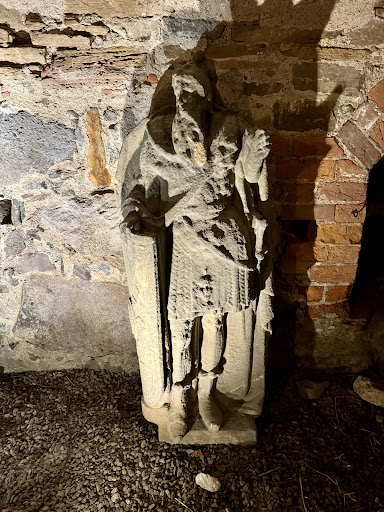
Also, I would've liked to get a better tour of the castle itself, in one place there stood multiple statues but you couldn't really see their details in the dark room and in another room there stood cannons but it's the same story here. I understand that they wanted to create a certain atmosphere but I would've liked there to be more light.
Also, we never really entered the castle, but went around in the outer walls and their cannon-rooms.
A "meh" experience...
Read moreNot only was this castle beautifully renovated into its Renaissance past, it had displays in English as well as Swedish and German.
Perhaps the best part was the man who sold us our tickets. He was SO HELPFUL to us. We had been given a parking ticket in another town, and being from USA we were having a very hard time trying to figure out the process of what we had done wrong and hope to contact the ticking company. He was able to help us and answer questions about how to avoid them in the future. I cannot say enough wonderful things about this man....
Read more