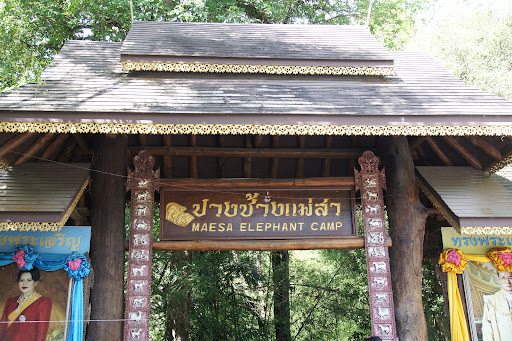
I had been looking for a sanctuary where the bathing, feeding, touching,... weren't allowed and where we could only observe the elephants living in their natural way. The situation of elephants is a very tricky one; with their lives being so intertwined with such a large "business" and so much mistreatment going on.
Despite all the research and thinking, today I accepted spontaneously to go to this one (without even knowing which one it was) when our friend told us he knew a place that was free of charge (maybe due to the season) and that he could drive us there, to "only see" the animals.
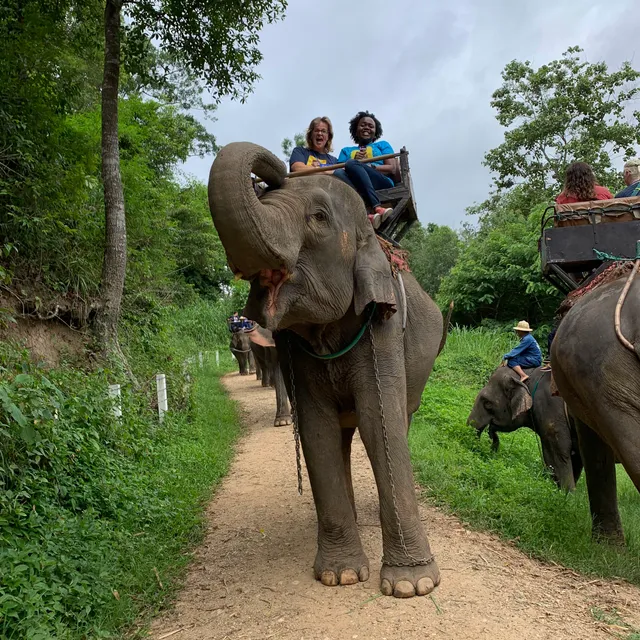
Anyways, the conditions weren't ideal, for sure. The few elephants that we saw were in a small area, mostly waiting for the food coming from the visitors (so it's basically like a zoo). Their caregivers were next to them at all moments to keep them under control, while they receive food from people, pose for a picture with them,... which probably means that they are taught to stay wise while all these unnatural things happen. They weren't tied or hit in front of us, but we saw the chains around the neck and the feet of a passing-by elephant, and worse, some caregivers carrying a wooden stick with a metal tip, so it is very likely that there is violence happening/happened (to "train"?).
Although, the animals didn't seem depressed whatsoever, they were dynamic, walking around, searching for food,... probably since they adapted to the situation (they stay wise so they get their food and they are not hit?).
To conclude; they are not completely free, they spend at least some hours "at the scene" where visitors can get close to them, touch them, feed them, and take photos together with them. They had a list of more than 60 elephants residing there (if they are all still alive), which means that they take turns to come show up for the humans (5 or 6 elephants present at the same time). Chains and sticks are heartbreaking, however I am not sure if they are treated better in other parks. I hope that this "training" is kept at a minumum and even if it happened at some point, it is not repetitive. This place, very probably, is not among the "best" ones; but I don't think it's among the worst, either.
PS: The sanctuaries I had on mind were Chang Chill and BEES. I'll update if I visit either...
Read moreThere is no absolute “No hook, no chain” elephant sanctuary, camp or tourism place. Very few people are aware that even in a so-called elephant sanctuary, be it for-profit or non-profit, all elephants are chained at night so that they can’t wander off from the area and get themselves in trouble e.g. hit by a vehicle, cause some damage to people’s property, get into a fight with other elephants, etc. The only way one might be able to let them chain-free 24 hours is to invest 10s or 100s of millions to build a huge and strongly fenced facility for each group or each individual elephant. It is quite annoying that many places omit this fact and purposely mislead their visitors to think that their elephants are 24-7 chain-free. In some cases, they mislead people to think that the elephant being trained to cooperate in putting on or removing the chain from its ankle is their attempt to put the elephant in the forever chain-free state. In my experience, to have an elephant tethered in a 20-meter long chain in the bush area for 8-10 hours is not that bad. Elephants, just like most other domesticated animals, get used to their routine and are able to enjoy their quiet and peaceful night provided that the keepers place some grass or other food to keep them fed and the chain area is safe for them to lie down when they want to actually sleep. Some elephants love to interact with their friends who are tethered nearby which is another way they spend part of their evening. This is also fair for the keepers who need to go back to their families and get some rest like people in other professions do. Instead of demanding for a No Hook, No Chain condition, elephant lovers can probably be more helpful to shift their focus to see if the chain is in good condition, intact, no sharp point that can hurt the ankles of the elephants, the length of time the chain is being put on and other facilities the place provides for the welfare of the elephants. #Thank you Credit by...
Read moreFirstly, I must stress that this place does not fit the description of a sanctuary. While the elephants were not hit or physically harmed, the mahouts gave the elephants instructions verbally, by tapping on their legs/backs or by pulling on the elephants' ears to perform small tricks such as placing a hat on a visitor's head, 'kissing' visitors or lifting up their trunks to rest them on their foreheads.
Secondly the elephants were surrounded by many visitors at one time, which I can imagine caused the animals a lot of stress. The elephants were fed, had people pose for photos near them and were petted by around 70-80 people in the space of one to two hours. During this time, some elephants were either in an open space, while others were in a small pen.
After being fed, some of the visitors could pay around 1000baht to bathe with the elephants. Therefore three of the elephants were taken down to the river and made to sit or lie in the water while 14 visitors poured water on the elephants and brushed their heads. The mahouts kept pushing the trunks under the water so that the elephants would spray water on the visitors in the river with them.
Moreover, on two or three occasions during the visit, the mahouts rode on top of the elephants, though this was not done by the people visiting.
My last observation is that there was a baby/young elephant. While I do not know if this calf had been rescued or not (no educational information about the elephants' habits, needs or preservation was given), I have read online that this could be due to captive breeding, an unethical practice, and thus I thought it might be relevant to include in my feedback.
Finally, my overall impression was that the animals were working. While they may not have been giving tourists rides, logging or being physically harmed, they were not left in their natural habit and were instead told to do tricks and move/stand/sit to entertain visitors. I would not call this well looked...
Read more