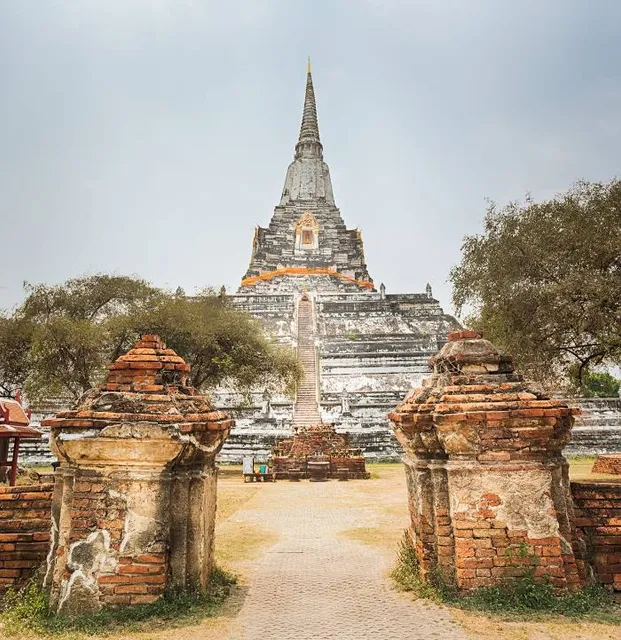
After traveling for almost 2 days by road from Penang we finally make it to Wat Phu Khao Thong, also known as the "Golden Mount," a captivating temple located approximately 3 km northwest of Ayutthaya's city center. The temple was originally established in 1387 by King Ramesuan of the Ayutthaya Kingdom. However in 1569, Ayutthaya falls into the Burmese's hand, where King Bayinnaung of Bago commissioned The construction of this temple unfortunately it was never completed.
If you happen to be in Ayutthaya, you got to see this unique serene historical site that offers ancient architectural beauty, making it hard to resist.
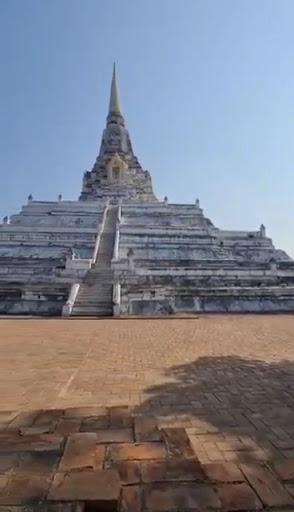
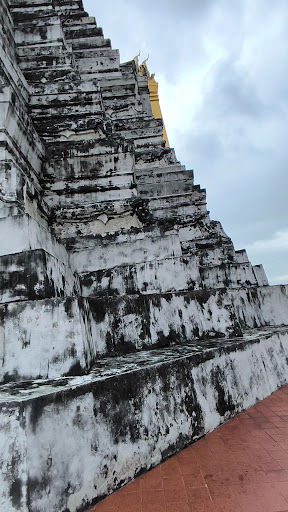
🏛️ Architectural Design The chedi stands approximately 50 meters tall and showcases a harmonious blend of Mon-Burmese and Thai architectural styles. Its square base with indented corners supports a towering spire, reflecting the fusion of cultural influences over time. Visitors can ascend to a midway platform, offering panoramic views of the surrounding rice fields and the city of Ayutthaya.
Distance from Ayutthaya City Center is approximately 3 km northwest. You can commute there either ride a Tuk-Tuk, or ride a bicycle - for the adventurous scenic route, hire a car or Taxi or public transport to easily access to the temple.
🌟 What you will find Golden Ball - a golden ball weighing approximately 2.5 kgs was placed atop the chedi to commemorate 2,500 years of Buddhism 2. Buddha Footprint - The temple houses a revered Buddha footprint, attracting pilgrims and visitors alike. Panoramic Views - The elevated platform provides breathtaking vistas of Ayutthaya's landscape, ideal for photography and reflection.
This temple stands as a testament to Ayutthaya's rich history and cultural resilience and a profound glimpse into Thailand's spiritual heritage.
........................
If you find this article useful, give me a Like...
Read moreWat Phu Khao Thong – A Majestic Viewpoint with Historical Charm
Located slightly away from the bustling center of Ayutthaya, Wat Phu Khao Thong offers a serene and less-crowded experience compared to other historical sites. The temple’s striking white chedi rises dramatically against the sky, making it an impressive sight from a distance and an excellent spot for photography.
Climbing to the top can be a bit challenging, especially under the midday sun, but the panoramic views of the surrounding countryside are absolutely worth the effort. The golden spire gleaming in the sunlight adds a majestic touch to the structure, and the tranquil atmosphere at the top allows for a quiet moment of reflection.
Entry is free of charge, which is a pleasant surprise in comparison to other sites. However, facilities are minimal, and bathrooms are not always well-maintained, so it’s best to prepare in advance.
While Wat Phu Khao Thong might not have the same level of intricate ruins as other temples in Ayutthaya, its unique architecture and stunning views make it a worthwhile stop. Bring water, sunscreen, and a camera—you’ll want to capture both the grand structure and the sweeping vistas...
Read moreWat Phu Khao Thong is in the village of Phu Khao Thomg ( Phu Khao means mountain and Thong means goal), is around 2 kilometers at the northwest direction of the royal palace.In A.D. 1569 ( B.E.2112 ), King Bhuleng Noung of Hongsawadee ( Burmese city) issued an order to build pagoda in Mon style , with the height of 50 meters and stand in rice field, Burmese army used as the observation tower ,the real purpose of construction was to commemorate his victory over Ayutthaya, over 2 centuries later this Chedi fell into despair.In A.D 1387 ( B.E. 1930) King Ramesuan found the adjacent temple ( also named “Wat Phu Khao Thong”). In A.D.1584 ( B.E.2127) , Somdej Phra Naresuan Maharat declared Ayutthaya as independent city and ordered to build a Thai style pagoda to superimpose on the large Mon style base at Thung Makam yong and monks were allowed to reside at this temple again in A.D. 1957. This Chedi was last long 200 years, finally it collapsed due to lack of maintenance.During A.D. 1733-1758, under the reign of King Boromakot, he ordered to put pagoda in Thai style( the squared -based and indented corner ) on the Burmese based, this Chedis can be...
Read more