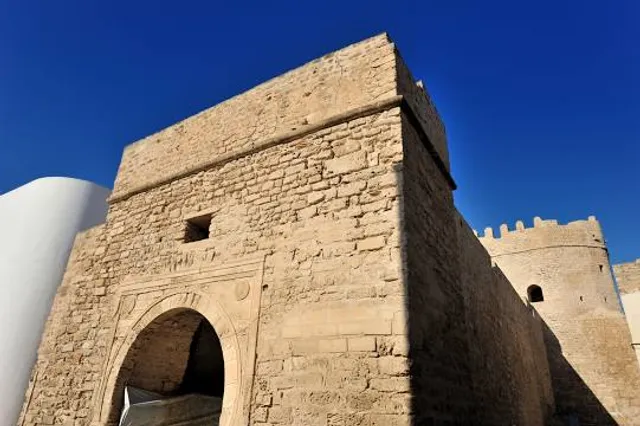
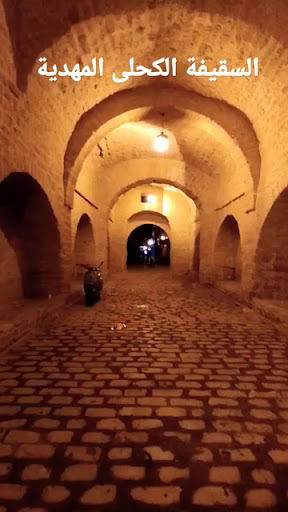
The Skifa Kahla also known as Bab Zouila, is a fortification of the 10th century, the structure is one of the few remnants of the ancient walls of Mahdia in Tunisia. The building was built by the Fatimids, in which it was used as the main strong to protect the access to the city. The fort is one of the few remnants of the ancient ramparts, as well as being one of the access points to the historic center of Mahdia.The construction of the building dates back to 916.The building was constructed by the order of the first Fatimid caliph, al-Mahdi Billah.The design of the structure is based on Fatimid architecture. In the 11th century, modifications were made to the building to accommodate more artillery made by the Turks, rooms and warehouses were also built to house weapons and ammunition.The building has survived the siege of the city of Mahdia executed by the monarch Charles V. For a time, the building was the only land entrance to the city of Mahdia.The building served as a defense to prevent Christian invasions as well as imperial wars to the city of Mahdia. According to historians, including some from Spain, it is said that the name "Skifa Kahla" means "Dark Vestibule" (French: Vestibule Noir).In 1554, a group of Spaniards blew up the entrance to the building.After the attacks by the Spaniards, the building underwent several modifications. At the end of the 16th century, the building's wall system was rebuilt by Turks. Skifa Kahla served as the main tower for the second line of defense of the city. In 2015, several concrete restorations were made to the building. The building renovations were conducted by the Tunisian National Heritage Institute to commemorate the 1200th anniversary of the founding of the...
Read moreالسقيفة الكحلة اومايطلق عليها باب الفتوح او باب زويلة من اهم المعالم التاريخية المعمارية يعود بناءها الى اوائل القرن العاشر ميلادي(916م-921م) من طرف الخليفة الفاطمي عبيد الله الفاطمي وكانت تمثل المدخل الوحيد الى مدينة المهدية السقيفة الكحلة سميت كذلك لشدة ظلمتها أو باب زويلة أو باب الفتوح
هي باب محصن لمدينة المهدية، بني ق10م وتمثل البرج الرئيسي لسور المهدية ومدخلها. تتكون من برج علوه 18.5 مترًا، وعرضه 12 مترًا مع عمق 12.70 مترًا، وممر مغطى يؤدي إلى المدينة العتيقة طوله 33 مترًا وعرضه 5 أمتار وبه 6 أبواب حديدية. معماريا تعتبر حلقة وصل بين الفن البغدادي والفن الفاطمي. ويشهد لتونس وللمهدية بعراقتها وبهائها. والمهدية هي ثاني عواصم الخلافة بإفريقية، تنوعت الآثار فيها. باب زويلة هو أحد أهم الأبواب التاريخية بخصائصه العمرانية المميزة
🔸Sqifa al-Kahla – Mahdia
Is one of the rare vestiges that bear testimony to the power of the defence system that the new dynasty had put in place in order to defend the Shiite capital from internal and external enemy assaults.
A system that was admired by the Arab powers of the time as well as by Northern Mediterranean enemies and that disintegrated under heavy cannon fire by the Spaniards in 1555.
The monument is a small fort flanked by two projecting towers, with a gate opening into a long corridor (sqifa) that is attached to the inner wall.
Publication: Bardo, Tunisia’s Creat History, a Museum, Archaeological Sites and Monuments Text: Abdelaziz Daoulatli Edition : Alif – 2019
🔶Bab al Futuh (al- Skifa al Kahla - Mahdia).
Le monument constitue tout ce qui subsista de l’unique porte terrestre de Mahdia. Malgré les remaniements du XVll ème siècle (adjonction de deux saillants polygonaux aux angles) il garda l'essentiel de ses dispositions héritées du X ème siècle. Monument majeur de l'art militaire musulman, la porte se compose de deux parties : un ouvrage massif et élevé (de 18 m de haut, aménagée en fortin, et un long vestibule voûté, qui servait à relier le mur principal à la troisième enceinte intérieure. Le fortin (de 21 m de côté), dans lequel est percée la baie d'entrée extérieure, était occupé par une enfilade de galeries voûtées dotées de vantaux de fer. Des escaliers extérieurs donnaient accès à l'étage occupé au XVl ème siècle par le gouverneur de la ville. Le vestibule (de 33 m de long) jouait, à l’instar des takat(s) de Baghdad, le rôle d’une voie défensive, ayant également une rôle commercial.
Publication : Les Fortifications en Tunisie Texte : Neji Djelloul Edition : Agence de Mise en Valeur du Patrimoine et de Promotion Culturelle – 1999 #amvppc...
Read moreMahdia (Arabic: المهدية al-Mahdīyah) is a Tunisian coastal city with 62,189 inhabitants, south of Monastir and southeast of Sousse.Mahdia is a provincial centre north of Sfax. It is important for the associated fish-processing industry, as well as weaving. It is the capital of Mahdia Governorate.The old part of Mahdia corresponds to the Roman city called Aphrodisium and, later, called Africa (a name perhaps derived from the older name),1 or...
Read more