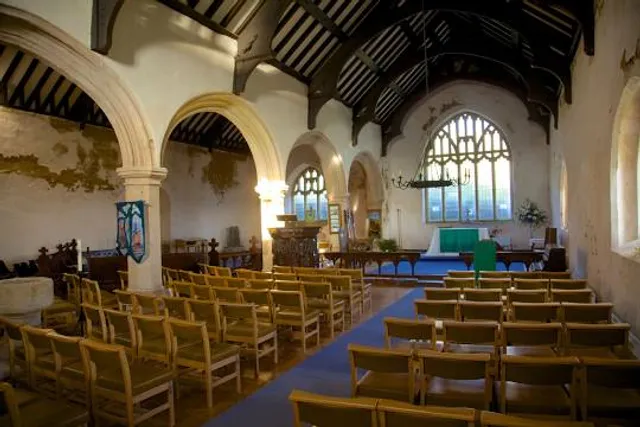
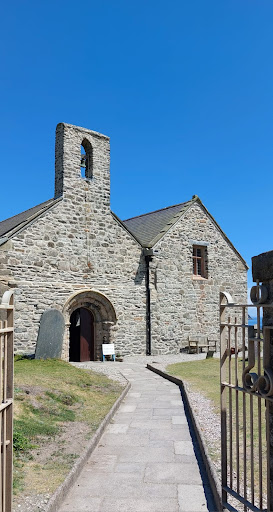
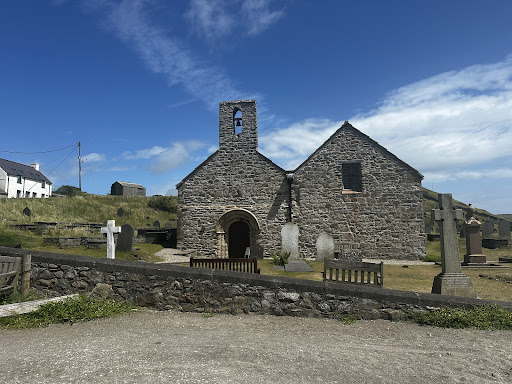
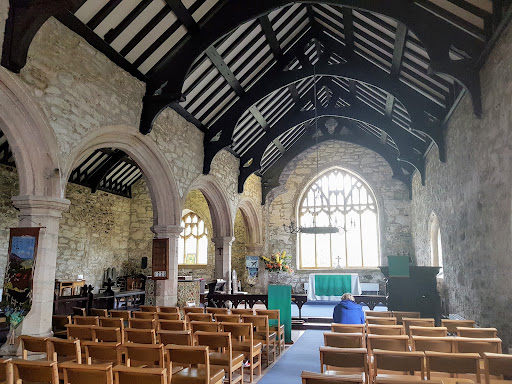
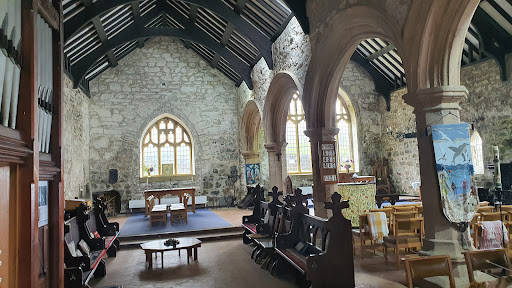
This church occupies a stunning location in the centre of the village and right by the sea. Fortunately these days it is protected by a substantial sea wall but even so, in storms, the salt spray can go right over the roof. In 2018 sea water entered the church - the first time in living memory - and then it happened again only two weeks later. There are sandbags by the door now in case it happens again. The exposure to the elements has been very challenging to the people responsible for maintaining it. In the last 10 years though the church has had some significant improvements. It has been completely re-roofed using new extra heavy Welsh slate from Cwrt y Bugail quarry in Snowdonia but the biggest difference that visitors will see is inside. Bravely, but somewhat controversially, the church elders and architect Alex Finlason decided to give up trying to keep plaster on the walls. The penetration of salt spray through the ancient walls had made this an impossible task. Some of the walls had been completely replastered in 2006 but was already failing two years later. So now, the plaster is stripped off to reveal the original stone work in all its glory. The improvement is dramatic and the visitors can now see for themselves how the building has evolved over the centuries.
The church is magnificent but so also, in a different way is the churchyard. It is a haven for wildlife with over 70 species of plants and wild flowers growing there, best seen in spring and early summer. Displays of bluebell, sea thrift and sea lavender and blue butterflies are perhaps most notable in their season. It is now recognised as a valuable resource for seed and the National Trust in 2019 took newly cut hay from there to help restore wildflower meadows on nearby fields. A terrific example of new life from a graveyard.
This review doesn't even touch on the fascinating history or the poet R S Thomas who was vicar here or the shop inside. All are notable, and there is something for everyone here but you will have to discover these for yourself. Don't miss it and if you can leave a small donation to help with it's upkeep, it will be...
Read moreThis fine and distinctive Church, the “Cathedral of Llyn”, stands right on the edge of Aberdaron beach and is dedicated to St Hywyn (and to St Lleuddad) who came over from Brittany in the 6th Century. Built on the site of an ancient oratory, it is a large medieval building of two naves and a plain but handsome Norman west doorway. The second, southern, aisle was added around 1500 together with an arcade of five arches. The Church was sometimes used as a place of sanctuary for the Welsh Princes and members of their families who had an unhealthy habit of killing one another. On one of the arch pillars can be seen markings made by the sharpening of spear or arrow heads. In the graveyard there is a stone dating from 1787 and reputed to be the last man on Llyn to be hanged for sheep stealing.
There were noteworthy restorations in 1868, 1906 and 2006, the most recent costing in the order of £400k. In 1841 it was feared that the church in the village would be lost to the sea and a new one was erected up the hill to the north of the village. However, in 1868 a sea wall was built and the old church was restored. R.S.Thomas, the celebrated poet, was vicar here from 1967.
Displayed in the church are two early Christian stones which were found at Capel Anelog, a site on the eastern slope of Mynydd Anelog. They both appear to have been carved by the same sculptor and both record the graves of priests (presbyter). The smaller is inscribed VERACIUS/PBR(short for presbyter)/HIC/IACIT “Veracius the priest lies here” The larger reads SENACUS/PRSB/HIC IACIT/CVM MULTITV/D(I)NEM/FRATRVM/PRESB(IT)E(R) “Senacus the priest lies here with a multitude of the brethren-priest” The central words of this inscription are grammatically incorrect which indicates that even priests were then having...
Read moreA beautiful, simple church. This building, first recorded in 1115, is a clas church, meaning that it's a native non-norman parish. Added to in C14 and C15 when Aberdaron became a departure point for pilgrims going to Bardsey Island. Fell into ruin but was rebuilt and reinstated circa 1870 when the locals were unhappy with their new church building. Clas churches were akin to abbeys although on a much smaller scale and were the heart of the community. It appears once again to be so 👌 Love the prayer cairn...
Read more