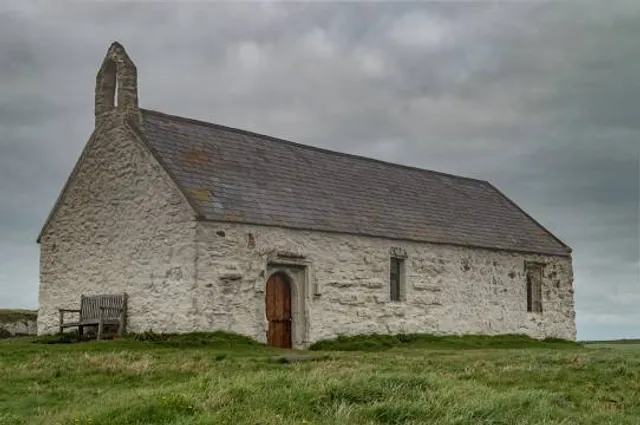
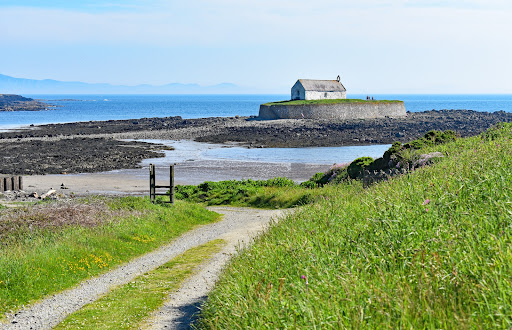
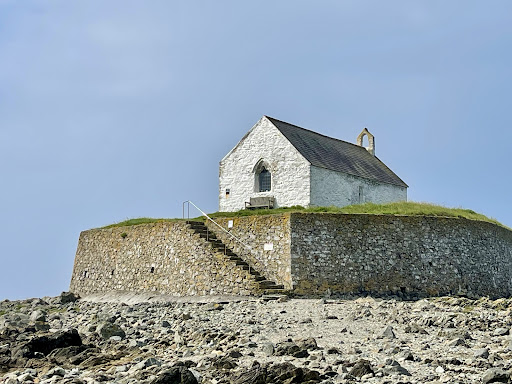
The Church of Saint Cwyfan, perched on the tiny tidal islet of Cribinau, is known as “Eglwys bach y môr”, Little Church in the Sea. The church dates from the 12th century, with some careful 19th century reconstruction. Cribinau, located on the West coast of Anglesey, was originally a small peninsula when the church was first built but centuries of coastal erosion have cut of the headland and turned it into an island. The church today is white-washed rubble, a single cell with continuous nave and chancel. The oldest section of masonry is the West end of the South wall, with a projecting string course. Thought to be 12th century, this section also features a pair of very weathered carvings either side of the door. The better preserved one to the right of the door appears to be a green man. Significant expansion occurred in the 15th; a second nave was built onto the church but the three bay arcade on the North wall is the only reminder. Originally the only seating in the medieval church, the stone bench along the north wall would have had a corresponding partner along the long gone South wall. The irregular roof timbers date from the 16th century. The great storm in October 1859, written about by Dickens and famous for wrecking the Royal Charter steam ship on the other side of Anglesey, ripped through the church, taking off the roof and all but demolished the North nave. In 1893, local architect Harold Hughes raised money to rebuild the church as it is today and construct an imposing seawall around the island. The church is Grade I listed and the seawall is Grade II*. Apart from the occasional special sermon and the Easter service, today the church is mostly used as a wedding venue during the summer, when the tide allows. There is a two-hour window either side of low tide when the causeway is out of the water. The church is not left open but access can be arrange with the Bro Cwyfan...
Read moreIn Welsh this beautiful gem of a church is known warmly as Eglwys Bach Y Mor which translates as the little Church in the sea. It's location sets it out as a must see for many people. The views from the Church island are breathtaking as is the sheer photogenic essence of the place overall. Once seen never forgotten. Some walking is needed to reach the Church and there are different routes to take but they are all worth it. The Fisherman's car park near the noisy Ty Croes racing circuit is a good place to start for most people followed by a gentle mile long walk down to the bay containing the island. Coming through Aberffraw is easier by car though as there is some minimal car parking close to the entrance of the bay followed by a smaller walk to the Church itself. Historically, the Church dates back to the 12th Century but is still shown as attached to the mainland in the 1630's and reference to it made as late as 1770 does not refer to it as being tidal as it is today. By the late 19th Century the Church was in disrepair with parts of the graveyard falling into the sea. In 1893 though, the decision was made to restore this lovely building and it's retaining wall to show it as it is today. The causeway to the little island is a little rocky so care is needed to avoid a stumble and a sprain especially when taking pictures or video. The island is tidal and not accessible near high tide so I recommend downloading a local tide app for your phone to plan arriving on the approach to low tide ideally. Such apps are...
Read moreWe parked out the end of the lane close to the beach, this lane is very narrow so be prepared for oncoming cars. Park at the bottom on the right and make your way to the beach. The access is a little steep but it’s accessible for all. Walk over the stones and you hit the sandy beach. Head out to the church, but check the tide times. It comes in fast! Stunning location, and quite a spectacle. The beach is dog friendly and very sandy in the middle. Just watch the stones on the way out to the church, if you aren’t sure footed wear flat shoes. Amazing place for kings to...
Read more