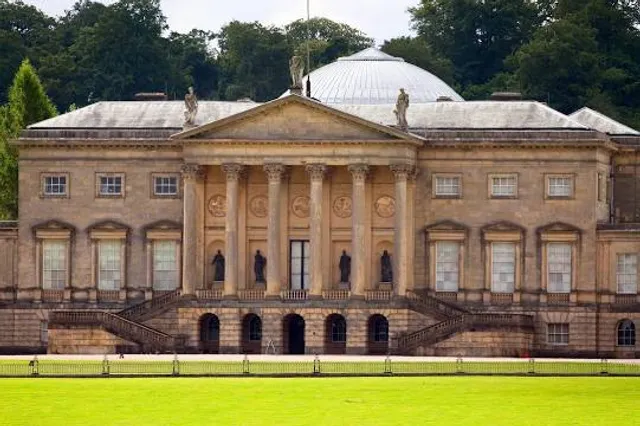
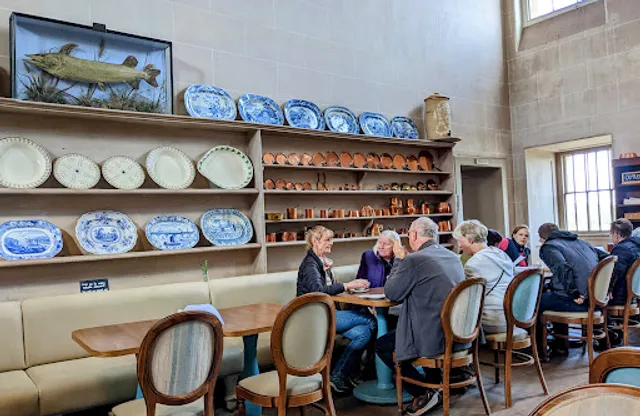
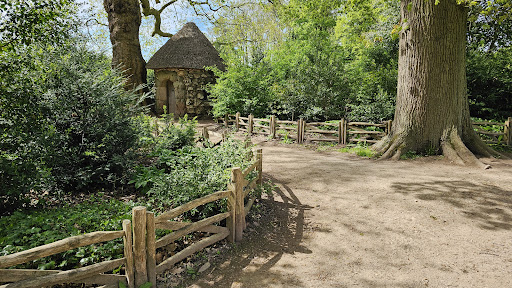
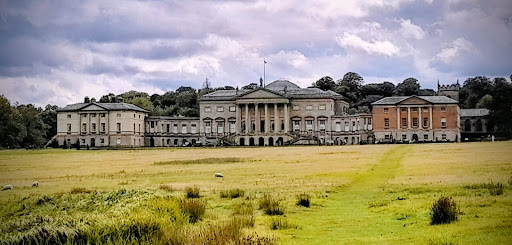
Driving up to this property, you get a feel for the size of this place and the open grounds around the house. Although some of the house is still private and closed off from the public, there are a lot of rooms to walk around, all of which are still in peak condition and largely furnished as they were. The initial entrance seems to lull you into a false sense of scale and grandeur, seeming quite a low ceiling and darkened room. When you walk into the rest of the house upstairs, then the true perspective of the house hits you, particularly when you step inside the grand Marble Hall (above the entrance room). The height, length, width and decorative opulence of the house really jumps out at you, and this continues as you walk on through into the adjoining room. You might get a stiff neck from looking up as much as around you, but it's worth the temporary discomfort to take it all in. It's hard to get many rooms in one photo, as is the scope and detail, so take many photos (but no flash photography). You can easily spend at least half an hour in the house, or much more if you read the room information or chat with the many people from the National Trust around all the rooms. Besides the house, the walks around the property are plentiful. There is a long walk which is just over 3 miles (5km) around the woods on the south of the property, and most of this is a shaded path meandering through the treeline, with paths in good condition. The last part comes out by the river and along the grass back up to the house. There are many benches along the way, and views of the house, not to mention all the trees and wild flowers (plenty of bluebells and wild garlic today on a late April day). Back near the house, there is a cafe/restaurant with more choice than most National Trust cafes, and plenty of seating indoors and out infront (great on a sunny day like today). The shop and toilets are quite close to here, as are the church and second-hand book shop. From the church or shops there are paths through to the north side of the house which has a large open garden with deck chairs, benches, flower beds and trees to wander around or...
Read moreUtterly magnificent! Kedleston is one of the most opulent stately houses in Britain, built between 1759-1765 for Sir Nathaniel Curzon by the noted architect, Robert Adam. The palatial building replaced a much older & far less ostentatious medieval house that stood here previously. The Curzon family came to England with the Normans, so their family history is significant. The 18th century house was built as a rival to Chatsworth, I can vouch that it certainly achieves that. The family still live here, but in a private wing, which is where they've always lived, they never occupied the main house which was originally used for entertaining high end visitors & to wow fellow nobles. The furnishings & adornments are beyond elaborate & in many cases reflect an ancient Rome influence, although many of the inner structures ie, columns, are actually alabaster & not marble. The guides you will find throughout the house are very knowledgeable, so please don't be shy about asking them anything about the house & its contents. The grounds are beautiful with many different species of trees & flora. There is a very nice cafe/restaurant with outdoor seating for the warmer months, the service is excellent. I can't praise Kedleston enough, it took my breath away. Also, please make a point of visiting the small museum of asian artefacts on the ground floor. the collection of a thousand items was collected by George Nathaniel Curzon who was Viceroy of India, he inherited Kedleston in 1916, in his will (1925), the collection was shared between the Victoria & Albert museum & Kedleston. I thoroughly recommend a visit to this incredible property, it's a true...
Read moreHaving spent an enjoyable afternoon, and with this being our third visit to Kedlestone i felt a review was a little overdue. Symmetry and order is the theme within the house, space and focal points sum up the outside. We have enjoyed a springtime circular walk around the lakes to one side of the picturesque bridge, a field, wooded and lakeside walk to the other side on another occasion. We have had a free roam view of all rooms in the house during early summer and then today's visit was a structured room tour by booking only. Some of the rooms have a major wow factor in particular the Great Hall and the domed ceiling sprung floor ballroom both situated on the first floor. They really have to be seen, pictures do not do them justice. Currently the lower floor rooms are not open or part of the tour but house many treasures from India and the Far East. As mentioned, symmetry runs through the house and can be observed in every room. Vast paintings adorn the walls, oak floors, high ceilings finish the rooms, even the hingeless doors are a work of art. Kedlestone is a masterpiece and as much as I like it, I strangely don't feel connected??... maybe it's just a personal thing? Other halls and houses tend to have at least one room where there is a calmness that makes me feel i could sit and enjoy it for hours or a bedroom i could imagine getting the best nights sleep ever. I can't quite put my finger on it but i don't get that feeling here... I still enjoy it and I'm sure to return again to admire the many things on show and to enjoy the walks in the surrounding estate. Well...
Read more