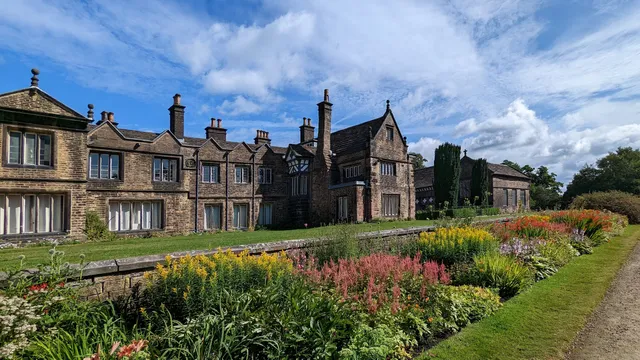
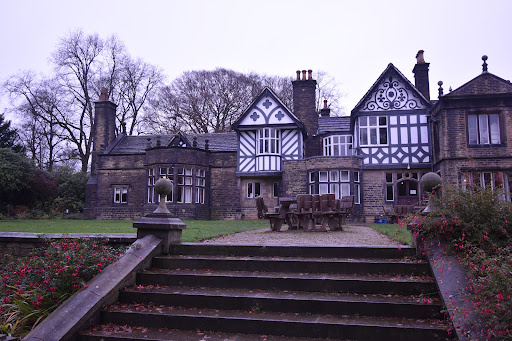
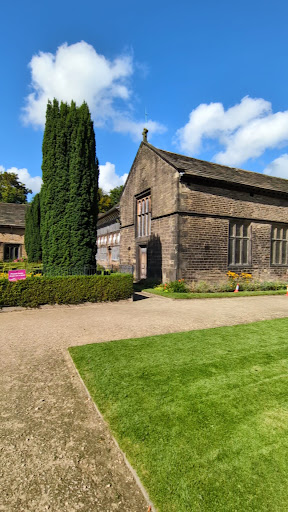
Smithills Hall is a Grade I listed manor house, and a scheduled monument in Smithills, Bolton, Greater Manchester, England. It stands on the slopes of the West Pennine Moors above Bolton at a height of 500 feet, three miles north west of the town centre. It occupies a defensive site near the Astley and Raveden Brooks. One of the oldest manor houses in the north west of England, its oldest parts, including the great hall, date from the 15th century and it has been since been altered and extended particularly the west part. Parts of it were moated. The property is owned by Bolton Metropolitan Borough Council and open to the public.
The name Smithills derives from the Old English smeþe meaning smooth and hyll, a hill and was recorded as Smythell in 1322. Early medieval records about the hall began in 1335 when William Radcliffe acquired the manor from the Hultons who held it from the Knights Hospitaller. On Radcliffe's death in 1369 it passed to his son and heir Sir Ralph Radcliffe, High Sheriff of Lancashire for 1384–1387 and twice MP for Lancashire. The Radciffes lived there until 1485, when the male line failed and Smithills Hall passed to the Bartons, wealthy sheep farmers who lived there for nearly 200 years.
In 1659 the hall and estate passed by marriage to the Belasyse family. In 1722 the Byroms of Manchester bought the manor and kept it until 1801 when the hall and estate were acquired by the Ainsworths, who made their fortune as the owners of bleachworks at Barrow Bridge. Around 1875 Richard Henry Ainsworth employed architect George Devey to extend and modernise the hall. In 1938 the Ainsworths sold the hall to Bolton Corporation. Parts of it became a residential home and day centre that closed in the 1990s.
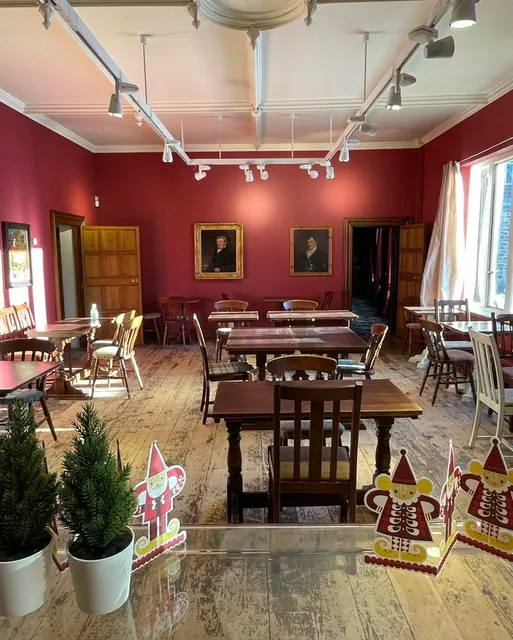
The oldest parts of the hall opened as a museum in 1963, and in the 1990s, the museum was extended into some of the Victorian extensions. The west wing was restored by the council in 1999, and is currently being restored to its former Victorian grandeur. The Devey Room was fully refurbished in 2018. Since 2017, the ground floor now also houses Poppins At Smithills, a Mary Poppins themed tea room
In 1554 George Marsh a preacher from Deane near Bolton was 'examined' at Smithills Hall, before being sent to Chester to be tried for heresy. He was found guilty and executed at Boughton in Chester. A footprint, supposedly left by Marsh, is said to bleed every year on the anniversary of his death (24 April).
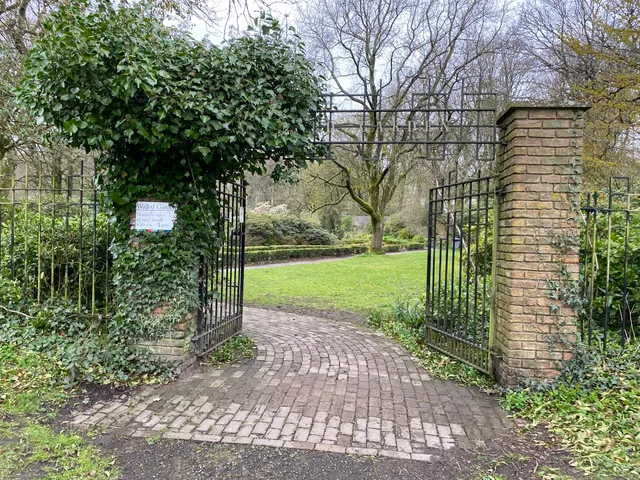
Smithills Hall is built on a formal terrace, surrounded on all sides by parkland on the south side of a steep-sided valley formed a tributary of the Raveden Brook.
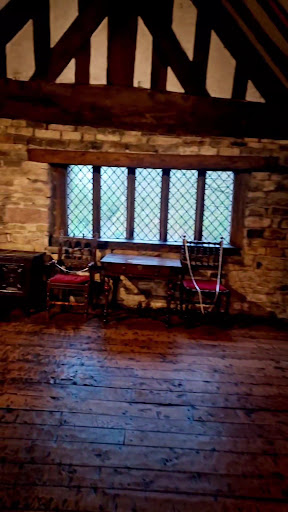
The hall has three ranges around an open court. The oldest part of the structure is the great hall in the north range which was probably built in the early-14th century and once was surrounded by a moat. It has been altered but retains its original plan and medieval features. The oldest parts were built with timber frames and the oldest stonework is roughly coursed rubblestone. The 19th-century west wing is built in coursed, squared stone and has decorative timber framing. All the roofs are covered in...
Read moreVery interesting visit. I had a guided tour from an elderly gentleman who was very knowledgeable not only of the place, but also the families who lived there and the visitors from far and wide. The Ainsworth family were very wealthy and had the coaching house built to receive guests and for an overnight stop for the horses and carriages. They entertained the royals and other wealthy gentry of the time. Although in late 1890's there were few cars, apparently there were protests about land ownership around smithills and evidence indicates this involved tens of thousands of people - even though no transport as such - probably walked or cycled. Well worth another visit. The grounds and woods are a pleasure to walk around in Summer. In the past, Tudor festivals have been held by Bolton council which are very authentic. Not sure if they are done now though. It's a shame that the coaching house restaurant has closed and has been replaced by housing albeit in keeping with the character as it is a graded building. It was a favourite venue of my parents for a proper traditional family meal - a unique place really. In my view it's...
Read moreInteresting, historic country house with a long history, set in its 9wn grounds.
Smithills Hall is run by the local Council, so hasn't suffered the rampant commercialism that affects National Trust and English Heritage managed properties. Entrance is free, but donations are gratefully accepted and the gift shop carries a small but relevant range of items.
I visited on a particularly miserable, mid-November Sunday. I did walk around the outside of the property but didn't venture on any of the walks around the area.
Entrance into the property is free and you're free to wander at your leisure. The chapel, (which appears to have been renovated and brought back into use as a working church), has a fine collection of stained glass windows.
There's a well stocked and competitively priced coffee shop with views over the grounds.
Car parking is free but may become busy over the warmer months.
All in all, I would highly recommend Smithills Hall if you're...
Read more