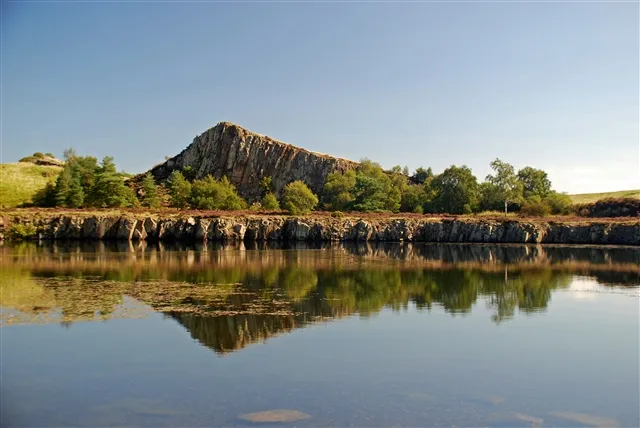
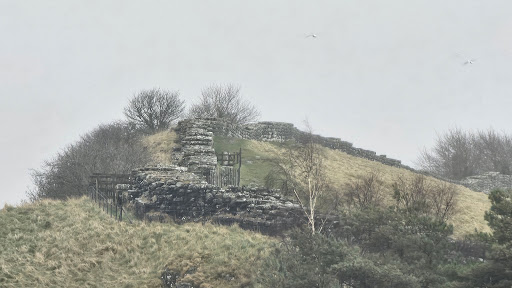
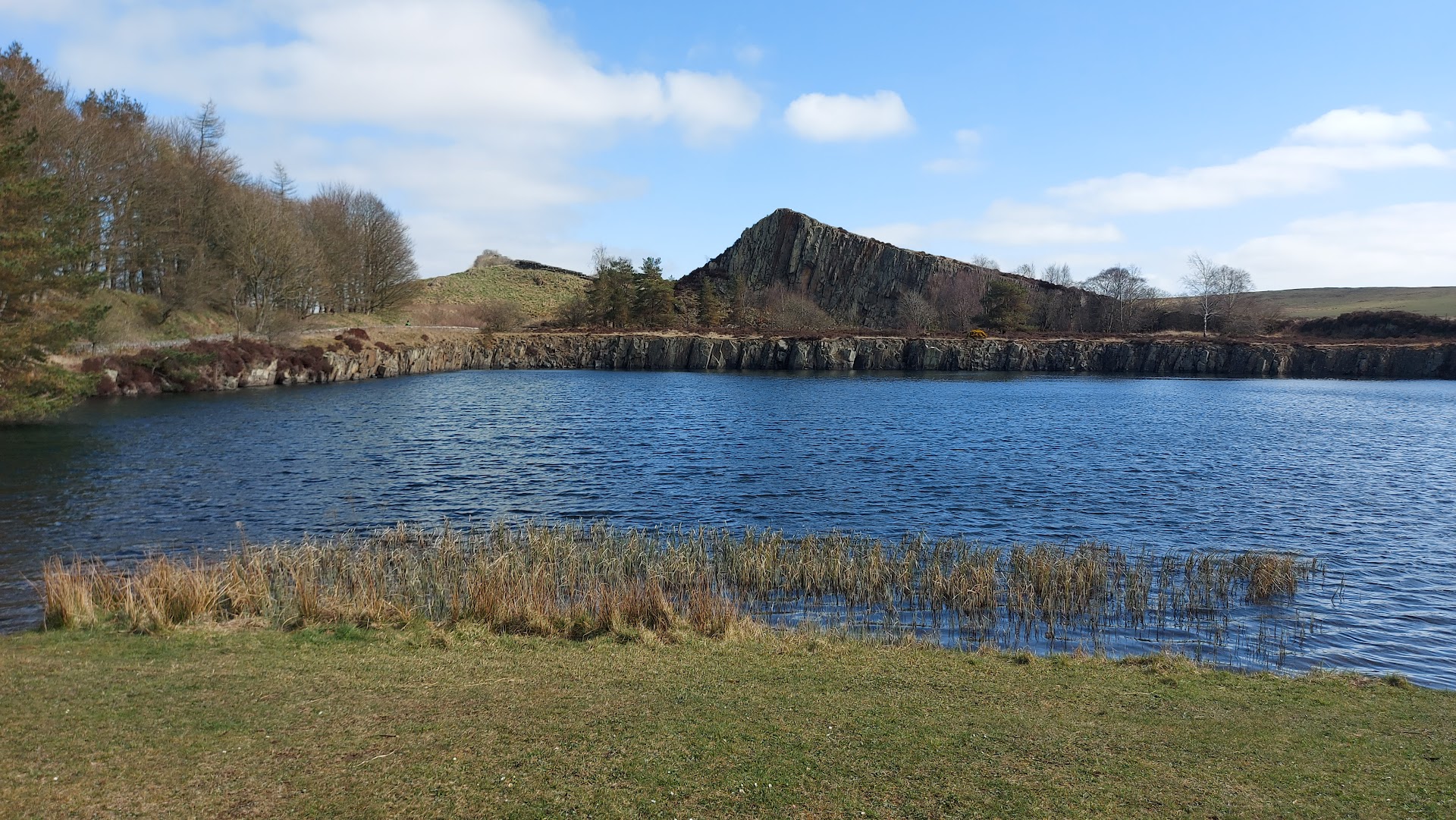
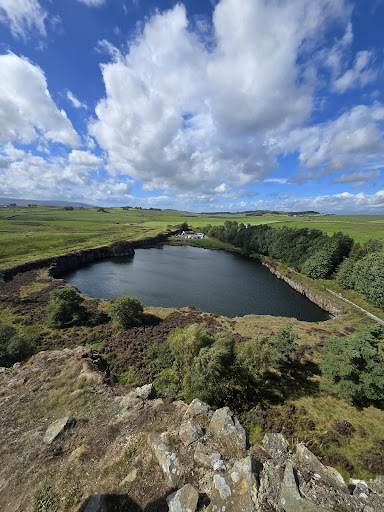
Our forebears did not have the same respect for heritage as we do, hence the value placed upon Cawfields was due to the useful properties of dolerite rather than respect for the great legacy of the Roman empire in this area. The imperative for them was the building of Britain's industrial cities, particularly roads and footpaths and the medium-grained crystalline rock was ideal for this purpose. The Whin Sill at Cawfields was, therefore, extensively quarried and the ridge was truncated, leaving us with what we see today: a lake and a pyramid-like structure which is, in effect, a cross-section of the Sill. The extraction of the rock meant the destruction of the section of the wall upon which it was built. It is possible to climb the "pyramid" by means of the "staircase" which bears sharply right just before reaching the Milecastle. These rocky steps are usually wet so care must be taken. The steep ascent is rewarded by a splendid view of the dip slope of the Sill, the Wall and a unique view of the Vallum, all to the east. To the west the way is barred by a stout wooden fence and a sign warning us not to proceed further. However, the Wall can be seen to advance before us until it stops abruptly at the precipice. To see this is to experience a rather eerie sensation as we try to imagine the wall in it's ghostly continuance and a sense of loss as we realise we will never know how it once looked. The result of this vandalism, as we might think of it, is not all bad : Cawfields has become a focus, a dramatic start and finish point for excursions by the Wall both east and west. Not least, for the student of geology, is to see the columnar jointing of the dolerite. For the tourist, whether on foot or by car, a very satisfying experience and the possibility of lunch at one of nearby picnic tables. For the bird watcher, there may be swans or ducks on the lake! 14th June 20. Cawfields the start point for an out and back to Housesteads. Mist and cloud on the NE coast extended this far west and further, so we set off in dull conditions which improved during the morning to provide a lovely sunny afternoon. By 4.30pm conditions were such that Criffel and the Solway Firth could be seen from Winshields Crag. 11.5 miles, starting at 10.20am, ...
Read moreThe quarrying that produced the picturesque reservoir below the milecastle may have begun at the time Hadrian's Wall was built, but it was not until 1902 that the Newcastle Granite & Whinstone Company began to quarry Cawfield seriously. Quarrying continued until 1952 when pressure from groups interested in preserving Hadrian's Wall forced the closure of the site. The deep quarry pit became a reservoir, landscaped to provide a picnic area with access to the Wall. Cawfields boasts one of the best-preserved and most scenic stretches of Hadrian's Wall in Northumberland. Cawfields Quarry is officially recognised as a “dark sky discovery site”, perhaps one of the best in the UK! You can also park overnight for £10, which was Great, until you're being eaten alive by mosquitos, they are 'bad' Really 'bad' black clouds of them, even the toilets were...
Read moreWe had an unscheduled visit to Cawfield Quarry on March 2025. Primarily, our visit was for a much needed refreshment break. There is ample parking to use the toilet or picknic facilities and parking for you to walk along the nearby section of the historic Hadrian's wall. There is a charge for parking and is reasonably priced.
There are placards around providing some historical and some interests of a nature theme. There is a bike station also offering you the chance to service your push bike.
Other facilities include free men/ladies toilets and a fully equipped accessible toilet. This included a wet floor room with a clos-o-mat toilet, a ceiling track hoist, an adult sized drop-down shower tray, and a wall mounted shower. The accessible toilet is opened with...
Read more