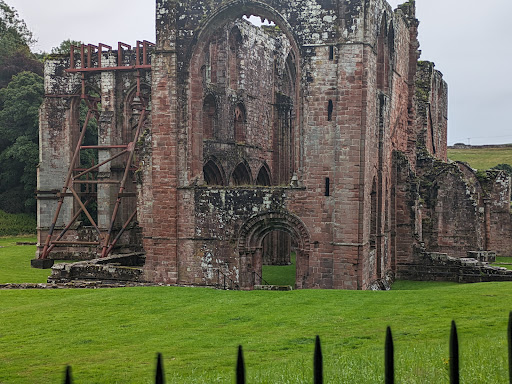
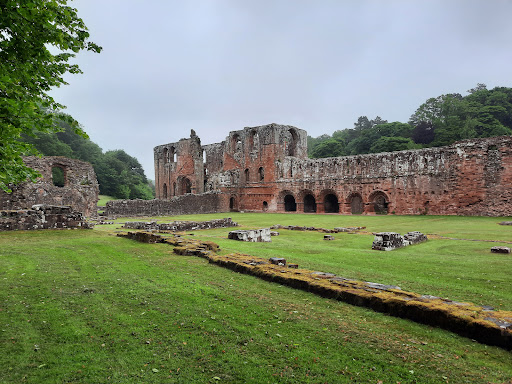
Founded in 1123 by Stephen, Count of Boulogne, it was built originally for the Order of Savigny. Located in the 'Vale of Nightshade', south of Dalton-in-Furness, the abbey is built entirely out of local sandstone. It passed in 1147 to the Cistercians, who gradually enlarged and rebuilt the original ornate church. The majority of the current ruins date from the 12th and 13th centuries. By the 15th century, it had been completely remodeled and had become the second richest and most powerful – as well as one of the grandest – Cistercian abbeys in England, behind Fountains Abbey. The Gothic-style monastery and its adjacent structures cover an expansive area of land and reach a maximum height of 40 metres above ground level.
The monks of the abbey were large landowners, and the most powerful body in what was then a remote border territory. In particular, they were heavily influential on the Isle of Man. One of the kings of Mann and the Isles is buried at the abbey, as are many of the Bishops of Sodor and Man. Rushen Abbey on the Isle of Man was built on land owned by the monks. They also owned mines on the island, and built Piel Castle to control trade between the Furness Peninsula and the Isle of Man.
Being about 70 miles down the coast from Scotland, the monks occasionally found themselves in between the frequently warring Scots and English. When Robert the Bruce invaded England, during The Great Raid of 1322, the abbot paid to lodge and support him, rather than risk losing the wealth and power of the abbey.
The Abbey was disestablished and destroyed in 1537 during the English Reformation under the orders of Henry VIII.
The Furness Abbey complex is a Scheduled Monument and Conservation Area containing five Grade I listed buildings and structures. Restoration work took place between 2008 and 2017 amid fears that part of the abbey could have collapsed.
There are many stories and sightings claiming that Furness Abbey is haunted. There are supposedly at least three ghosts which have been seen numerous times at the Abbey. First, it is said that the spirit of a monk has been seen climbing a staircase and also possibly walking towards the gatehouse before vanishing into a wall. Another sighting is that of a squire's daughter. She was known to meet her lover at the ruined abbey after the Reformation, although one day her partner took a journey out to sea from which he never returned. It is thought that the girl went back to the Abbey every day until her death to the site she and her partner once loved; the track she walked is today still known as "My Lady's Walk." There have also been many sightings of a white lady, although due to possible conflicting stories, it is unclear whether the White Lady and the ghost of the squire's daughter are of the same person or not. Possibly the most famous ghost of Furness Abbey is a headless monk on horseback, who rides underneath the sandstone arch near the Abbey Tavern; the death of this individual is linked to an invasion by the Scots in 1316.
A tunnel is said to run underneath the Abbey to both Piel Castle and Dalton Castle, allowing the monks to receive supplies and keep watch upon the local settlements. It has also been rumored that the Holy Grail and King John's missing jewels are hidden somewhere inside the...
Read more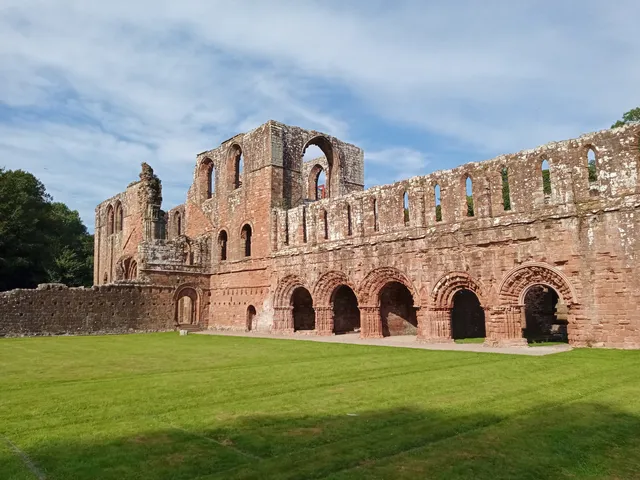

 Learn more insights from Wanderboat AI.