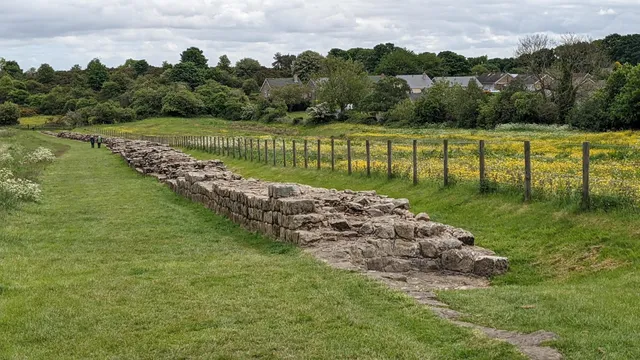
Visited Heddon during the course of our walk. Redolent of the Roman Occupation of so long ago with one of the few sections of preserved Wall this far east, with it's original broad guage.The circular depression in the foreground of my photograph is where a limekiln of much later date has been built into the ruins.(Pevsner et al "The Buildings Of England Northumberland 1992"). In Pevsner's original work of 1957, our attention is drawn to the summit of the whin-covered hillock, in the background of my photo, to the east of the remains where the Vallum "with rock cut ditch is notable". Many of the street names in the newer development capitalise on the Roman connection: Trajan Walk, Centurion Way, Antonine Way, Remus Avenue etc. Heddon is proud of it's history, and rightly so. Pevsner found The Church of St.Andrew to be of "considerable archaeolgical significance......there is evidence of the Saxon church...At the SE corner of the nave there are massive Anglo-Saxon quoins on edge. The W part of the chancel is said to be early Norman, rather than Saxon. It has a very narrow blocked priest's door with a plain tympanum* and masonry which matches it in date.Inside there is another tympanum over the door to the vestry. Presumably this early church was apsed and the apse removed to provide the new square sanctuary in the C12.It is a remarkable piece of architecture but visible from the outside only in one tiny round-headed N window." Pevsner found much else to interest him as he traced the evolution of the church right through to the C19. To the student of church architecture and the fascinated amateur his book is invaluable. A tympanum is the space between a lintel of a doorway and the...
Read moreThe hunt for Hadrian's wall lead us on our holiday to Heddon on the Wall where we ended up on the edge of a housing estate. Heddon is a pretty small place with residential areas, a petrol station and a few restaurants and pubs. It must have been a bizarre sight to see a family of five park up in front of a random house, roofbox on proud display, raincoats on, traipsing off around a residential area on the ddge of the village to a site of historical importance yet that is what happened.
The wall at this location is about 100 meters in length and about a meter high on the edge of a field with a main road on one side and a piece of private land on the other. There is no official parking, facilities or anything except a UNESCO board at either end explaining what it is.
It gives a good understanding of the thickness and makeup of the wall with turrent locations marked out in the stonework that remains.
I am sure that there are other parts of the wall but where they are is something I am still not quite sure.
For anyone who is looking for this read around first. In fact gping to see Hadrian's Wall should be treated more like a Roman Tour. Spend the day "travelling along the wall" stopping off at the forts, visitor centers and the like learning about British life at this time but set your expectations pretty low on seeing a lot of the wall itself, certainly on the east...
Read moreHeddon-on-the-Wall is a lovely spot to experience a genuine piece of Hadrian’s Wall history. It’s one of the best-preserved sections of the wall and offers a quiet, authentic glimpse into Roman Britain without the big crowds found at some of the larger sites.
The village itself is charming and easy to reach, with clear signage leading you to the wall. You can park nearby and walk a short distance to see the remains, which stretch across the landscape with beautiful countryside views all around. It’s especially nice if you enjoy peaceful walks, photography, or exploring history at your own pace.
There are a few information boards explaining the site’s background, and it’s fascinating to imagine how this area once marked the edge of the Roman Empire. For a longer visit, you can also follow parts of the Hadrian’s Wall Path, which connects several nearby historical points.
Heddon-on-the-Wall is a perfect stop for anyone travelling through Northumberland or following the Hadrian’s Wall route — calm, scenic, and...
Read more