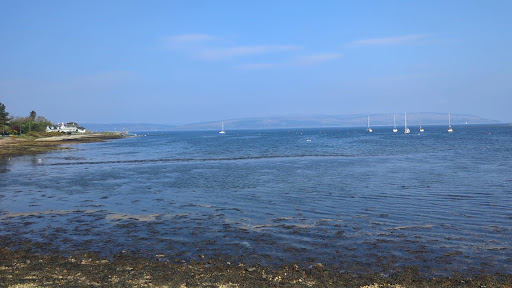
Free parking (limited spaces) & free entry to these ruins.
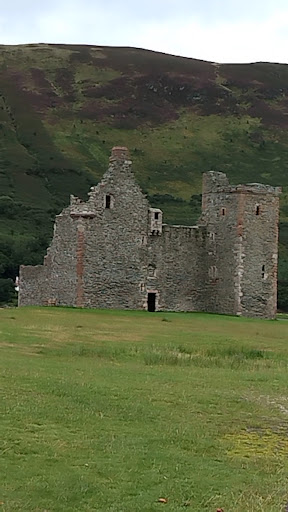
Lochranza Castle is a picturesque ruined castle situated on the northern coast of the Isle of Arran in Scotland. It stands prominently on a small peninsula that extends into Loch Ranza, creating a dramatic and photogenic scene.
The castle’s earliest sections date from the late 13th century and are believed to have been constructed by the MacSweens, a significant family in the region at that time. Over the centuries, Lochranza Castle changed hands several times. In the 14th century, it came under the control of the Stewarts. Later, in 1490, James IV of Scotland used the castle as a base during his campaign against the Lord of the Isles. The Hamilton family acquired it in the 16th century, making substantial changes and converting it into a tower house. For a time, the castle served as a hunting lodge and noble residence. By the 18th century, it fell into disuse and was eventually abandoned.
Architecturally, Lochranza Castle is a classic example of a Scottish L-plan tower house, characterized by its main rectangular block with a wing projecting at right angles. The main block stands three stories tall, built with thick stone walls and equipped with small defensive windows. There is a spiral staircase in the projecting wing, which was typical for Scottish castles of this era. The great hall would have been located on the first floor, while storage and service rooms were below. Defensive features include gun loops and narrow slit windows.
Today, Lochranza Castle stands as a ruin but remains largely intact in terms of its external walls. Some internal floors and roofs are missing. The site is managed by Historic Environment Scotland and is freely accessible to visitors, though entry inside may be restricted for safety reasons. Its setting is particularly striking, offering impressive views across the loch and surrounding hills, making it a favorite spot for photographers and walkers.
Local tradition claims that Robert the Bruce may have landed at Lochranza during his campaign in the early 14th century, although there is no documentary evidence to confirm this story. The remote location also made the castle vulnerable to raids during times of unrest.
Nearby is the village of Lochranza, known for its whisky distillery and abundant wildlife, including red deer and seals. The area attracts hikers and nature lovers eager to explore Arran’s scenery.
Lochranza Castle is one of Arran’s most iconic historical sites, combining centuries of history and architectural character with remarkable...
Read moreLochranza Castle, perched on a narrow promontory in Loch Ranza on the Isle of Arran, is a striking ruin that beautifully captures Scotland’s medieval and Renaissance past. At first glance, it appears as a classic 16th‑century L‑plan tower house. But archaeological analysis from the 1950s revealed a much older core: a late‑13th‑century hall‑house, probably built by Dougall MacSween, Lord of Knapdale.
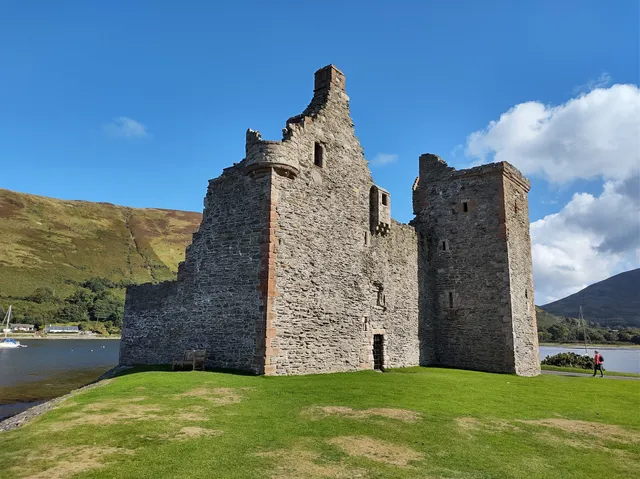
Originally a two‑storey structure with storage below and a great hall above, its upper‑floor entrance was reached via a wooden forestair—possibly to be lifted in times of attack . In the late 1500s, the Montgomerie Earls of Eglinton transformed it into the stone L‑plan tower house visible today, adding floors, redesigning the entrance to face inland, and vaulting new rooms.
Over the centuries, the castle changed hands and roles frequently. In 1262, King Alexander III granted the site to Walter Stewart, Earl of Menteith. It is traditionally believed Robert the Bruce landed here in 1306 en route from Ireland . By 1371 it was a royal hunting lodge under Robert II; James IV used it in campaigns against the Lord of the Isles in the 1490s; James VI garrisoned it in 1614; and Cromwell’s troops occupied it in the 1650s . Ownership passed to the Hamilton family in 1705, and it fell into disuse by the late 18th century .
Today, it is a scheduled monument under Historic Environment Scotland, open April–September, though its interiors remain roofless and accessible only on the ground and first floors . It offers captivating views across the loch, making it a favourite spot for photographers, walkers, and history enthusiasts. Wildlife—otters, deer, eagles—enhances the experience, and the adjacent village of Lochranza, with its distillery and ferry links, provides a charming context to this evocative relic of Scottish...
Read moreThis has to be one of the most picturesque and idyllic ruined Castles in all of Scotland. The Castle situated in the tiny village of Lochranza on the north side of the Isle of Arran is free to enter where you can marvel at its fantastic architecture. There is an informative and interesting information board detailing a brief history of the Castle giving you some background about it, which is good. Visitors can even wander inside where are a series of signs telling you the different rooms that you are in and you can wander up a couple of stairs to see some views of Kintyre in the distance but for what appears to be a shell of a building and not much to look at on the outside it's in a remarkably decent condition showing the diligent and fantastic work that Historic Scotland has done in preserving for the future. From the castle you can enjoy spectacular views of the surrounding area which is absolutely breathtaking and you can get a chance to see and hear the local wildlife such as an Oystercatcher making the visit all the more pleasing and memorable. There is no cafe at the site or shop some of these facilities can be found at the nearby Lochranza Distillery. Overall this is a fantastic and pleasant place to stop off at for half an hour or so and enjoy the breathtaking picturesque scenery of the local area and also the local wildlife. Definitely worth a stop whilst on the...
Read more