Buy tickets in advance online for a discount!
The house is beautiful and well maintained. The bedroom may not look as though it has much going on, but we (adults) had great fun dressing up in the old-fashioned hats and clothes available. It also has some signs by the windows which point out various features of the garden that would not otherwise be known.
The most interesting 'display' upstairs was unfortunately broken. Under normal conditions, there should be a hologram of Darwin in the HMS Beagle. Instead, this was just a very dark-looking ship's interior. The volunteer staff were very apologetic.
Darwin's study is mostly off limits: one can look from a distance but definitely not get close enough to investigate anything. All behind a barrier. Similarly in the dining room and drawing room. A shame, as there is much to be seen but it's not able to be studied to really get the feel of where and how he lived his life and carried out his experiments. And that is, afterall, why most of us visit.
The volunteer guides are knowledgable and did their best to fill us in on the details. It's worth talking to them.
Some displays, such as the unfortunate animal displays and most hanging pictures are lacking labels, which is a shame.
There is a room that is obviously geared up for small children, though I'm not sure of its purpose - it had some play tables and plastic toy dinosaurs for example.
There is a good number of objects in display cases in the upstairs room relating to the Darwin's family and home life, from Victorian bracelets made of hair to drawings done by the children. Not all items on display were owned by the Darwins - some are there simply to provide context.
Some key pages of Darwin's draft OTOOS are on display - as are his notebooks and diary from his Beagle days. Though the books can't be examined, digital scans have been made and are available on a small viewer at the end of the room. I did not find it to be useful as the scans were not high quality.
There is a lift to reach the upper rooms, and I don't remember noticing any trip hazards anywhere. Though there are steps to reach the 'costume' area of the bedroom.
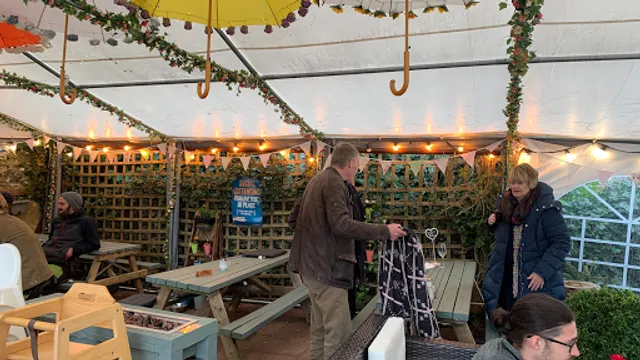
The tea room served a good selection of drinks, cakes, and snacks, and I saw someone with hot food. There are toilets outside, next to the outdoor seating area.
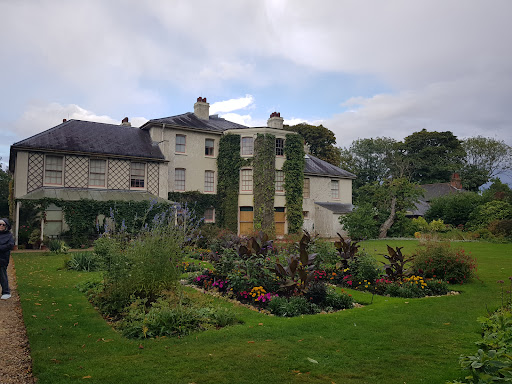
The garden is very long, and has a lovely greenhouse (don't go in if you're an arachnophobe). Inside and to the right is the potting area where seeds are available to purchase via an honesty box, so have change on you if you think you might like some (50p per pack with about 6 different plants available).
One of the upper rooms is a second-hand bookshop. Books are to be paid for downstairs in the gift shop.
The gift shop has a lovely selection of goods including seasonal flavoured meads, gins, jams and spreads, chocolates, books, collectables etc etc. Outside the exit to the garden is a selection of vegetables and plants available to purchase, all grown in the garden. Payment is again inside at the gift shop.
We weren't informed that the Sandwalk was closing early so do ensure you check the times when you arrive as that was the one area I really wanted to see and was bitterly disappointed not to be able to visit it. Although closing time for the site is 5pm, the entrance to the sandwalk closes at 4pm. Additionally, there is no access to the meadows where Darwin conducted his work at all.
If one has no knowledge of Darwin's history, there is much to learn from the displays. If one really wants to experience where and how he conducted his work, that's simply not so easily accessible. But it's still a wonderful place to visit even if there may be some slight disappointment.
If arriving by public transport (a bus service runs between Bromley and Down) then there is an uphill walk along a country road that does not have a pedestrian pavement. This means walking in the road for about 1/3rd of a mile. The hill is not especially strenuous but remember to walk TOWARDS...
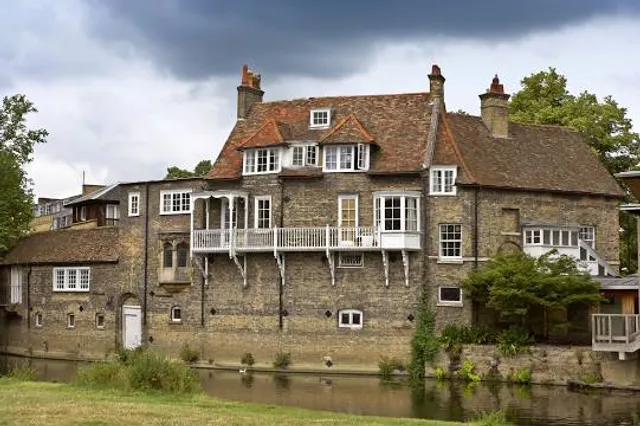
Read moreAn important historical house where Charles Darwin assembled his groundbreaking theory of evolution by natural selection, taking two decades to carefully bulletproof his findings before revealing them to the world. This was Darwin's cherished family home, workplace, and sanctuary - he lived here for 40 years, from 1842 until his death in 1882 aged 73.
If you are a fan of natural history, science, and human progression in general — this isn't a bad place to spend some of your day.
Many displays admirably point out Darwin's privilege being born into wealth which allowed him to focus on his work (to mankind's benefit ultimately). Darwin kindly paid notice to a less privileged man (Alfred Russel Wallace) who was formulating a near identical theory around the time he was then prompted to finally publish and finalise his own.
The site is maintained and run by English Heritage and £20 per person is charged for entry. I believe this should be in the region of £10 a head instead, as a couple attending together would be set back £40! The house and grounds don't offer quite enough to justify asking for £20 a ticket.
The house is largely furnished as it would have been in Darwin's time, but a number of rooms have been turned into display/exhibition rooms which undermines the feel of the original use of the space.
Tours and audio guides are offered - which I would strongly suggest visitors utilise to maximise their experience. The display boards are okay but the typeface/font/design is outdated and the arrangement of these boards in relatively small rooms isn't ideal for groups of people trying to read them - it becomes a cramped affair as people shuffle around.
A separate more corridor-like information centre should be built nearby out of the way and out of direct line of sight, but in situ of the house. A place for information and objects of interest to be held.
Darwin's "sandwalk", which can be walked at the property grounds, was his usual "thinking path". I recommend taking some time to do the walk.
The café from a beverage point of view is quite good; the cappuccinos have a Darwin-themed dusting which is...
Read moreSituated near the village of Downe, Down House is close to Biggin Hill aerodrome - visitors may often see Spitfires flying from the airfield overhead.
The road leading to Down House, is along country lanes, so care should be take approaching the house as there are cyclists and other road users as the lanes are narrow. Also it is best to have a Sat Nav to guide you as the area is remote, despite being on the edge of London.
The upper storey of Down House is dedicated to Charles Darwin and his work. It is fascinating as it not only details his work but those to whom he was connected to, including his uncle, Josiah Wedgewood - who's daughter Emma, Charles married. Also included is Charles Darwin's grandfather, Erasmus Darwin as one of those who influenced Darwin.
The lower floor of Down House is a collection of rooms Darwin lived in with his family that are open to the pubic. Officially there are no photos allowed to be taken in the house, although some clearly were.
Outside, there are gardens where Darwin carried out some of his experiments on plants, with a woodland walk and views of the North Kent downs. Around the grounds are benches, although some of the paths are rough as you proceed out of the gardens into the woodland and fields.
Inside the house there is a lift for those with wheelchairs to get to the upper level of the house, and disabled parking in the car park. Parking is limited by the house, but there is an overflow car park nearby.
There is a gift shop and tea rooms in the house, with outside seating, along with inside seating. Also there are plants for sale outside the gift shop.
It should be noted, that if entering the greenhouse in the gardens, there is a sign up stating large bags and back packs are forbidden inside. This is due to theft of some of the plants and CCTV is in operation in that area.
It is best to check on the English Heritage website for admission prices to the house as they can change each year - just search for Down House. Entry though for English Heritage...
Read more