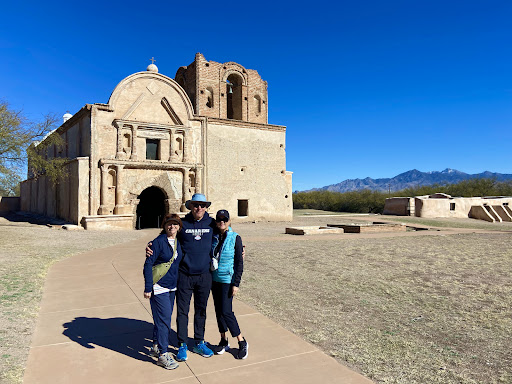
This is the 4th time I've visited Tumacacori and the museum. On this last visit I was lucky enough to tour the other two missions - Guevavi and Calabazas – which are part of the Tumacacori National Historical Park. These are only accessible on an NPS-guided tour, offered every two weeks from Jan-March. The tours sell out fast, and I estimate that I was one of fewer than 100 people who got to see them this year. When comparing photos from 1900 to their present condition, one can see that there may not be many future opportunities to visit these firsthand.
I only found out about the special tour last year after asking a ranger how I could visit the other two missions. They don't advertise this tour, so most people don't know they even offer them. The tour was guided by an NPS archeologist who explained what they know based on excavations and historical records, as well as a bit of speculation. I'd highly recommend this for anyone interested in history. After we returned to Tumacacori, the archeologist gave a guided tour of that site as well, giving more insight beyond even what the displays show.
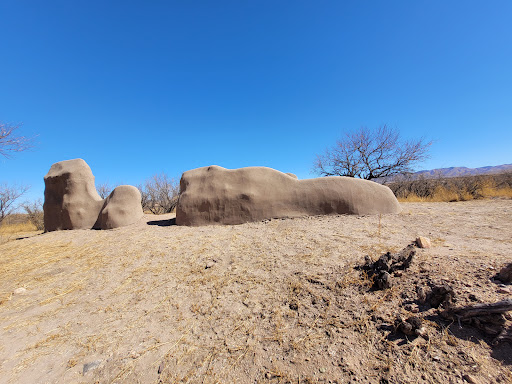
These two sites were abandoned before Tumacacori, which itself was abandoned in 1848 with the parishioners moving to the beautiful San Xavier del Bac which is still in use today. The Guevavi site now consists of just a few walls as it was abandoned earliest on (around 1775) and not maintained. The Calabazas site, abandoned in 1786, is in better condition because it was occupied, maintained and modified in the 1800s by cowboys, ranchers and troops as they used it for shelter at various times. It is now covered by a large awning to slow further deterioration of the walls. Currently, one can still walk through the Calabazas building.
This “Pimeria Alta” was Spain’s first foray into the (now) American Southwest, and the founding of these missions predates those in California. The Bautista de Anza party stayed in Tumacacori and Tubac on their way to establish the California missions in 1775. Compared to Tumacacori, not many structures are left, but these were once sizeable towns complete with native dwellings, cattle pens, farms and orchards. After 300 years the high Sonoran Desert has reclaimed most of her land.
Besides damage from age and weathering, Apache raids, and vandalism, the problem with adobe is that it must be continually maintained with a protective coating of lime plaster. Otherwise, adobe walls just melt before your very eyes. These missions are in a state of slow perpetual decay, which is all the more reason to see them while they are...
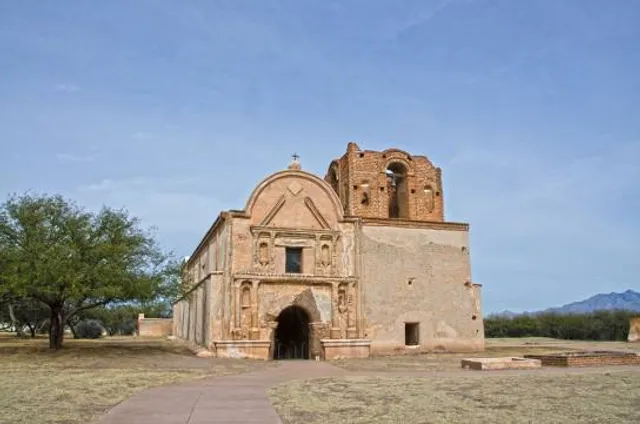
Read moreMission San Cayetano del Tumacacori was founded by Jesuit Father Eusebio Fransisco Kino in 1691. Originally built on the east side of the Santa Cruz River, it was located near a native Sobaicuri (O'odham) settlement. After the O'odham Uprising (also called the Pima Revolt/Rebellion) in 1751 against Spanish settlements, this mission was abandoned.
In 1753, Mission San Jose de Tumacacori was re-established but built on the west side of the Santa Cruz River, its current location. The first church on this site was finished in 1757.
In 1768, the Spanish King Carlos III ordered all Jesuit priests out of Mexico and the missions they controlled. He had become convinced that the Jesuits were faithful to the Pope and not to Spain. The Mexican missions were then placed under the control of the Franciscan order and Father Junipero Serra. Fr Serra, soon after (seeking new converts), traveled to Alta California and established its El Camino Real (the King's Road).
In 1880, the Franciscan order was determined to build a new church to rival the northern Mission Xavier del Bac (near Tucson). In the first year, a foundation was laid. Over the next few years, a wall of only 7 feet was built as there was little funding. By 1821, with the sale of cattle, the church walls were raised to 14 feet before work stopped again. Over the next few years work continued but Mission San Jose was never finished.
With the expulsion of all Spanish-born missionaries by the Mexican government in 1828, Franciscan Father Diaz (born in Mexico) became the last priest to serve at Mission San Jose. As one if the two last remaining Franciscan priests, they divided and then were forced to constantly travel between Pimeria Alta's (Sonoran desert) many missions. Father Diaz died in 1841.
By 1848, Mission San Jose was completely abandoned. Restoration began in 1908 when President Theodore Roosevelt declared it Tumacacori National Monument. As a NPS site, a visitor center was built in 1937, the Tumacacori Museum was finished in 1939. In 1990, it became the Tumacacori National Historic Park.
Mission San Jose de Tumacacori is in ruins. But that doesn't diminish this site or its history. The museum contains many exhibits, a video and small educational bookstore. Tours are offered or you can take a self-guided trip around the grounds. One highlight is the fantastic tortilla maker that displays her craft, serving fresh tortillas to visitors. If interested in southwestern history, Mission San Jose is definitely...
Read moreI started coming here back in the late 90’s and have returned several times. Not many places contain the historical significance, spiritual significance and beauty of this place. We are all so very fortunate that the parks department chose to save it, restore it and manage it with a great group of rangers, employees and volunteers. If you wanted to you could spend a half a day or more reading, touring the grounds both inside the mission walls and beyond. Take the time to explore it all, including a walk down to the river, along that section of the Anza trail to both north and south boundaries. The entry has many great books for purchase. If staying in the area try to book one of the Ranger lead hikes that travel beyond the mission. I did both a tour of the other mission ruins under the park’s jurisdiction and a great moonlight hike to the river with a naturalist. If it’s your first time always start with the 17 minute movie which explains Tumacacori and the history of its people in great detail. Soak it all up. You will think about it long...
Read more