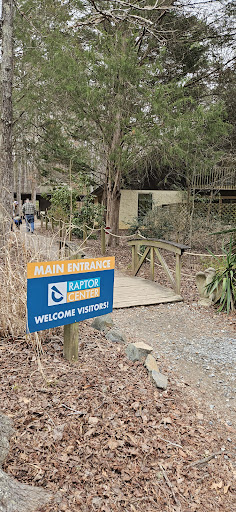
Five stars and heartfelt thanks go to the wonderful staff and volunteers of Raptor Hospital at the Carolina Raptor Center for their skill and dedication rescuing and rehabilitating injured, sick, and/or orphaned raptors.
I recently witnessed a rescue by Michon, then a new volunteer for the Raptor Rescue Team. Michon had just finished training, and this rescue was her first, yet she performed procedures with great care and confidence (reflecting well on the program and leadership too). Tom, Michon’s husband, assisted the rescue.
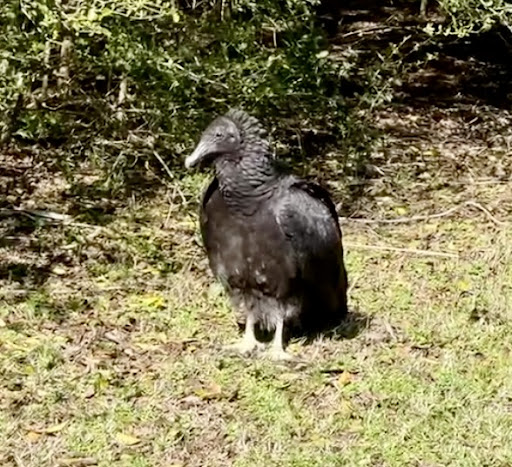
The raptor requiring Michon’s rescue was a black vulture I found on the ground in a park 24 hours earlier while walking my dog. The vulture sat alone in a tiny clearing cupped by a small, wooded area where it could watch its flock roosting nearby on a transmission tower. It showed no signs of injury and its physical condition looked good, but the small vulture acted lethargic and didn’t fly away even as people and dogs passed.
Worried about its health and safety, I called Carolina Raptor Center and spoke to the hospital medical coordinator, Milan. She took details about the bird’s condition, behavior, and location and asked for any photos or videos taken. After consulting with the medical team, Milan said they recommended the vulture be left overnight to see if it might rejoin its flock. Since steady rain had fallen that day, it was possible the vulture’s feathers had become too wet to fly and needed more time to dry. She asked if I could check on the bird the next morning and call with an update.
Early Sunday, the vulture was still on the ground and almost non-responsive. The hospital was notified. Just before noon, Brendon, the hospital raptor tech, said a message was posted to volunteers about the need for a rescue. There was no guarantee a rescuer could take the assignment, so I was thrilled when late that afternoon one did – Michon!
When Michon and Tom arrived at the park, they pulled thick rubber gloves over their hands and wide sunglasses over their eyes for protection from the vulture’s sharp beak and talons. Michon had towels to wrap around the bird when caught while Tom carried a sturdy ventilated box.
Eying the vulture’s location, the two discussed their approach and which way the bird might try to escape, knowing vultures often run or take flight when rescuers closed in. As Michon and Tom inched forward, the vulture was no exception -- it began flapping its wings to lift off the ground then soared toward the tower. I held my breath, hoping this signaled the vulture was well enough to rejoin its flock. But as the bird descended, landing and wrapping its talons round a rung of the tower, it suddenly lurched sideways and began tumbling down, cartwheeling through the air with wings outstretched.
Michon quickly moved forward, navigating through brambles and tall weeds. A few minutes later she returned carrying the now bulging towel enveloping the vulture. Tom knelt to steady the box as Michon slowly lowered the bird inside and the two carefully closed the top. The rescue was a success!
My heart was lifted knowing the vulture would soon receive the best medical care possible at Raptor Hospital.
--- Deep gratitude goes to Michon, Tom, Milan, Brendon, and the medical and leadership teams at Raptor Hospital for their impassioned efforts to admit this patient and give it a second chance at life. Sadly, medical evaluation suggested the raptor had contracted a deadly virus known to affect a wide variety of wild birds, including vultures and euthanasia was deemed the kindest way to prevent prolonged suffering. Blood tests later confirmed the diagnosis was accurate.
Michon expressed feelings best: “We are heartbroken…but we understand. I’m thankful…that we were able to save that sweet soul versus [it] suffering in the wild….” Michon continues to volunteer rescuing raptors, with a turkey vulture and a baby red-shouldered hawk amongst her most recent rescues.
Medical records for this patient, as well as all Raptor Hospital patients past and present, can be viewed on...
Read more


 Learn more insights from Wanderboat AI.