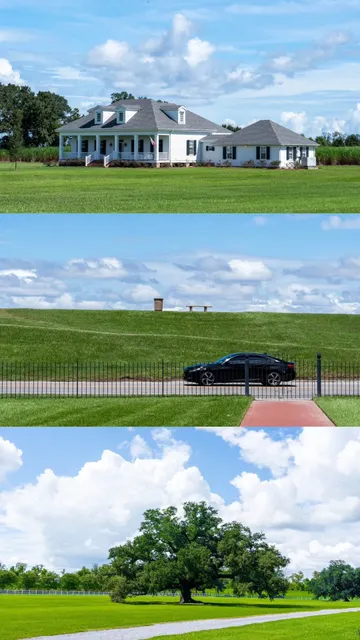
When exploring history, context is everything. I had the opportunity to tour the Laura plantation yesterday. Invited by an associate, I must confess I was hesitant. I had an unsatisfactory experience at one well established plantation that didn’t address the history of enslavement and one revolutionary experience at Whitney that solely focuses on enslavement. To me, I had struck out once and witnessed life changing history at the other. I am uncomfortable with the concept of tourism to any plantation that does not encourage anti racism. I reluctantly agreed to go.
Boy, am I glad I did.
It challenged me to explore the complex and often forced community of this particular site. It never glamorized or made the owners of the big house heroic or to be emulated but spoke with direct honesty of their view points and transgressions. It spoke of a woven narrative that explained the integration of the household side by side was not equality.
Due to the matriarchy of this Creole (not American) household there is a narrative offered here with direct sources that gives incredible detail and many specific enslaved individuals. The French records offer insight that often the American records can’t.
The willingness of this organization to hold themselves accountable to this narrative since 1994 means they are version 20 of the tour. Every time they uncover new information about a complexity they return to the drawing board and thoughtfully create a narrative that includes the brilliant craftsmanship of skilled labor and the absolute cruelty of capitalism around enslavement.
I’d like to mention that our tour guide Joseph was an absolute gem of a guide. Even though he primarily guides in French his descriptions in English were crafted with dignity and he wasn’t afraid to challenge pre established concepts. I have rarely seen such skill bridging any history much less one that requires such dexterity.
I now believe that if someone was interested in de-colonization and anti racism the Laura is essential. I think a day trip that would alter your concept of history forever would be Laura, a picnic at Laura after decompressing and then Whitney. It’s essential to understand that if you visit New Orleans nearly every boutique hotel, every store, every historic house, every public park has a history directly linked to enslavement. At Laura they understand that responsibility.
If you are strong enough to look this history in the eye, you might see yourself reflected. But beyond that reflection is a path forward. But first we must do the work. The work is being done at Laura. And now it’s up to me...
Read moreI agree with the previous review from a month ago.
The tour was very short and focused too much on the family who owned it and barely anything about the enslaved people. As a history teacher, the stories seemed watered down and did not really go into details or even the more upsetting aspects, which although upsetting, are extremely important and more fascinating. Also, so many rooms were passed with no discussion of what would’ve occurred in there.
It felt a bit disrespectful (in my opinion) to centre the enslavers rather than the enslaved. It felt as though the enslaved people were background characters to the story of the family, which is problematic.
This is not a knock on the tour guide, as he did a good job, was kind, and I assume he follows what he is supposed to cover daily. There were also some interesting stories as well (the tragedy of the teenage daughter for example). We also did not have a big group which was nice. However, I found the content in the museum more interesting, varied, detailed, and focused more on humanizing the enslaved than the tour itself.
I really hope they take this into consideration to add more information and time. Possibly exploring more of the grounds and not just the neutral or positive parts of the plantation experience. However, seeing that reviews from 8 years ago say the same thing, I highly doubt they actually care...
Read moreAs a plantation exists, it is automatically an important part of history due to what happened on each and every one of them. Some are more cognizant of that than others. The Laura Plantation made marginal effort in telling the stories of those enslaved by the Duparcs. The majority of their history is listed on plaques and posters in a building off to the side of the main entrance. It is essentially an optional viewing. The gift shop sells books and stories written by people of color, which is great, but they're not highlighted. As far as I know, this is still a business and not a non-profit like the Whitney plantation is, which in my opinion is not ethical. You can call this a "family friendly" tour, but it does a huge disservice in telling the stories of the children and families that faced suffering here. Imagine growing up with someone and being close to them... being relied on for their care, food, and labor, yet simultaneously being treated as their property. We have to remember that this is how people thought then. This was normal. Sexual assault, branding, and other punishments were normal. On our specific tour, Renee was our guide and was unquestionably knowledgeable for her field. My rating is 3/5 primarily because of her; I would have given it less otherwise. The experience as a whole falls short of what it could and should be and I hope that they...
Read more