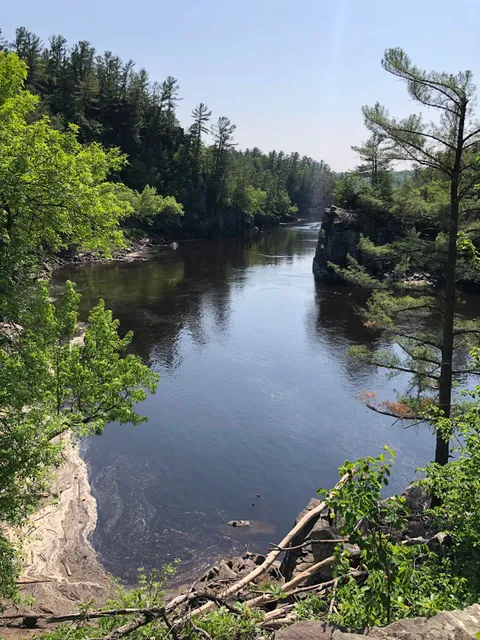
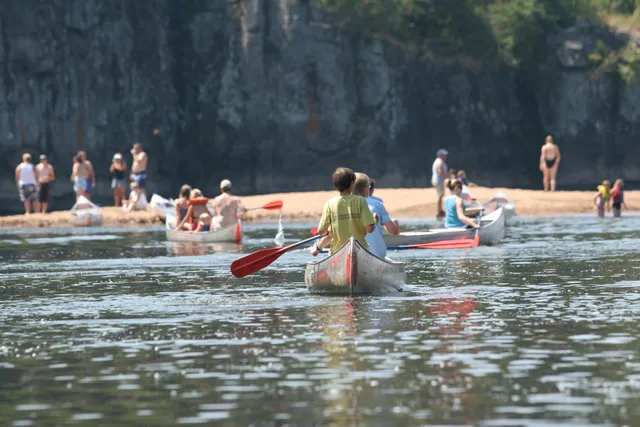
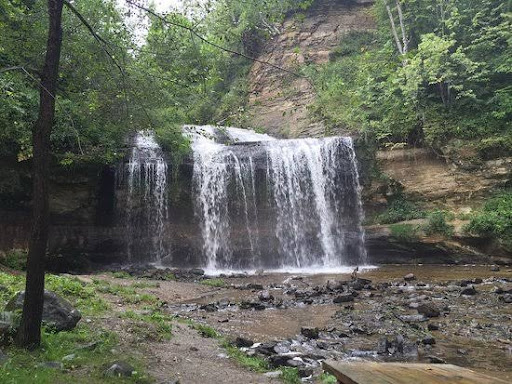
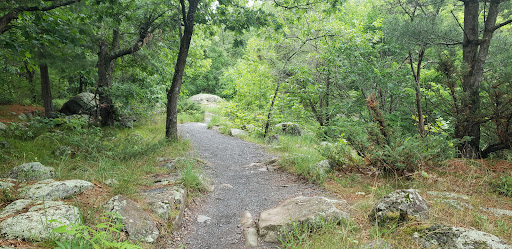
Comparing this state park to the Interstate State Park on the other side of the St. Croix River in Minnesota, I like this park a lot better. I didn't give them a 5 star review because their prices for an overnight stay plus $11 pass per day adds up really quick if you are from out of state. They dont sell year long passes, so if you decide to buy one in August, it could expire in december, unlike Minnesota. Also, the fact that for the space, a majority of the camp sites have little privacy between you and your neighbor, and some are right off of the drive. Not all though and they do have some really cool sites. The South camp doesnt have showers...you have to drive over to North camp to shower and there are only 3. One was out of service and there was only cold water. A hot shower was not an option. The toilets are not flush toilets - they are porta potty style but with stalls and there will be bugs covering the walls during the summer like an outhouse. If you have an RV or dont mind the rusticness, it's not a problem. I love that there are short to medium-length trails to cool destinations, such as a waterfall or scenic overlook. There is a beach where you can swim, a playground, kayak rentals (off-site but the companies will bring the kayaks/canoes to the park or you can drive down the street to hop on a kayak or canoe), and the camp sites themselves are more spread out. There is a North Camp and South Camp, as well as a Group Camp. There are a few really cool tent sites that are more isolated on a ledge by the river, but they are rare to be able to book because of the high demand. Just make sure to come prepared. I think my favorite part of this park is the scenic drive through and the activities/hiking trails that make this park more of a...
Read moreOne of my new favorite parks! The park is expansive, and if you can think of an outdoor activity, it's probably available here. Canoeing, kayaking, climbing, hiking, swimming, etc. There are a wide variety of trails throughout the park, traversing a number of different biomes and suited to almost any skill and fitness level. The interpretive center does a nice job of concisely explaining the amazing geology in the park and the history of it's use and discovery.
To get around in the park, you'll want a vehicle or a bike, since there's a pretty good road distance between points of interest, visitor center, and campgrounds. It took us at least 15 minutes to drive from the visitor center to our camp site.
Camp grounds are ok. Not much for space or trees between sites, so noisy neighbors are very obvious (pro tip: don't be a noisy neighbor. Respect quiet hours and all those lovely rules that are clearly posted.) Bathrooms are decently clean and well maintained. Make sure you reserve any weekend camping trips well in advance!
Taylor's Falls is within view of the park, and offers restaurants, yummy ice cream, and various touristy activities. The Minnesota side of the park is also beautiful and has some unique geological features. Since you're literally within spitting distance of the MN park, you should definitely spend at least an hour or two exploring the western shore...
Read moreThe St. Croix River was an important transportation route for Native Americans. Prehistoric tools have been found in the park, but no village sites.4] The first Europeans to pass through the Dalles were Daniel Greysolon, Sieur du Lhut, and his 1680 expedition, though he made no particular mention of the site. Fur traders used the river extensively, and a French fort was located near the Minnesota campground in the early 18th century.
During the logging era from 1837 to 1898, logs were rafted down the St. Croix River. By 1857 a sawmill was operating near what is now the Minnesota campground, joined in 1867 by a boat-building yard.[6] Both were owned by a leading citizen of Taylors Falls, W.H.C. Folsom, after whom an island in the park is named. The narrow gorge and the sharp turn at Angle Rock caused severe logjams in 1865, 1877, 1883, and 1886.[4] The June 1886 jam is believed to have been the worst in history; at least 150 million board feet of logs were backed up for 3 miles (4.8 km).[9]Neither dynamite nor steamboats with tow ropes were able to budge the jam. A crew of 175 men working 24 hours a day under electric lights took six weeks to break the jam, during which time several mills downstream went out of business.[4 To control the water flow and prevent further catastrophic jams, the Nevers Dam was built upstream in 1890 in what is now Wild River...
Read more