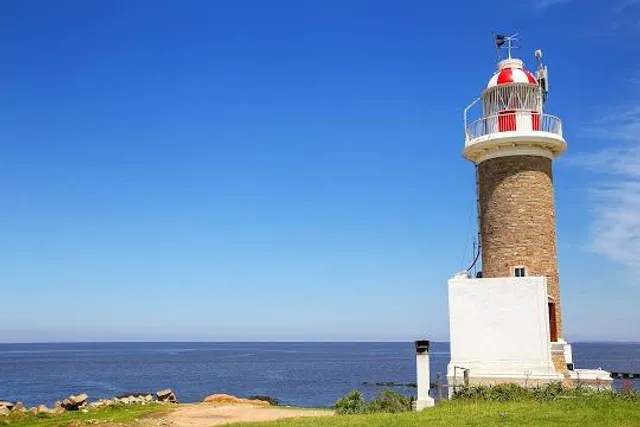
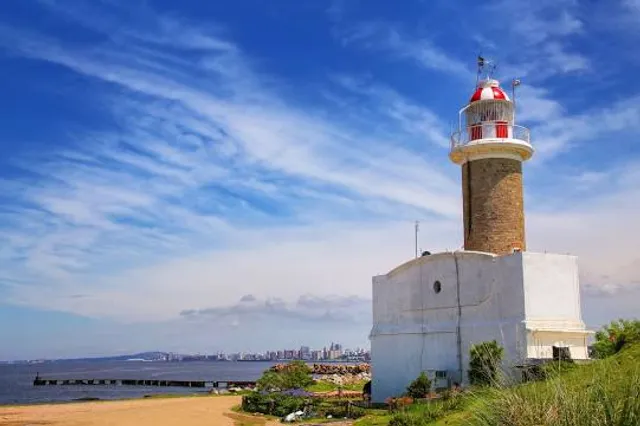
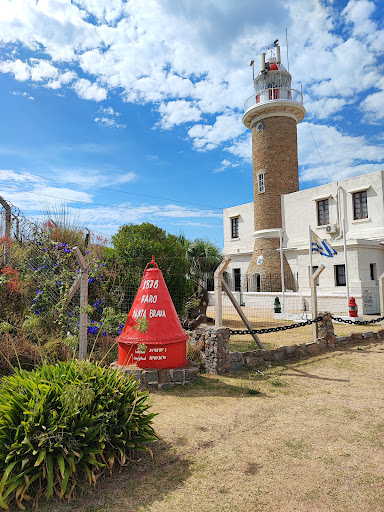
🗼 Punta Carretas Lighthouse – Montevideo’s Southern Light Located on the rocky edge of Punta Brava, the Punta Carretas Lighthouse (Faro de Punta Brava) has been watching over Montevideo’s southern coast since 1876. This elegant cylindrical tower of carved stone rises 21 meters above the sea, serving both as a historical monument and an active aid to navigation.
Originally built to guide ships through a treacherous stretch of coastline, the lighthouse was electrified in 1962, though its current light pattern — a flash every 10 seconds, alternating between white and red — was already established in 1948. The signal helps vessels safely reach Banco Inglés, Puerto del Buceo, and the Santa Lucía River.
Today, the lighthouse is still in full operation, maintained by Uruguay’s maritime authorities. It is considered a National Historical Monument, not only for its utility, but for its role in shaping Montevideo’s maritime identity.
🧭 Cultural and Symbolic Context Punta Carretas was once called "Punta Brava" for a reason: rocky, unlit, and dangerous. The lighthouse gave the area a new life, a new identity — and eventually, its name. From the early 20th century, the neighborhood began to grow around this signal of safety.
More than a navigational tool, the lighthouse became a symbol of the city’s relationship with the sea — a place where nature, architecture, and urban rhythm meet. On windy days or during sunsets, locals and travelers come here for peace, views, and photographs.
🛠 Architectural and Technical Details Height of tower: 21 m (69 ft)
Construction: masonry tower with a rectangular white keeper's house
Material: local stone, red and white painted iron lantern
Lighting pattern: alternating red and white flashes every 10 seconds
Range of light: approximately 15 nautical miles (~28 km)
Operational status: Active (as of 2024)
Electricity installed: 1962
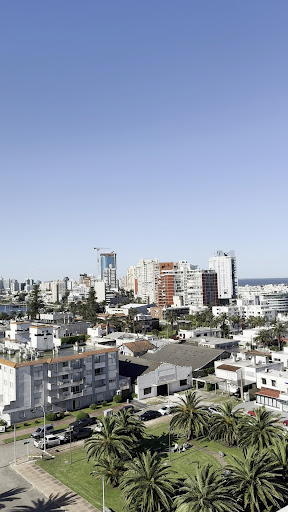
The narrow spiral staircase inside the tower leads to a circular gallery, from where visitors can enjoy panoramic views of the city skyline, Río de la Plata, and migratory seabirds.
✅ Visitor Information General access: Free and open-air. The lighthouse itself is accessible on foot from the Rambla.
Tower entry: Occasionally open to the public; modest fee (under 50 UYU) may apply.
Best time to visit: Late afternoon to sunset — for golden light and seabird spotting.
Accessibility: The base is accessible via paved footpaths, but the tower climb requires physical mobility.
Getting there: 15–20 min walk from Punta Carretas Shopping or Parque Rodó via Rambla Gandhi.
Whether you're a lover of lighthouses, a photographer, a walker, or someone who enjoys peaceful moments by the water, the Punta Carretas Lighthouse is a must-see stop. It combines history, architecture, and the unique geography of Montevideo’s southernmost point — a quiet icon that still watches...
Read moreThe Punta Carretas Lighthouse in Montevideo is a charming coastal landmark that combines history, beauty, and stunning views. Built in the 19th century, it has guided ships safely along the Uruguayan coast for generations. The lighthouse sits on a rocky point where the Río de la Plata meets the Atlantic, creating a picturesque setting that is especially beautiful at sunset. Visitors can climb to the top for panoramic views of the coastline, the ocean, and the city in the distance—a perfect spot for photography and quiet reflection. The surrounding area of Punta Carretas is also pleasant to explore, with coastal paths and nearby cafes that make for a relaxing visit. While the lighthouse itself is relatively small, its historic charm and breathtaking location make it a highlight for anyone traveling to Montevideo. It’s a peaceful yet inspiring stop that captures both the maritime heritage and natural...
Read moreIdeas para pasear con perros sueltos, que corran, jueguen y se metan al río si les gusta nadar. También es un espacio perfecto para meditar frente al agua y reconectar con la naturaleza.
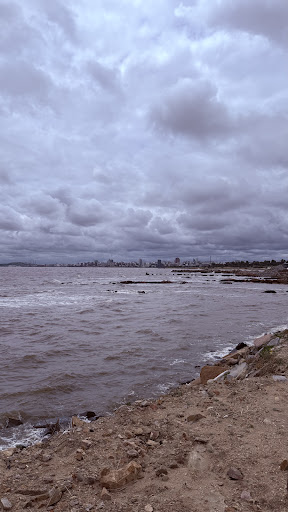
De mañana, mirando hacia el este, podés disfrutar de unos amaneceres increíbles y a la tardecita, hacia el oeste, mucha gente se reúne para ver el atardecer hacia el oeste.
Además, está el faro, que aunque es relativamente bajo, es muy antiguo y lleno de historia. Sus horarios de visita son bastante limitados: de lunes a viernes de 10 a 17 h, con un corte al mediodía, y la entrada tiene un costo simbólico creo que de 1 o 2 dólares aprox al cambio de hoy, que se paga en efectivo al cuidador.
Pero lamentablemente, la basura sigue siendo un gran problema. Muchos pescadores y visitantes dejan botellas, bolsas, envases, tanzas de pesca… y el mar también trae residuos todos los días 😢.
Y algunas noches, sobre todo los fines de semana y madrugadas, el lugar se llena de autos que lo usan como una especie de villa cariño. Algunos no son nada discretos así que ojo si vas con niños, y lo peor es que dejan preservativos, botellas, plásticos y papel higiénico tirados por todos lados. Es bastante asqueroso y una muestra clara de falta de conciencia ciudadana.
No hay espacios para tirar la basura, así que llevate los desechos que generes y lo que encuentres en tu camino 🙏, y al volver a casa depositalo en un contenedor adecuado.
Llevá una bolsa y aprovechá para limpiar un poco: tu pequeño gesto hace una gran diferencia. Yo lo hago todos los días, y el río, los pájaros y el planeta te lo agradecerán.
Días de marea alta: las rocas se llenan de gaviotas, cormoranes, garzas… Cuidemos lo que amamos. No cuesta...
Read more