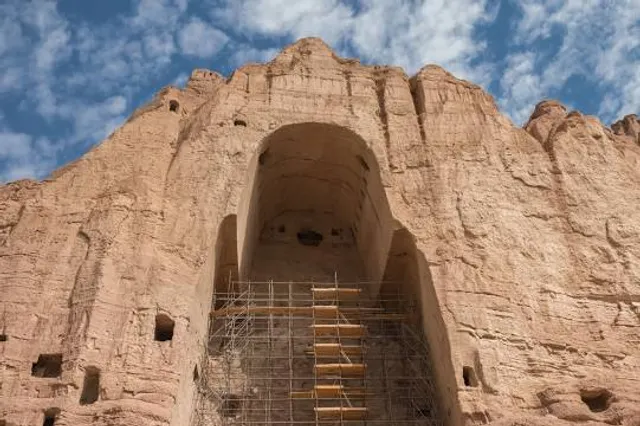
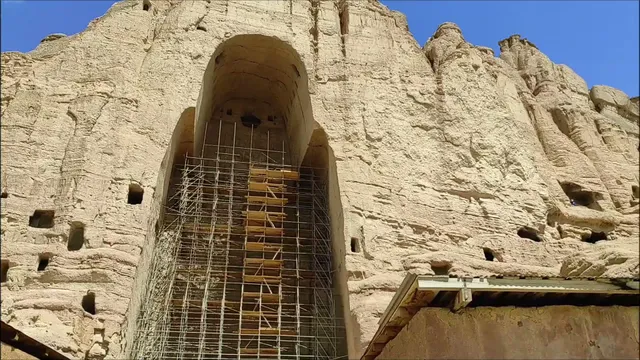
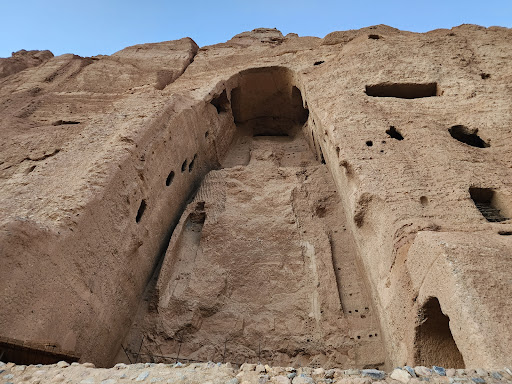
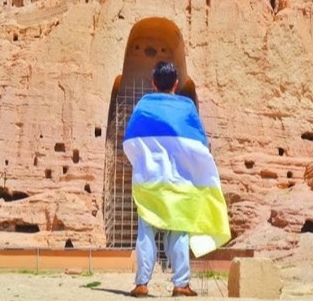
The astonishing site for visit. The problem is international tourist can come and visit it walking all the stairs up to the head. But National Afghans are not allowed since new law passed.
Bamiyan lies on the Silk Road, which runs through the Hindu Kush mountain region in the Bamiyan Valley. The Silk Road has been historically a caravan route linking the markets of China with those of the Western world. It was the site of several Buddhist monasteries, and a thriving center for religion, philosophy, and art. Monks at the monasteries lived as hermits in small caves carved into the side of the Bamyan cliffs. Most of these monks embellished their caves with religious statuary and elaborate, brightly colored frescoes, sharing the culture of Gandhara.
The Great Buddhas of Bamiyan were built around 600 CE during the time of the Hephthalites, who ruled as principalities in the areas of Tokharistan and northern Afghanistan. The Hephthalites did not always follow the Buddhist faith. For instance, during the time of Song Yun, who visited the chief of the Hephthalite nomads at his summer residence in Badakhshan and later in Gandhara, said that they had no belief in the Buddhist law and served a large number of divinities." Bamiyan had been a Buddhist religious site since the 2nd century CE under the Kushans, and remained so up to the time of the Muslim conquest of the Abbasid Caliphate under Al-Mahdi in 770 CE. It became Buddhist again from 870 CE until the final Islamic conquest of 977 CE under the Turkic Ghaznavid dynasty.
Murals in the adjoining caves have been carbon dated from 438 to 980 CE, suggesting that Buddhist artistic activity continued down to the final occupation by the Muslims.
The two most prominent statues were the giant standing sculptures of the Buddhas Vairocana and Sakyamuni (Gautama Buddha), identified by the different mudras performed. The Buddha popularly called "Solsol" measured 55 meters tall, and "Shahmama" 38 meters. The niches in which the figures stood are 58 and 38 meters respectively from bottom to top.
Before being blown up in 2001, they were the largest examples of standing Buddha carvings in the world (the 8th century Leshan Giant Buddha is taller, but is sitting).
Mapping of the 38 meter smaller Eastern Buddha, dated to 591–644 CE, and its surrounding caves and chapels.
Following the destruction of the statues in 2001, carbon dating of organic internal structural components found in the rubble has determined that the two Buddhas were built c. 600 CE, with narrow dates of between 544 and 595 CE for the 38-meter Eastern Buddha, and between 591 and 644 CE for the larger Western Buddha. Recent scholarship has also been giving broadly similar dates based on stylistic and historical analysis, although the similarities with the Art of Gandhara had generally encouraged an earlier dating in older literature.
Historic documentation refers to celebrations held every year attracting numerous pilgrims, with offers being made to the monumental statues.
They were perhaps the most famous cultural landmarks of the region, and the site was listed by UNESCO as a World Heritage Site along with the surrounding cultural landscape and archaeological remains of the Bamyan Valley. Their colour faded through time.
Pre-modern era
edit
Chinese Buddhist pilgrim Xuanzang visited the site on 30 April 630, and described Bamyan in the Da Tang Xiyu Ji as a flourishing Buddhist center "with more than ten monasteries and more than a thousand monks". He also noted that both Buddha figures were "decorated with gold and fine jewels" (Wriggins, 1995). Intriguingly, Xuanzang mentions a third, even larger, reclining statue of the Buddha. A monumental seated Buddha, similar in style to those at Bamyan, still exists in the Bingling Temple caves in...
Read more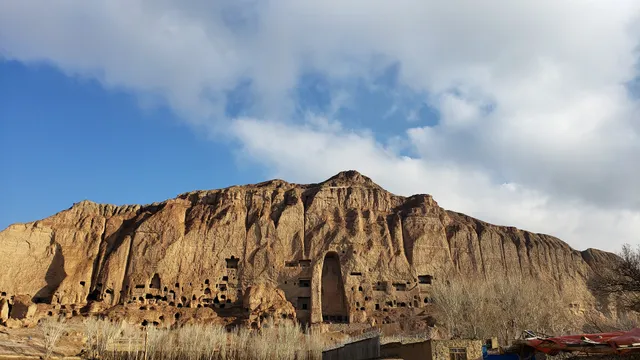
 Learn more insights from Wanderboat AI.