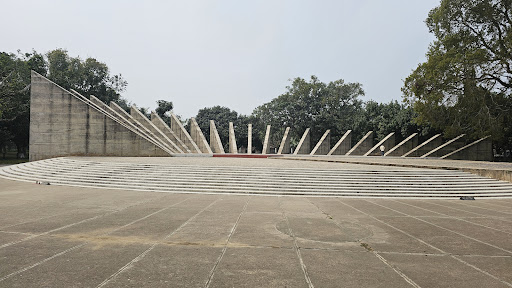
Mujibnagar Smriti Saudha (Memorial) At the initial stage of the War of Liberation, the government in exile of the People's Republic of Bangladesh took oath at village Baidyanathtala in Meherpur district on 17 April 1971. Baidyanatala was renamed as mujibnagar after the name of Bangabandhu Sheikh Mujibur Rahman. Later a memorial monument was constructed to commemorate the place of oath.
Immediately after the War of Liberation the Government of Bangladesh took initiative to make Mujibnagar memorable. On 31 August 1973 the government gave an instruction to construct a memorial at Mujibnagar. During the observance of Mujibnagar Day on 17 April 1974, Syed Nazrul Islam, the acting President of the Bangladesh Government in exile during the liberation war, formally inaugurated the project.
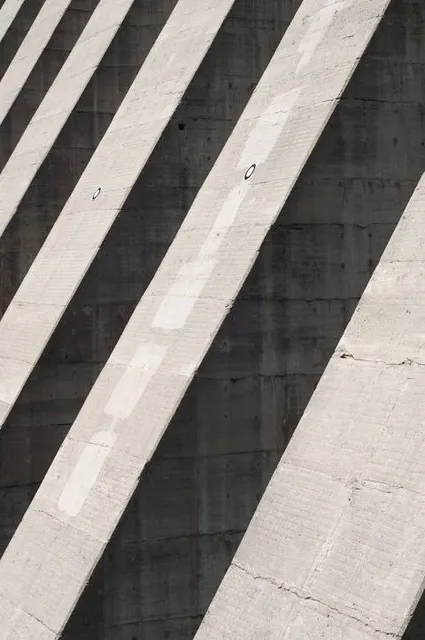
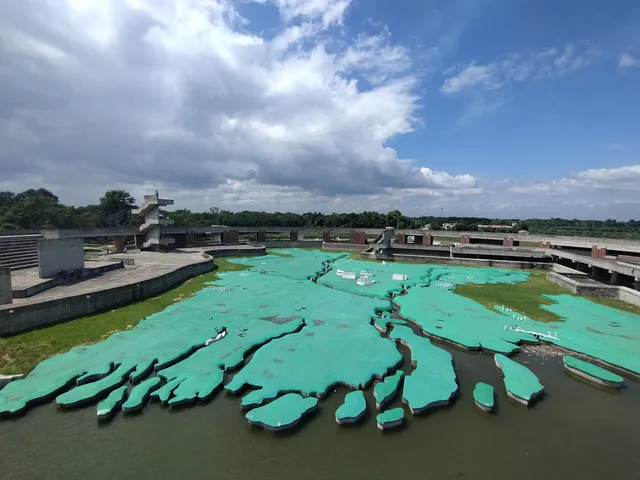
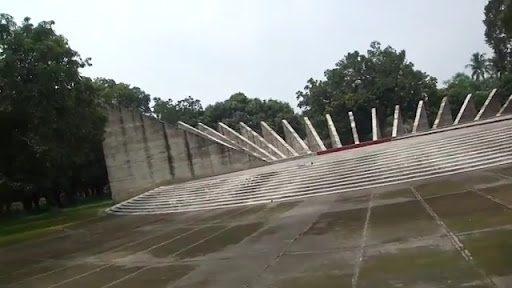
But after 1975 the work of the project was suspended. In 1986, initiative was taken to complete the work of the monument for which nearly two crore taka was sanctioned.The Mujibnagar Smriti Saudha is the symbol of liberation war and the sacrifice of the Bangalis. It stands on a land measuring 20.10 acres. This monument was erected on twenty three triangular shaped concreted pillars, and appears to be a symbol of the rising sun in its design planned by architect Tanveer Naquib. Twenty three pillars symbolise the twenty three years of Pakistani rule and of the struggle that the Bangalis gradually unfolded during those twenty three years. The altar is built with a height of 3 6 and a diametre of 160. The pillars are standing in a line covering half of the altar. Of the octagonal triangular shaped pillars the height of the first one is 9 and the length is 20. Each of the following pillars has an additional height of 1 and length 9/ from the previous one and thus the 23rd pillar assumes a height of 25 6 with length 25 6. The round shaped altar is divided into three parts of different height from the surface. The height of the first, second and third is 2 6, 3 and 3 6 respectively. The numerous circles on the other part of the altar of 2 6 height symbolise the thirty lac martyrs in the War of Liberation. The other part of the altar of 3 height is covered by numerous pebbles symbolising the unified struggle of seven crore freedom fighter Banglalis. The place where oath was taken by the Mujibnagar Government has been earmarked by a rectangular of red cyramic bricks. The ascending stairs to the altar is of nine steps symbolising the progress of liberation war during the nine months.
A construction farm, 'Everyday Engineering' completed the construction work of the memorial under the supervision of the Directorate of Public Works of the government. President H.M Ershad formally inaugurated the Mujibnagar Smriti Saudha on 17 April 1987. It was transformed into the Mujibnagar Smriti Saudha Complex by annexing the new establishments like a library, a mosque and guest house during 1996-2001. [Courtesy: Mohammad...
Read moreMujibnagar (Bengali: মুজিবনগর), formerly known as Baidyanathtala (Boiddonathtola) and Bhoborpara, is a town in the Meherpur District of Bangladesh.[2] The Provisional Government of Bangladesh was formed on 10 April 1971, however, sworn in on 17th April 1971 in this place by the elected representatives of the Bengalees (mostly belongling to Awami League), that led the Bangladesh Liberation War, who were leading the guerrilla war for the independence of Bangladesh (then East Pakistan) from Pakistan in 1971.[3] The place was renamed Mujibnagar by the proclamation of independence,[4] in honour of Sheikh Mujibur Rahman, who declared Bangladesh independent.[1] The actual capital of the government while in exile was Calcutta. A memorial complex covering 20.10 acres (8.13 ha) has been built at the site where the ministers of that first government took their oaths.
Throughout the war with the Pakistan Army, the Mujibnagar government would serve as the nominal head of the pro-independence guerrilla militias, mainly the Mukti Bahini. Although the state gained independence that was recognized by other countries only in December 1971, the Mujibnagar government is recognized as the first official government of Bangladesh.[3] The Vice President of Bangladesh, Syed Nazrul Islam, performed the ceremony at Mujibnagar in the role of Acting President, because the President, Sheikh Mujibur Rahman, was detained in Pakistan throughout the war.[3] Mohammad Faiquzzaman (2012), "Mujibnagar Smriti Saudha", in Sirajul Islam and Ahmed A. Jamal (ed.), Banglapedia: National Encyclopedia of Bangladesh (Second ed.), Asiatic Society of Bangladesh Md. Abu Hasan Farooque (2012), "Meherpur District", in Sirajul Islam and Ahmed A. Jamal (ed.), Banglapedia: National Encyclopedia of Bangladesh (Second ed.), Asiatic Society of Bangladesh Faiquzzaman, Mohammad (2012). "Mujibnagar Government". In Islam, Sirajul; Jamal, Ahmed A. (eds.). Banglapedia: National Encyclopedia of Bangladesh (Second ed.). Asiatic Society of Bangladesh. Miah, Sajahan (2012). "Proclamation of Independence". In Islam, Sirajul; Jamal, Ahmed A. (eds.). Banglapedia: National Encyclopedia of Bangladesh (Second ed.). Asiatic Society...
Read moreMujibnagar, situated in Meherpur district of Bangladesh, holds immense historical significance as the birthplace of Bangladesh's independence. In April 1971, during the tumultuous period of the Bangladesh Liberation War, Mujibnagar emerged as the provisional capital of the newly formed government of Bangladesh.
Following the declaration of independence by Bangabandhu Sheikh Mujibur Rahman on March 26, 1971, the struggle for freedom intensified against the oppressive regime of Pakistan. As the Pakistani military cracked down on Bengali nationalists, the leadership of the independence movement recognized the need for a unified and organized administration to guide the nation's fight for liberation.
On April 10, 1971, the leaders of the Bangladesh Awami League, along with other political and military figures, gathered in Mujibnagar to form the Provisional Government of Bangladesh. This historic event marked a pivotal moment in Bangladesh's quest for independence, as it established a legitimate authority to lead the nation's liberation war efforts.
Under the leadership of Prime Minister Tajuddin Ahmed, Mujibnagar served as the nerve center of the liberation movement, coordinating military operations, diplomatic efforts, and humanitarian initiatives. Despite facing immense challenges and operating under the constant threat of Pakistani aggression, the Mujibnagar government exhibited resilience and determination in its pursuit of freedom and sovereignty.
The significance of Mujibnagar extends beyond its role as a temporary administrative capital. It symbolizes the spirit of unity, resilience, and sacrifice that characterized the struggle for Bangladesh's independence. Today, Mujibnagar stands as a poignant reminder of the courage and determination of the Bengali people in their fight against oppression and injustice, ensuring that its historical legacy remains etched in the annals of...
Read more