History of the Cemetery Of Jannat Al-Baqi Where Imam Hasan Ibn Ali (2nd Imam), Imam Ali Ibn Al-Husayn (4th imam), Imam Muhammad Ibn Ali (5th imam), & Imam Ja'far Ibn Muhammad (6th imam), peace be upon them, are buried
Many of our Prophet's relatives and companions.
The first companion buried in Al-Baqi was Uthman Ibn Madhoon who died on the 3rd of Sha'ban in the 3rd year of Hijrah. The Prophet (s) ordered certain trees to be felled, and in its midst, he buried his dear companion, placing two stones over the grave.
On the following years, the Prophet's son Ibrahim, who died in infancy and over whom the Prophet (s) wept bitterly, was also buried there. The people of Madina then began to use that site for the burial of their own dead, because the Prophet (s) used to greet those who were buried in Al-Baqi by saying, “Peace be upon you, O abode of the faithful! God willing, we should soon join you. O' Allah, forgive the fellows of al-Baqi”.
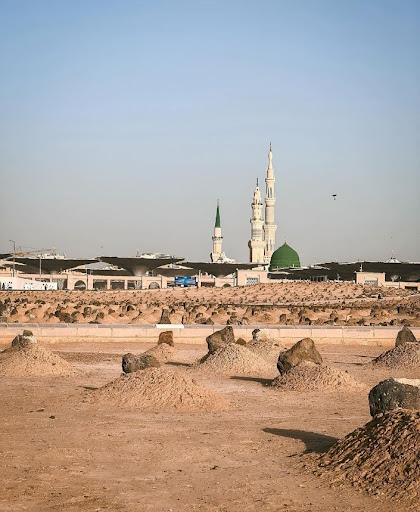
The site of the burial ground at al-Baqi was gradually extended. Nearly seven thousand companions of the Holy Prophet (s) were buried there, not to mention those of the Ahlul Bayt (a). Imam Hasan Ibn Ali (a), Imam Ali Ibn Al-Husayn (a), Imam Muhammad Al-Baqir (a), and Imam Ja'far Al-Sadiq (a) were all buried there.
Among other relatives of the Prophet (s) who were buried at al-Baqi are: his aunts Safiya and Aatika, and his aunt Fatima Bint Al-Asad, the mother of Imam Ali (a). The third caliph Uthman was buried outside al-Baqi, but with later extensions, his grave was included in the area. In later years, great Muslim scholars like Malik Ibn Anas and many others, were buried there too.
In front of it is the grave of Ibrahim son of our Prophet (s) with a white dome over it, and next to it on the right is the grave of Abdul-Rahman son of Umar bin Al-Khattab, popularly known as Abu Shahma
Facing it are the graves of Aqeel bin Abi Talib and Abdullah bin Ja'far Al-Tayyar. There, facing those graves is a small shrine containing the graves of the Prophet's wives, following by a shrine of Abbas bin Abdul Muttalib.
The grave of Hasan bin Ali (a), situated near the gate to it's right hand, has an elevated dome over it. His head lies at the feet of Abbas bin Abdul Muttalib, and both graves are raised high above the ground
At the farthest end of al-Baqi is the grave of the caliph Uthman, with a small dome over it, and there, next to it, is the grave of Fatima bint Asad, mother of Ali b....
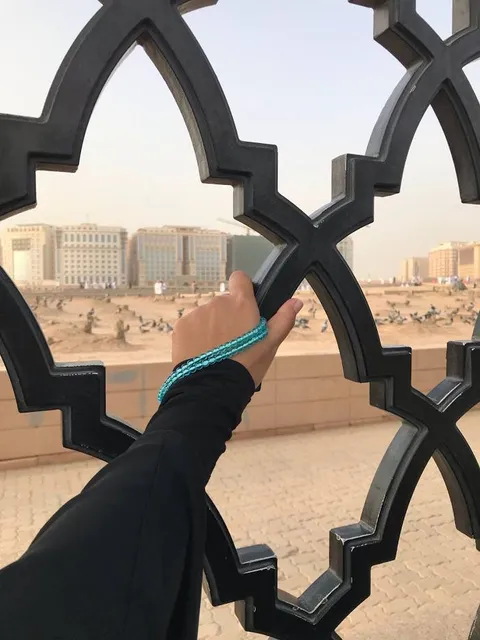
Read moreJannat al-Baqi is the most established and the main Islamic burial ground of Medina in the Hejazi district of present-day Saudi Arabia. It is situated toward the southeast of the Prophet's Mosque, which contains the graves of a portion of the Islamic prophet Muhammad's loved ones. It is otherwise called Baqi al-Gharqad.
At the point when Muhammad showed up at Medina from Mecca in September 622 CE, al-Baqi' was a land covered with Lycium shawii boxthorn trees. As indicated by authentic records, after the appearance of Muhammad, the places of Medina created close to al-Baqi', which was thusly thought to be as the public burial chamber. The thorn development was cleared and the spot blessed to be the future graveyard of the Muslims who kicked the bucket at al-Madina.Additionally al-Baqi' was presented as some place whose east side is Nakhl and west side contains houses. Truth be told, before destruction al-Baqi' was situated behind the houses in the city.
During the development of the Prophet's Mosque, on the site he bought from two vagrant kids when he showed up after his relocation from Mecca to Medina, As'ad ibn Zurarah, one of Muhammad's mates passed on. Muhammad picked the spot to be a graveyard and As'ad was the primary person to be covered in al-Baqi' among the Ansar.
While Muhammad was outside Medina for the Clash of Badr, his girl Ruqayyah fell debilitated and kicked the bucket in 624. She was covered in al-Baqi'. She was the principal individual from Ahl al-Bayt Family of Muhammad covered in this cemeter
انا للّٰہ وانا الیہ راجعون
"Verily we have a place with God, and verily to Him do we return."
It advises us that their demise has been announced by Allah, and we will all re-visitation of our maker.May Allah envelope your cherished one in benevolence and absolution. Ameen.
Graves are to remind individuals that they generally go in there.May Allah favor the people who are covered in their graves.May Allah favor us all in our lives and when we bite the dust and are in our graves.On the off chance that you are coming to Madinah,visit the Baqi Cemetery,The timings are after Fajar...
Read moreJannat al-Baqi‘ – The Blessed Cemetery of Madinah
Jannat al-Baqi‘, also known as al-Baqi‘ al-Gharqad, is located on the eastern side of Al-Masjid an-Nabawi in Madinah. It is the earliest and most significant Islamic cemetery, where thousands of Companions of the Prophet ﷺ, members of the Ahl al-Bayt, Tabi‘een, and great personalities of the Ummah are buried.
Religious and Historical Significance:
This is the cemetery where Prophet Muhammad ﷺ instructed the burial of his family members and many of his Companions.
Most of the Mothers of the Believers (Ummahat al-Mu’mineen, the wives of the Prophet ﷺ) are buried here.
Notable figures resting here include: Prophet’s son Ibrahim (RA), Caliph Uthman ibn Affan (RA), Imam Hasan ibn Ali (RA), Imam Ali Zayn al-Abidin (RA), Imam Muhammad al-Baqir (RA), and Imam Ja‘far al-Sadiq (RA).
The Prophet ﷺ himself would often visit al-Baqi‘, supplicate for its people, and remind his followers about the reality of life and death.
Spiritual Experience: The cemetery is simple in appearance, without elaborate structures, yet it carries a profound spiritual weight. For millions of Muslims, visiting Jannat al-Baqi‘ is a deeply humbling and emotional part of their journey to Madinah.
Visiting Guide:
Located directly beside Al-Masjid an-Nabawi, easily accessible after prayers.
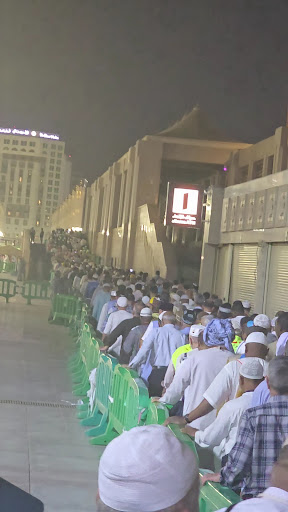
The gates are usually opened for visitors for a short time after Fajr and Asr prayers.
Visitors are encouraged to maintain silence, dignity, and make du‘a for the deceased, as this is the resting place of some of the greatest figures in Islamic history.
Jannat al-Baqi‘ is not just a cemetery — it is a living chapter of Islamic history and a reminder of the legacy of the Prophet’s family and companions. Stepping inside fills the heart with humility...
Read more