

HTML SitemapExplore
Find Things to DoFind The Best Restaurants

Florence actually has its own "Forbidden City."

**Florence's "Forbidden Palace"** Florence actually has its own "Forbidden City," which is known as the Palazzo Vecchio. The term "Vecchio" translates to "old" or "ancient," and while it might be a stretch to call it the "Forbidden City" like Beijing's, it does evoke a sense of historical grandeur. Similarly, the Ponte Vecchio, or "Old Bridge," is also transliterated as "Vittorio Emanuele II Bridge."❤️❤️❤️ **Palazzo Vecchio** is the town hall of Florence and one of Tuscany's most magnificent municipal buildings. It overlooks the Piazza della Signoria, with a replica of Michelangelo's David statue and numerous other sculptural masterpieces. This place is also one of Italy's most important public spaces.😀😀😀 Initially called the **Palazzo della Signoria**, named after the rulers of the Florentine Republic, it has also been known historically as the **Palazzo del Popolo**, **Palazzo dei Priori**, and **Palazzo Ducale**. After the Medici family moved their ducal residence to the Palazzo Pitti across the Arno River, this building became known as the "Palazzo Vecchio."😍😍😍 The **Sala dei Cinquecento** (Hall of the Five Hundred) is the most opulent room in the Palazzo Vecchio. Measuring 52 meters long and 23 meters wide, it was built in 1494 by Simone del Pollaiolo under the commission of Girolamo Savonarola, who became the spiritual leader of the Republic after expelling the Medici family. He intended it to be the meeting place for the Consiglio Maggiore (Great Council). Later, the hall was enlarged by Giorgio Vasari to serve as the throne room for Duke Cosimo I. Some famous unfinished works were lost during this transformation, including Michelangelo's sketch for the **Battle of Cascina** and Leonardo da Vinci's **Battle of Anghiari**. Leonardo was commissioned in 1503 to paint a battle scene celebrating Florence's victory on one of the long walls. He experimented with new methods and materials, mixing wax into the paint. However, the paint dried too slowly, so he brought in a brazier of hot coals to speed up the process. To everyone's horror, the wax in the mural melted due to the heat, and the paint ran down the wall and onto the floor. Michelangelo, who was working on the opposite wall, never prepared a full-scale cartoon for the mural. He was called to Rome by Pope Julius II to paint the Sistine Chapel, and his sketches were destroyed by eager young artists who wanted to learn from him, tearing them into pieces. The existing decorations in the hall were painted by Giorgio Vasari and his assistants between 1555 and 1572, marking the height of Mannerism and making this hall the epitome of the entire palace.🖼️🖼️🖼️ Architecture or art students can purchase discounted tickets with their current enrollment letters. The Palazzo Vecchio tower can be visited, but it is quite popular, so it is recommended to book in advance through the official website: [Musei Civici Fiorentini]. The tower may be closed during heavy rain or strong winds, so it is advisable to check the weather in advance and carefully read the ticketing details on the website. If you don't insist on climbing the tower, you can also buy tickets offline at the ticket office on the ground floor, accessible through the north entrance. The ticket office also has a free luggage storage area and restrooms. #Italy #Florence #Firenze #PalazzoVecchio #TiltShiftPhotography #ArchitecturalPhotography #Renaissance #MediciFamily #ForbiddenCity #Sculpture #Canon5D3 #Canon2470
Related posts
Hidden Gem Restaurants in FlorenceNUGOLOFlorence Michelin-recommended savory popcornA Hidden Café 🍵 in an Art Gallery in Florence's City CenterThe huge steak astonishes all tourists!Buca Mario, which has been in business since 1886
Xenia Dalton
Xenia Dalton
7 months ago
Xenia Dalton
Xenia Dalton
7 months ago
no-comment

No one has commented yet...

Florence actually has its own "Forbidden City."

Florence's "Forbidden Palace" Florence actually has its own "Forbidden City," which is known as the Palazzo Vecchio. The term "Vecchio" translates to "old" or "ancient," and while it might be a stretch to call it the "Forbidden City" like Beijing's, it does evoke a sense of historical grandeur. Similarly, the Ponte Vecchio, or "Old Bridge," is also transliterated as "Vittorio Emanuele II Bridge."❤️❤️❤️ Palazzo Vecchio is the town hall of Florence and one of Tuscany's most magnificent municipal buildings. It overlooks the Piazza della Signoria, with a replica of Michelangelo's David statue and numerous other sculptural masterpieces. This place is also one of Italy's most important public spaces.😀😀😀 Initially called the Palazzo della Signoria , named after the rulers of the Florentine Republic, it has also been known historically as the Palazzo del Popolo , Palazzo dei Priori , and Palazzo Ducale . After the Medici family moved their ducal residence to the Palazzo Pitti across the Arno River, this building became known as the "Palazzo Vecchio."😍😍😍 The Sala dei Cinquecento (Hall of the Five Hundred) is the most opulent room in the Palazzo Vecchio. Measuring 52 meters long and 23 meters wide, it was built in 1494 by Simone del Pollaiolo under the commission of Girolamo Savonarola, who became the spiritual leader of the Republic after expelling the Medici family. He intended it to be the meeting place for the Consiglio Maggiore (Great Council). Later, the hall was enlarged by Giorgio Vasari to serve as the throne room for Duke Cosimo I. Some famous unfinished works were lost during this transformation, including Michelangelo's sketch for the Battle of Cascina and Leonardo da Vinci's Battle of Anghiari . Leonardo was commissioned in 1503 to paint a battle scene celebrating Florence's victory on one of the long walls. He experimented with new methods and materials, mixing wax into the paint. However, the paint dried too slowly, so he brought in a brazier of hot coals to speed up the process. To everyone's horror, the wax in the mural melted due to the heat, and the paint ran down the wall and onto the floor. Michelangelo, who was working on the opposite wall, never prepared a full-scale cartoon for the mural. He was called to Rome by Pope Julius II to paint the Sistine Chapel, and his sketches were destroyed by eager young artists who wanted to learn from him, tearing them into pieces. The existing decorations in the hall were painted by Giorgio Vasari and his assistants between 1555 and 1572, marking the height of Mannerism and making this hall the epitome of the entire palace.🖼️🖼️🖼️ Architecture or art students can purchase discounted tickets with their current enrollment letters. The Palazzo Vecchio tower can be visited, but it is quite popular, so it is recommended to book in advance through the official website: [Musei Civici Fiorentini]. The tower may be closed during heavy rain or strong winds, so it is advisable to check the weather in advance and carefully read the ticketing details on the website. If you don't insist on climbing the tower, you can also buy tickets offline at the ticket office on the ground floor, accessible through the north entrance. The ticket office also has a free luggage storage area and restrooms. #Italy #Florence #Firenze #PalazzoVecchio #TiltShiftPhotography #ArchitecturalPhotography #Renaissance #MediciFamily #ForbiddenCity #Sculpture #Canon5D3 #Canon2470

Florence
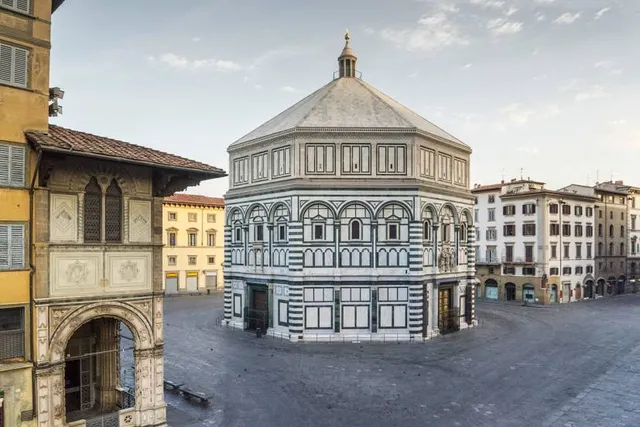
The Baptistery of St. John
The Baptistery of St. JohnThe Baptistery of St. John