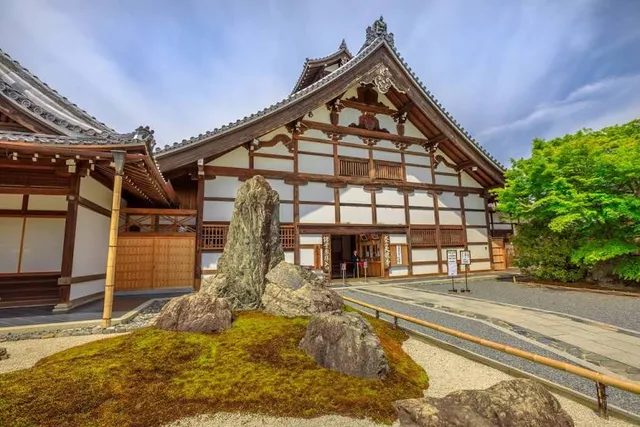

Notes on the Temple Complex: Kyoto's Tenryu-ji (1) 🌇
Tenryu-ji is located in Ukyo-ku, Saga-Tenryu-ji-Komachicho, Kyoto. 🎢🌟 Its full name is Reikizan-Tenryu-Shisei Zenji, and it is the head temple of the Tenryu-ji branch of the Rinzai Zen sect. 🍃🌺Nestled at the foot of Arashiyama, the temple is especially beautiful during the cherry blossom and autumn leaf seasons when the entire Arashiyama area is in full splendor. The scenery is breathtakingly beautiful, and it attracts a large number of visitors. 🌸🍁 🎢🌟 Tenryu-ji was originally established in 1339, during the second year of the Rekiō era. 🍃🌺The temple's founding abbot was Musō Soseki (1275-1351), and it ranks first among Kyoto's "Five Mountains." Musō Soseki was a legendary Zen master who lived during the transition from the Kamakura Shogunate to the Muromachi Shogunate. 🎢🌟 At the end of the Kamakura period, the shogunate still held military and political power, while the Kyoto court, though largely powerless, continued to be embroiled in internal strife. The "Daikaku-ji line," descended from Emperor Kameyama, and the "Jimyō-in line," descended from Emperor Go-Fushimi, alternated in power. 🍃🌺 In 1317, during the second year of the Bunpō era, Emperor Go-Daigo of the "Daikaku-ji line" ascended to the throne with the goal of restoring imperial power. He launched two attempts to overthrow the shogunate. The emerging military leader, Ashikaga Takauji, took advantage of the situation to overthrow the Kamakura Shogunate. 🍃🌺 He drove Emperor Go-Daigo into exile and installed Emperor Kōmyō of the "Jimyō-in line" on the throne. In 1338, during the third year of the Enbun era, Takauji appointed himself as the shogun, establishing the Muromachi Shogunate. Emperor Go-Daigo fled to Yoshino in southern Nara, creating a situation of two rival emperors that lasted for half a century, known as the "Nanboku-chō period." 🍃🌺 In 1392, during the third year of the Meitoku era, the third Muromachi shogun, Ashikaga Yoshimitsu, reunified Japan. 🏯 #Kyoto 🌟🌟