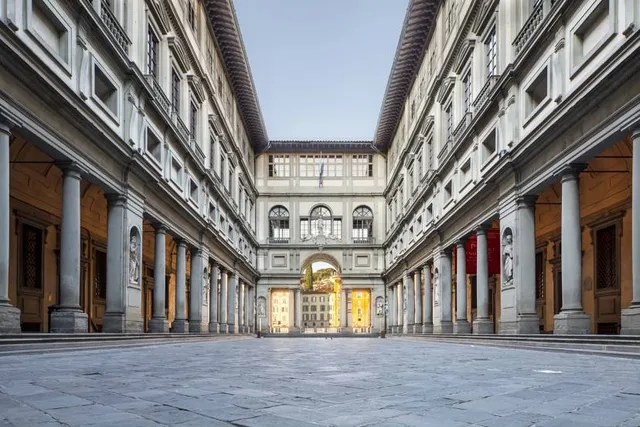

The Uffizi Gallery in Florence
Florence is the cradle of the European Renaissance, and the essence of Florence is preserved in the Uffizi Gallery. The most perfect representatives of the entire European Renaissance period are the three great masters of the High Renaissance: Leonardo da Vinci, Raphael, and Michelangelo.😀😀😀 Leonardo da Vinci's early work, "The Baptism of Christ," features only the two children in the lower left corner painted by him; the rest was done by his teacher. Even at this early stage, da Vinci's painting talent was evident, far surpassing that of his teacher, who subsequently encouraged him to seek further tutelage.😍😍😍 In his youth, da Vinci painted "The Annunciation," which is incredibly detailed. The patterns on the table and carpet are meticulously rendered, showcasing his profound painting skills and the effort he put into his work. Da Vinci's unfinished masterpiece, "The Adoration of the Magi," remains a testament to his genius.😻😻😻 Michelangelo's "Holy Family" is renowned for its precise depiction of muscles, a signature style that he brought from his sculptural work into painting. Raphael's "Madonna of the Goldfinch" is one of his most beloved works. His portrayal of the Virgin Mary is the epitome of the idealized image in people's minds. All of his works are housed in top-tier museums and galleries around the world. Sandro Botticelli's "The Birth of Venus" marks a significant shift in the early Renaissance. The subject matter transitioned from biblical stories to Greek (Roman) mythology, from religious to pagan themes. The figure has an elongated neck, a larger lower body, and narrow, drooping shoulders, all of which were deliberately distorted to enhance the aesthetic appeal of her form, prioritizing artistic sensibility over anatomical proportion. The use of light and shadow gives the clothing a soft, lifelike quality. Botticelli's "Primavera" (Spring), painted in 1482, was inspired by the poetry of Poliziano and created for the Medici villa. Along with "The Birth of Venus," it is one of Botticelli's most famous works. The painting is based on Poliziano's poem, with Venus at the center, though she appears somewhat somber. The three graces (Aglaea, Euphrosyne, and Thalia) on the left are depicted with vibrant energy. Bathed in sunlight at the edge of the forest, they dance hand in hand. The rightmost figure represents splendor, the middle one chastity, and the leftmost joy, symbolizing the joy of life they bring to humanity. Botticelli used a medieval decorative style to portray these female figures, with their beauty emphasized through smooth, flowing lines. On the right side of the painting are the figures of Flora, Zephyr, and Chloris (from left to right), symbolizing the arrival of spring and the renewal of nature. Both "The Birth of Venus" and "Primavera" are treasures of the gallery that are strictly prohibited from leaving the premises.🖼️🖼️🖼️ Caravaggio (Michelangelo Merisi da Caravaggio, 1571–1610) painted "Medusa" around 1597–1598. This Baroque mythological painting measures 60cm by 55cm. #UffiziGallery #Florence #Firenze