8 years of waiting for a big disappointment for The Vasari Corridor! I'm a professional travel writer and photographer, and I am in town to feature some of the latest experiences in the city. Saw the big announcement of the reopening of Vasari Corridor and bought a ticket myself as a visitor (not a press tour) on a day off to experience this unique passage and architectural masterpiece. The Single ticket Uffizi + Vasari Corridor cost 43€, a big extra from Uffizi gallery itself for 25€. Ticketholders are only allowed to enter the gallery two hours beforehand so that they can visit the gallery before entering the Corridor. This is because the Corridor is a one-way system only, leading from the Uffizi to the Pitti Palace. If you are an art lover like me, you can't finish viewing all the masterpiece pieces in two hours before rushing to the Corridor entrance.
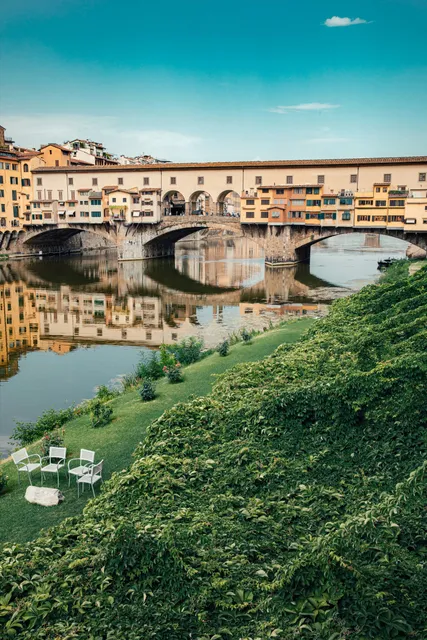
Unfortunately, I had some physical discomfort developed during the visit at the gallery, then I asked the team at the Corridor entrance, explained my situation and was hoping to rest a bit and enter the Corridor at a later time. The answer was NO due to the security policy, which I respected. Then I asked if there's any chairs or resting area during the Corridor tour, they also said no. I pushed myself to join the tour as scheduled since I was already there, then once you entered, there was "Nothing!" Everything is stored in a modern way and nothing fascinating or original to see besides the view outside the windows and over the Vecchio bridge and church. There were not really guides during the tour, especially in English. The main responsibility of the tour Associates was to escort the visitor and make sure you don't walk to slow or too fast for "security "reasons while there are dozens of cameras in each corner.
When you arrive at the end of the passage, you can see the staircase leading up to the Palazzo Pitti, but it is full of lost and found umbrellas, which completely ruined the vibe.
At the end, you exited the corridor at the Boboli garden, where there was absolutely no explanation. Everyone was just wondering around and taking pics. At the time, I was in such much pain and asked if I could finish and seek assistance to leave the tour, the answer was NO again, while my driver was already waiting outside. It was unbelievably unpleasant and I specifically told the Associates, "I Don't Feel Well", I need assistance and leave. Then they finally let me go.
I have been to Boboli gardens, Palazzo Pitti many times, it is very unfortunate that the experience ended in such bad note at two of my favorite sites in Florence.
I'm a member of many international museums, also Museum Association. This is the first time I would complain and ask for a refund from the tour and unpleasant experience. I mentioned I wish to speak with someone at the gallery, then an associate told me: "You can try to complain, but our Director decides the terms and inflexible policy for ALL TICKETS! Good Luck!" Wow, I hope this will fly well to Mr....
Read moreThe most important museum Sanctuary of the Italia Renaissance in the Heart of Florence: The Uffizi Gallery The Uffizi Gallery is not simply a museum; it's a profound and unmissable immersion into the beating heart of the Italian Renaissance. To call it a "unique place" is an understatement, considering the unparalleled concentration of masterpieces it jealously guards within its historic walls. Crossing the threshold of this art treasure trove means embarking on a journey back in time, a path that unfolds with surprising linearity over two floors. Along the corridors, almost as a solemn introduction to the Renaissance magnificence, one encounters busts and sculptures that narrate the grandeur of the Roman Empire, dating back to a period between 100 and 200 AC. This blend of eras, albeit discreet, adds a further layer of fascination to the experience. It's true that the Gallery's popularity, especially on weekends, makes it the destination of a constant flow of visitors. Advance booking is highly recommended. A valuable tip is to plan well in advance for any access to the Vasari Corridor, an exclusive experience that requires careful scheduling to secure the desired day and time. Once inside, the management is efficient and intuitive. The rooms, climate-controlled for the preservation of the artworks, maintain a constant temperature which, although ideal for the art, might feel slightly cool for some visitors, a detail to keep in mind for optimal comfort. But it is the presence of the masterpieces that leaves one breathless. Standing before the dramatic power of Caravaggio's "Medusa Head," the sublime elegance of Botticelli's "Venus" and "Primavera," or admiring the majesty of the altarpieces by giants like Cimabue and Giotto, is an indescribable emotion. Each room is a lesson in art history, a silent dialogue with the masters who shaped our visual culture. To state that one cannot come to Florence without visiting the Uffizi Gallery is not hyperbole, but a recognition of its pivotal importance. Finally, a suggestion that further enriches the visit is a stop at the gallery's café. In addition to offering a moment of refreshment, it provides an absolutely unique view of the city of Florence, a panorama that alone is worth a contemplative break. Uffizi Gallery is a total experience, a journey into the heart of Italian artistic genius that leaves an indelible mark on the soul of anyone who visits it. Planning is key to fully enjoying this priceless treasure, but the reward of coming face to face with the history of art amply repays...
Read moreThe Uffizi Gallery is more than just a museum; it's a profound journey through the evolution of Western art, housed in a magnificent building that was originally, and rather amusingly, a series of "offices" for the Medici family—which is what "Uffizi" literally means. The collection, largely built by the Medici themselves, is a testament to their patronage and vision. Walking through its long, vaulted corridors adorned with classical sculptures, you can trace the shift from the rigid, symbolic art of the Middle Ages to the human-centered realism of the Renaissance and beyond. The sheer volume of masterpieces can be overwhelming, but certain works demand you stop and simply gaze. For me, the most beautiful of all is Filippo Lippi's "Madonna and Child with Two Angels." The painting is a breathtaking departure from traditional religious iconography, presenting the figures with a startling humanity. The Virgin Mary, portrayed with a delicate, almost melancholic beauty, is thought to be a portrait of Lippi's love, the nun Lucrezia Buti. She looks not like a divine queen but a real mother, her face framed by an ethereal veil and intricate pearls, in the fashion of a 15th-century Florentine noblewoman. The two mischievous angels supporting the Christ child add a touch of playful realism, with the one in the foreground smiling directly at the viewer as if to invite us into this intimate, domestic scene. This blend of the sacred with the deeply human is what makes the work so captivating. While Botticelli's iconic "Birth of Venus" and "Primavera" rightly draw huge crowds, the Uffizi holds many less-known treasures. One of the more obscure delights is the Gioviana collection, a series of portraits of famous historical figures that lines the corridors. This collection, initiated by Paolo Giovio, was originally in a villa on Lake Como and later reproduced for the Medici. It's fascinating to see portraits of figures you wouldn't expect in an Italian gallery, such as England's King Henry V and even a posthumous portrait of Anne Boleyn, the second wife of Henry VIII. These portraits, while not masterpieces in the same vein as the main collection, offer a unique glimpse into the interconnectedness of European history and the Medici's fascination with powerful figures from across the continent. The Uffizi is not just a collection of art, but a historical and cultural record that continues to surprise and delight with...
Read more