īŋŧ
Search
Photograph your local culture, help Wikipedia and win!
īŋŧ
Shalban Vihara
Article
Talk
Language
Download PDF
Watch
Edit
Shalban Bihar (Sanskrit; Bengali: āĻļāĻžāϞāĻŦāύ āĻŦāĻŋāĻšāĻžāĻ°Â Shalban Bihar) is an archaeological site in Moinamoti, Comilla, Bangladesh.1] The ruins are in the middle of the Lalmai hills ridge, and these are of a 7th-century Paharpur-style Buddhist Bihar with 115 cells for monks. It operated through the 12th century.[2
Shalban BiharNative name āĻļāĻžāϞāĻŦāύ āĻŦāĻŋāĻšāĻžāϰīŋŧ
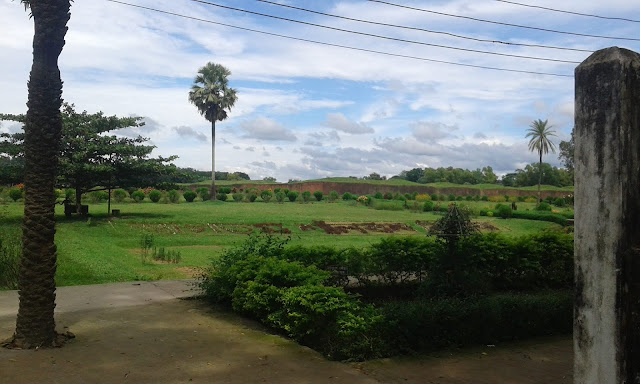
Ruins of Shalban vihara, Cumilla, Bangladesh
LocationMoinamoti, Comilla District, Chittagong Division, BangladeshCoordinates23.426234°N 91.1372098°EBuilt7th century
īŋŧ
īŋŧ
Location of Shalban Bihar in Bangladesh
Show map of BangladeshShow map of Southwest AsiaShow all
Excavations have revealed many archaeological artifacts dated to between the 7th and 12th centuries.[1]
Historyedit
īŋŧIntroduction of Shalban Vihara in both English and Bengali language
The Vihara was founded in the eighth century by Bhava Deva, the fourth ruler of the Early-Deva dynasty. The 168 square meters site was built in or on the outskirts of Devaparvata, the Samatata capital bordering the Lalambi forest.[4] The site was, previously known as Shalban Rajar Bari or King's residence at Shalban, was renamed Shalban vihara after archeological excavation revealed terracotta seals and copper plates identifying it as the remains of a residential Buddhist monastery.
Geographyedit
About eight kilometres west of Comilla town, lies a range of low hills known as the Mainamati-Lalmai range which is dotted with more than 50 ancient Buddhist settlements dating from the 8th to the 12th centuries. Almost at middle is the Shalvan Vihara of 115 cells built around a spacious courtyard with a cruciform temple in the centre. About 5Â kilometres north of Shalvan Vihara is Kutila Mura, which is a picturesque relic of a unique Buddhist establishment.[5]
Exploration and excavationedit
īŋŧShalban ViharaīŋŧView of Shalban Vihara, Mainamati, Comilla
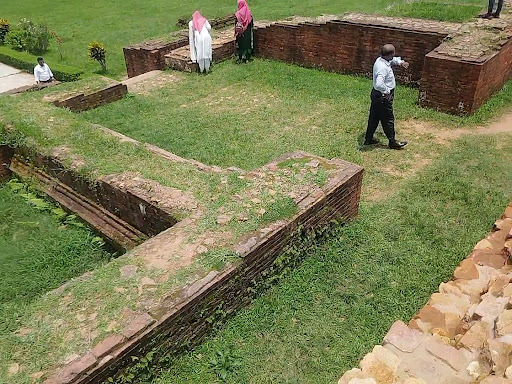
Deep diggings have revealed four repair and rebuilding phases in the monastery, the earliest corresponding to period III of the cruciform central shrine. No monastery remains corresponding to period I and II (7th century AD) has yet been found. Some scanty and ill-defined remains below the present structure may suggest their existence, probably of smaller size. During the next two phases (period IV and V: 9thâ10th centuries AD) new floors and thresholds were built on top of earlier remains. Two interesting features observed inside the cells, fireplaces and ornamental brick-pedestals, were not included in the original plan. Though there was a community kitchen and dining establishment, many of the resident monks (probably sramanas: lay-students) preferred to cook their meals individually inside their cells. The pedestals certainly served the purpose of private cult worship. Discoveries made during explorations and excavations suggests that this establishment may probably have some provision for accommodating poorer lay students (sramanas) from neighbouring settlements with cheaper arrangements for cooking their own food with materials brought from home, an age-old practice still in vogue in certain parts of rural Bengal .[6]Â Excavations at Shalban Vihara have also exposed a number of subsidiary structures including a community dining establishment, a small oblong, a pillared and a square shrine with exquisitely moulded plinth, two oblong chapels and a number of small votive stupas inside, and an interesting medium-sized shrine with a small sanctum connected by a long narrow passage and enclosed by a solid and massive brick structure, a columned terrace and colonnades just outside the monastery quadrangle.[7]
Architectureedit
īŋŧCentral of Shalban vihara
The large square monastery of 550-foot sides with 115 monastic cells, a dominant central shrine and a number of subsidiary shrines. Stupas and chapels, provides access through its monumental gateway on the north. While the central shrine revealed six building phases and the...
   Read moreBrief
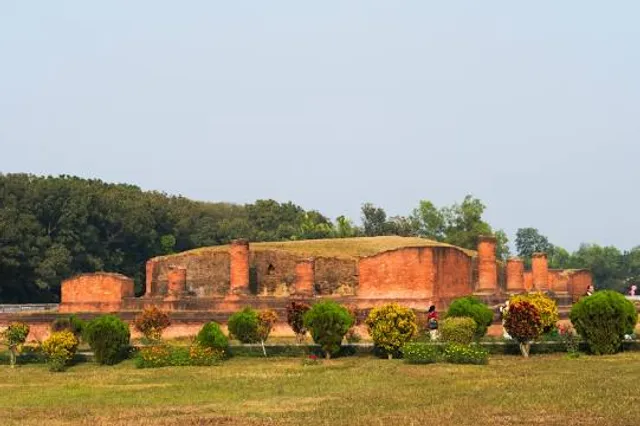
Salban Vihara (Sanskrit; Bengali: āĻļāĻžāϞāĻŦāύ āĻŦāĻŋāĻšāĻžāϰ Shalban Bihar) in Mainamati is one of the best known Buddhist viharas in the Indian Subcontinent and is one of the most important archaeological sites in the country. At the end of the 8th century, King Shri Bhavadeva (Vobodev) made the âSalban Biharâ in this place. The digging started from 80th decades. Many archaeological elements were found here. Most of them are kept in the Mainamati Museum now...
Previously it was known as Salban Rajar Bari. But after excavation ground plan of a Buddhist monastery measuring 550âx500Ⲡwith 115 monastic cells, it was exposed. Hence it is now popularly known as salbanvihara. The special attraction here is a dominant central shrine and its monumental gate way on the north. In its central shrine has revealed six building and rebuilding phases while in the monastery four. The terracotta in sealing indicates that the monastery was built by Sri Bhava Deva, the 4th ruler of the early deva dynasty during mid-8th century. Previously it was called Bhava Deva MahaVihara. The antiquities recovered during excavation are now displayed in the Maynamati Museum..
Before 1200 years ago the King Bhava Deva, the fourth ruler of the Early-Deva dynasty built that place on 168 square meters of ground. It was the royal palace for the early Buddhist students. This site, previously called Shalban Rajar Bari, came out after archaeological excavation as a Buddhist monastery and hence termed as Salban vihara from the terracotta seals and copper plates discovered. Its original name is supposed to have been Bhava Deva Mahavihara after the 4th king of the early Deva dynasty which ruled this region from the mid-7th to mid-8th centuries AD. It was built in or on the outskirts of Devaparvata, the Samatata capital bordering the Lalambi forest.
How to go
The final destination of the bus is Comilla town, but it will be better for you to get down at Comilla Cantonment, as it is near from Comilla Cantonment rather than Comilla town.
From Cantonment, take a âCNG Auto Rickshawâ; it will cost you 70 to 80 taka to reach the Shalban Bihar & Maynamati Museum. Just tell the driver that you want to go to Shalban Bihar &Maynamati Museum. Remember, they will ask BDT 100 to 150 from you for this. So you should be careful. Also there is mini bus transport through the cantonment; it will cost you 10-15 taka to reach at BARD, after that you can take a rickshaw to Shalban Bihar &Maynamati Museum.
How To Reach: Comilla District
Comilla has excellent transport and communication system. Comilla and Dhaka are linked by both road and railway. There is also an airport in the district, but it is not...
   Read moreShalbon Bihar is located in Comilla district's Coatbari area which is also a prominent symbol of Bangladesh's ancient civilization. During that time this area used have Shaal and Gajari forests from which the name Shalbon Bihar gained its popularity. Shalbon Bihar is very similar to Paharpur Buddha Bihar but the latter is a bit smaller in size. During the road construction in the Coatbari area in 1875, many came across the ruins of an ancient palace. During then, it was considered a part of the ancient fort. In 1917, the curator of Dhaka Museum, Professor Nolini Kanto Bhattoshali observed the Buddha Bihard and concluded it to be a part of Pattikera City. However, it is considered that this Bihar was constructed at the end of the 7th century by King Sree Bhobo Deb. At different times, six accounts were heard of building and reconstructing the Shalbon Bihar. It is thought that the central Temple was constructed and renovated 3 times within the 8th century. It was respectively renovated for the 4th and 5th time in the 8th and 9th centuries. Shalbon Bihar is rectangular in size and each side is 167.7m in length. The walls on four sides of the Bihar are 5m thick and the rooms have been built against the cordon. A door can be seen to enter the Bihar which is situated in the middle of the northern block. There are a total of 155 rooms and right in the center is the central Temple.
It is thought to be the place where Buddhist monks used to live and practice religion. There is a long balcony in front of the rooms and a wall at the very end. The walls of each room have a place reserved for oil candles and idols. On the other side, a hall room can be seen built on 4 huge pillars. It is thought that this room was used as the dining space for the monks. At different times during archaeological excavations nearly 400 gold and silver coins, bronze and clay statues, 8 copper plates, 8 seals and terracotta have been discovered. A large part of this collection is being exhibited at Mainamati Museum. At last, I wanna say, It's really an amazing place where you can go to know its history and take mental peace...
   Read more