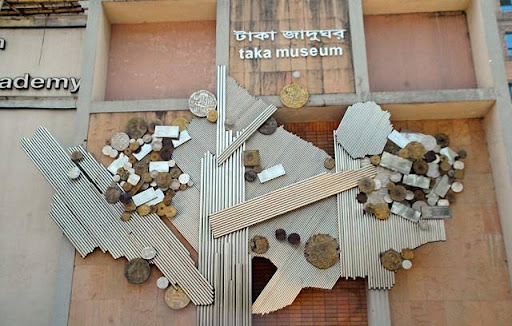
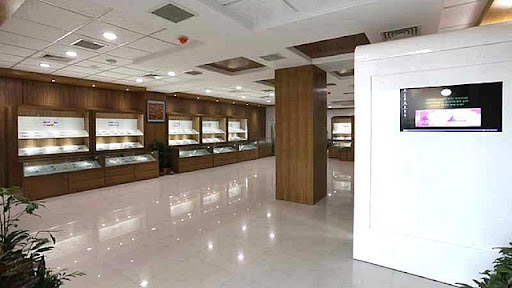
This museum is in Dhaka Mirpur 2 condition. A lot of beautiful Bengali money history is known. Earlier, there was a limited currency museum in the central bank of Bangladesh. This is the first money museum in Bangladesh that officially started its journey in 2013.
Preserved and displayed here are various types of coins, paper notes and coins related to coins printed from ancient times to the present time. Among the coins on display are the oldest stamped punch marked (silver coins) of the Indian subcontinent, including Bangladesh, dating from the 5th-4th century BC to the 2nd century AD. Modern currency reserves including Kushan coins, Harikela coins, coins of the Sultans of Delhi and Bengal, coins of the Mughal and British rulers. [1]
From time immemorial to the 19th century, cowries were used as coins in small transactions in Bengal, some specimens of those cowries are also on display. There are some specimens of shock Parthian and copper coins given by the Kushan emperors which were used in the 1st and 2nd centuries AD. Harikela coins were mainly used in the 7th and 8th centuries AD in the coastal areas of present day Sylhet, Noakhali, Mainamati of Comilla and Chittagong.
Huge Harikela coins are found from the archeological site of Mainamati. During the Muslim rule in the Middle Ages, i.e. during the Sultanate period (14th and 15th centuries), 27 rulers issued coins from different mints in Bengal. So far 40 mints have been named based on currency information. Sultan Mahmud of Ghazni was the first to introduce the currency as 'tanka' or 'taka'. Sultan Iltutmish of Delhi named his gold and silver coins 'Tankah' or 'Taka'. The 'Taka Museum' also has Mughal period 'Koch' and 'Ahom' or 'Assam' coins.
The 'Museum of Money' has a special place in the exhibition of Sultan Ghiyasuddin Tughlaq Shah of Delhi, Mughal Emperor Shah Jahan, Aurangzeb, Farrukhshiar and British Indian gold, silver, copper coins and paper notes. There is also a continuous history of post-British Pakistan period, currency and paper notes of independent Bangladesh.
The museum now has paper notes, polymers, hybrid notes and coins from about 120 countries. One of the attractions of the Master Museum of Coinage of Japan and German Mint. Polish banknotes, checks and bonds from various countries such as the former Soviet Union, the former Czechoslovakia, Italy, Afghanistan, China, Latin America, Vietnam, Lithuania, Hungary, Bulgaria and the Communist era. Currency of present day United States, England, Spain, Switzerland, Germany, Australia, New Zealand, South Africa, Nepal, Bhutan, India, Pakistan. [2]
So far, Bangladesh Bank has issued 12 commemorative coins and 4 commemorative notes in memory of language movement, liberation war, various important events, days and eminent persons. Of these, 1 is gold, one is nickel and the rest is silver. All these coins and notes will fascinate the visitors. There are not only coins or notes but also dice for making coins, traditional Bengali ornaments made on coins, items used in various economic activities, earthen pots for storing grains, etc. [3]
And what I like most is gold money notes, money watches, Bangladesh 1 anna coins and silver...
Read moremain aspects of Taka Museum are to collect, preserve, display and research the monitory tradition of Bangladesh. Taka Museum also discovers the untold history of the currencies through various kinds of research and publications. Here coins and notes with relevant objectshave been displayed attractively with detail information. Another important aspect of the museum is to foster the history of money to the common people by the displayed objects and provide the visitors immense pleasure.
History: Taka Museum was established first as a Currency Museum in 2009 at the 3rd floor of the main building of Bangladesh Bank at Motijheel. But that was not open to all. Considering the importance and necessity Dr. Atiur Rahman, honorable governor of Bangladesh Bank took the initiative to establish a full fledge currency museum in 2012 equipped with modern digital facilities, technology, architecture & art so that the glorioushistory and traditions of our currency can be preserved in a befitting manner. Later on this currency museum was named as Taka Museum.
Taka Museum started its journey on 27 April, 2013 with the foundation stone laid by Sheikh Hasina, honorable Prime Minister of the Government of the People's Republic of Bangladesh. The museum was inaugurated formally on 5 October, 2013 by Dr. Shirin Sharmin Chowdhury, honorable Speaker of the national assembly. From then the museum is declared open to all.
Activities: Taka Museum collects, preserves and conserves, displays and ensures the Security and documentation of the objects. It also arranges seminar, symposium and do research works related to the history of coins. Taka Museum has few publications also.
Future Plan: 2nd floor of Bangladesh Bank Training Academy (BBTA) has been allocated for the extension works of Taka Museum. A Library, a Conservation Laboratory, a multipurpose Cineplex cum auditorium and a corner for children will be established there.
Visitors: Since the inauguration of Taka Museum on 05 October, 2013 a number of visitors including School children, VIP�s from home and abroad and many others have visited Taka Museum.
Prohibition: Prohibition: Bearing food, gold ornaments and any kind of arms or explosives are strictly prohibited in...
Read moreI visited the Taka Museum hoping to gain a deeper understanding of the evolution of currency in Bangladesh and beyond. While the concept is fantastic, the execution left much to be desired, and I wanted to share my experience and suggestions for improvement.
The museum's policies feel outdated. The no photography rule is a major disappointment, especially since most modern museums allow non-professional photos. Allowing visitors to take pictures would be great publicity and would encourage more people to visit.
The museum's layout and presentation are also a concern. The four galleries spread across three floors feel disorganized, and the overall design lacks professional curation. The poor lighting and unappealing displays detract from the collections. The collections themselves aren't as comprehensive as they could be; the foreign currency section is quite sparse, and surprisingly, some of the newest Bangladeshi banknotes are not yet on display.
On the day I visited, there was a noticeable lack of staff presence and a general unwelcoming atmosphere. The bad odor, apparently from staff eating inside the galleries, was unpleasant. A service for printing souvenir banknotes was unavailable because the single technician was on a lunch break with no one to cover. This highlights a need for better staffing and management.
Given the low visitor count (I saw barely ten people visit a day), it's clear that the museum needs a significant overhaul. The management should consider investing in professional interior design, better publicity, and creating a more welcoming, interactive environment. Introducing programs and community engagement would make the museum feel less like a vault and more like an educational institute. Selling commemorative notes or coins could also attract collectors and generate revenue.
I believe this museum has immense potential, but it needs to be operated as a true museum. I hope the authorities take these suggestions to heart to make it a destination that truly celebrates the rich history...
Read more