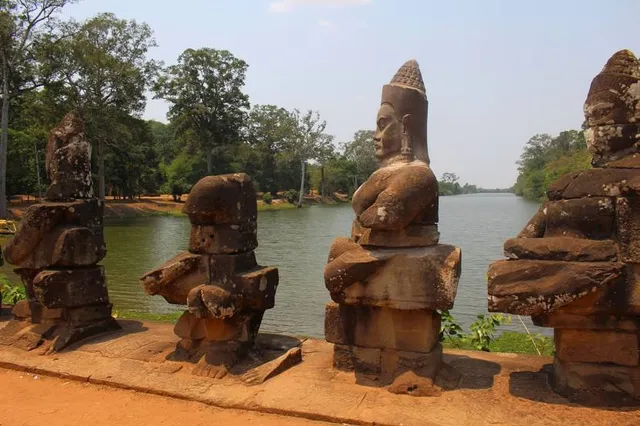
À chaque porte correspond une chaussée qui franchit les douves. Celle de la porte Sud est gardée de chaque côté par 54 géants, des yakṣas, qui tiennent le serpent fabuleux, le nâga montant la garde devant les quatre grands rois. Selon une autre interprétation, cette chaussée (comme les quatre autres à l'origine) est bordé d'un côté par des génies bienfaisants (les deva) et de l'autre par les démons (asura) qui tirent ensemble sur Vâsuki le roi des Nagas lors du Barattage de la mer de lait. Les constructions de Jayavarman VII sont représentatives par leur décoration du syncrétisme réussi par les Khmers entre le bouddhisme Mahāyāna et les cultes hindouistes de Śiva et de Viṣṇu.
Siem Reap : Angkor Thom - The South Gate. Angkor Thom ("Great City"), located in present-day Cambodia, was the last and most enduring capital city of the Khmer empire. It was established in the late twelfth century by King Jayavarman VII. It covers an area of 9 km², within which are located several monuments from earlier eras as well as those established by Jayavarman and his successors. At the centre of the city is Jayavarman's state temple, the Bayon, with the other major sites clustered around the Victory Square immediately to the north. The city lies on the west bank of the Siem Reap River, a tributary of Tonle Sap, about a quarter of a mile from the river. The south gate of Angkor Thom is 7.2 km north of Siem Reap, and 1.7 km north of the entrance to Angkor Wat. The walls, 8 m high and flanked by a moat, are each 3 km long, enclosing an area of 9 km². The walls are of laterite buttressed by earth, with a parapet on the top. There are gates at each of the cardinal points, from which roads lead to the Bayon at the centre of the city. As the Bayon itself has no wall or moat of its own, those of the city are interpreted by archaeologists as representing the mountains and oceans surrounding the Bayon's Mount Meru. Another gate—the Victory Gate—is 500 m north of the east gate; the Victory Way runs parallel to the east road to the Victory Square and the Royal Palace north of the Bayon. The faces on the 23 m towers at the city gates, which are later additions to the main structure, take after those of the Bayon and pose the same problems of interpretation. They may represent the king himself, the bodhisattva Avalokiteshvara, guardians of the empire's cardinal points, or some combination of these. A causeway spans the moat in front of each tower: these have a row of devas on the left and asuras on the right, each row holding a naga in the attitude of a tug-of-war. This appears to be a reference to the myth, popular in Angkor, of the Churning of the Sea of Milk. The temple-mountain of the Bayon, or perhaps the gate itself, would then be the pivot around which the churning takes place. The nagas may also represent the transition from the world of men to the world of the gods (the Bayon), or be guardian figures. The gateways themselves are 3.5 by 7 m, and would originally have been closed with wooden doors. The south gate is now by far the most often visited, as it is the main entrance to the city...
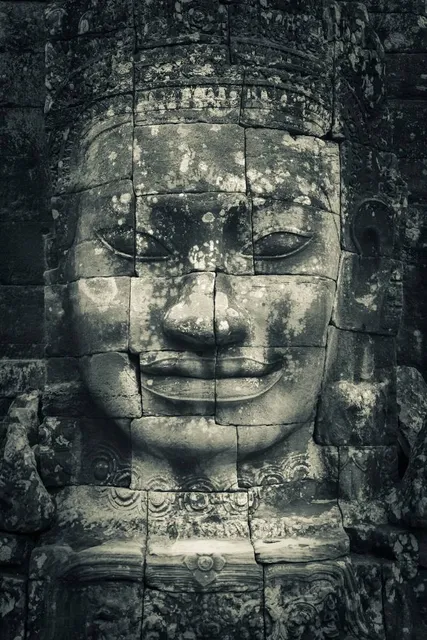
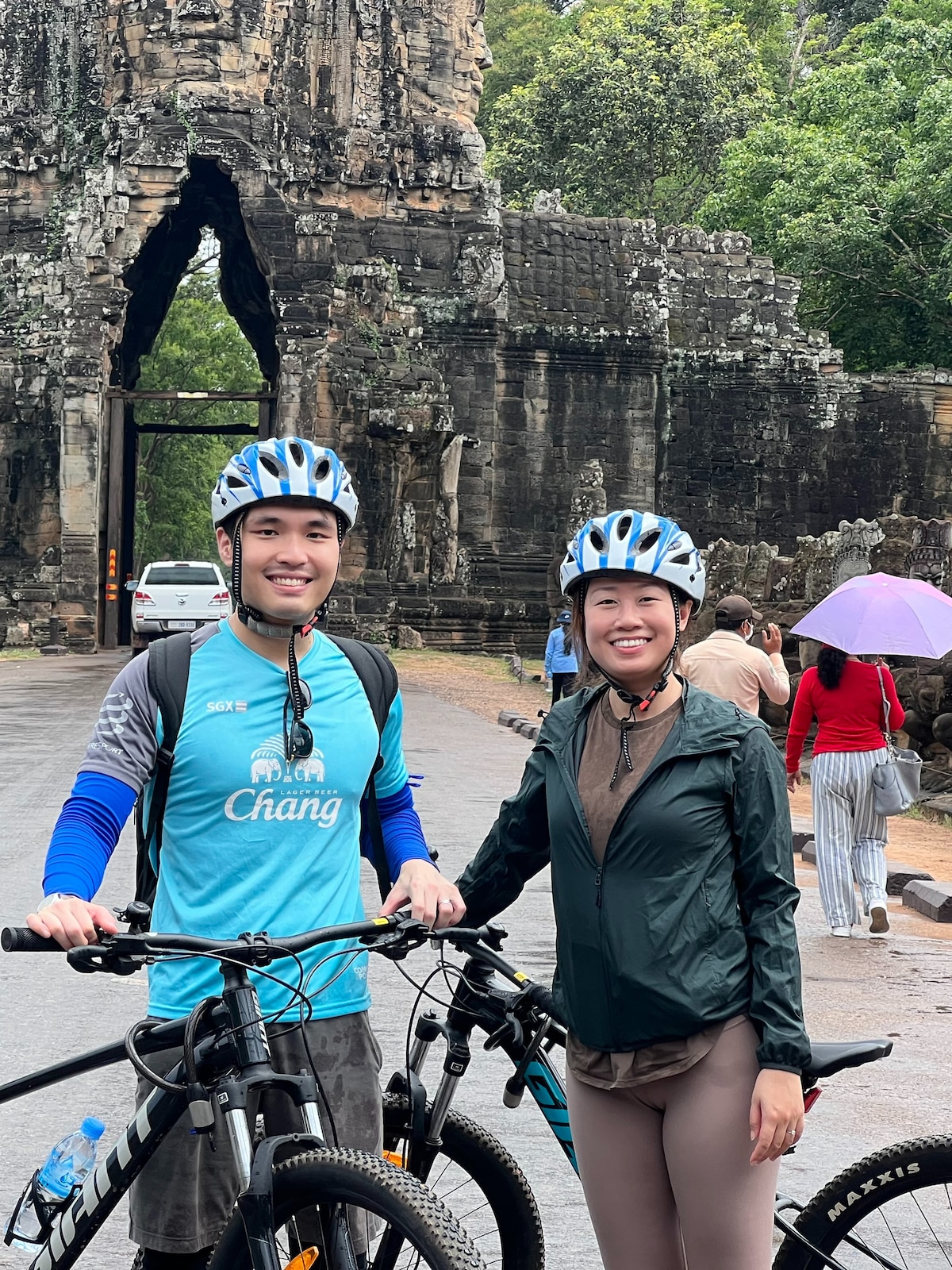
Read moreThe gate, the balustrade, the asuras and the devas on a single frame against a sunny midday just took my breath away. Angkor wat is at the pinnacle, but Angkor Thom is no less either. I have enjoyed the temples here the most. You just cannot, cannot miss Angkor Thom. After visiting "Angkor Wat", the old gate of "Tonle Om" - commonly known as the "South Gate" - will be ahead of you. It is the most famous entry gate to the royal capital city of "Angkor Thom"! Approaching Angkor Thom, you are first met by the grand causeway that crosses the 100 m wide moat which is flanked on either side by a naga balustrade beginning with a massive stone carving of a seven-headed Naga (mythical serpent) being held by a multi-armed and multi-headed giant. On each side, there are 54 stone giants pulling on the body of the Naga serpent. On one side, the giants represent Devas, on the other side are Asuras, together representing an endless tug of war between good and evil. Based upon Hindu mythology, the scene represents the "Churning of the Ocean of Milk". Gods vs. demons on opposing sides of the bridge each hold onto a lengthy serpent in a tug-of-war, fighting for immortality. A sandstone tower rises 23 meters high and is crowned with four heads, one facing each cardinal direction. The lower half of each head is modeled like an elephant with three heads. Their trunks, which serve as pillars, are plucking lotus flowers. The Hindu god Indra sits at the center of the elephant with an Apsara on each side. This gate has been restored to a pretty good condition compared to the other four gates. The South Gate is a memorable entrance into Angkor Thom complex and a spot worth stopping for a few pictures, even if the area may be crowded with other tourists these days. Note, you'll find other city gates that are similar when entering or exiting Angkor Thom from other directions. These include the popular Gate of the Dead to the east of the complex. We asked our Tuk-Tuk driver Sokea to meet us on the other side and walked the entire stretch taking pictures along the way. For our two-day of temple tour we hired a Tuk-Tuk to go around. For this, we used the services of Kakadu & Sokea from "Angkor Wat Tuktuk Day Tour". WhatsApp Number: (+855)...
Read moreBeautiful and the most famous gate facing south side
This is the most visited place,within the anglor archeological park. Standing on the cause way and admiring the beauty of the cause way and the gate is really astonishing. Love 💓 it
Tonle Om Gate, is one of the five ancient gates dated to the 12th century providing access through the 8m high laterite walls of Angkor Thom. The South Gate features the best restored causeway, recreating the awe-inspiring effect that surely must have been one of the original intentions of its ancient master architects. There surely would have been no doubt that you were entering the realm of the gods, as it is today, one of the world’s truly great wonders.
The other gates are the West Gate (Thvear Ta Kev), North Gate (Thvear Ta Nok), Victory Gate (Thvear Chey), and East Gate (Gate of the Dead or Thvear Khnoch).
Approaching Angkor Thom you are first met by the grand causeway that crosses the 100 m wide moat which is flanked on either side by a naga balustrade beginning with a massive stone carving of a seven-headed Naga (mythical serpent) being held by a multi-armed and multi-headed giant. On each side, there are 54 stone giants pulling on the body of the Naga serpent.
On one side, the giants represent Devas featuring slender oval eyes and a casual smile, on the other side, depicting Asuras with round bulging eyes and grimacing faces, together representing an endless tug of war between good and evil, the polar forces generating the dynamism of life itself. Some will also connect it to the ancient myth, Churning of the Sea of Milk, as so famously depicted on the southern gallery wall of Angkor Wat, and go even further to say that Angkor Thom represents a giant mandala with the Bayon at its center, representing the famed Mount Meru.
I recommend this place must to see while visiting Cambodia ...
Read more