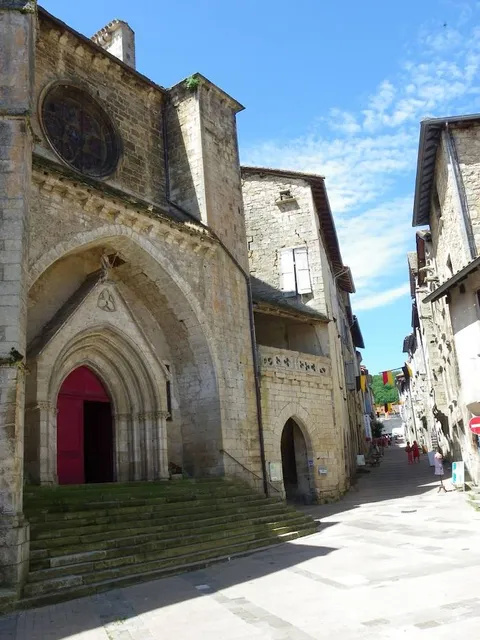
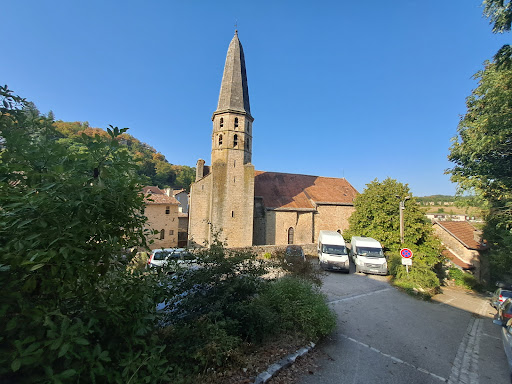
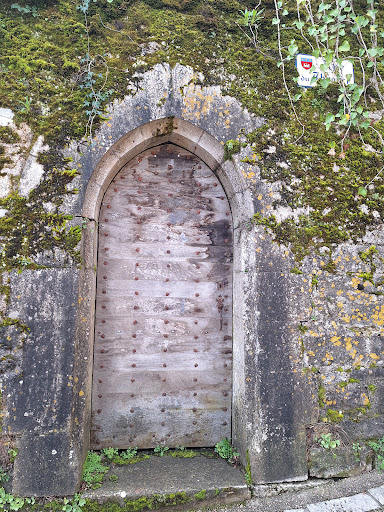
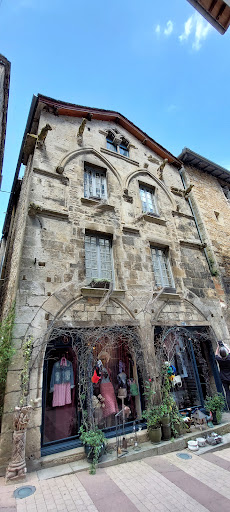
Probably the most unusual feature in Caylus is its least-known: a late 15th century Baby-hatch or Niche, situated directly behind the 13th century church on the avenue du 8 mai, which is the D19 to Saint-Antonin-Noble-Val. Its vulvular mandorla shape may not be coincidental.
Baby hatches used to be common all over Catholic Europe. These "drop-off points" for the disposal of unwanted, usually new-born babies, many (of course) the result of rape.
Many, like this one, involved the 'foundling wheel' (torna-ruota, or ruota degli esposti in Italian), which could be a horizontal wooden and hollow cylinder with a small door on one side, installed so that half remained inside the building and half outside on the road, on the same principle of the revolving plates for depositing and receiving money etc. in banks, etc.
A woman (usually a nun or novice) on the inside, alerted by a baby's cries or the ringing of a bell, would turn the wheel, thus bringing the baby inside while the mother - or other person if, for example, the mother had died from complications of childbirth - could slip or stumble away (usually at night) without being seen by the recipient.
The child was then "passed on", usually becoming the property of the associated or nearby orphanage or foundlings' hospital. Some may, as recently in Ireland, have been simply starved to death and dumped. If not, the Foundling's life was ineluctably 'in the service of God' - i.e. the Church - and we now know how grim that might have been, especially for girls...
The Caylus baby-hatch is now part of a private house, no longer the property of the Catholic Church, and is one of the very few to survive in Europe. Others known to me are in Naples, Montedoro and Florence. For further information, search for 'baby-hatch' on the Web..
Another unremarked rarity is a small, worn late 12th-century capital on the outside of the North (or funeral) door of the 13th century church (in the rue du Portail Obscur,) representing Hell. For artistry and execution it surpasses Zadkine's uncomplicated Christ within the church, but it is fairly weathered.
Pictures of the Baby-hatch and the Hell capital follow this review.
Around the village (which is a mostly late/post-medieval urban strip without a centre) are various small details : small plaques, little masks,of tongue-stickers, sculptures of beasts...which the average visitor does not see and certainly is not pointed towards. The very engaging and moveable modern metal sculptures of animals by 'Belbet on the Ground' are thus the latest of...
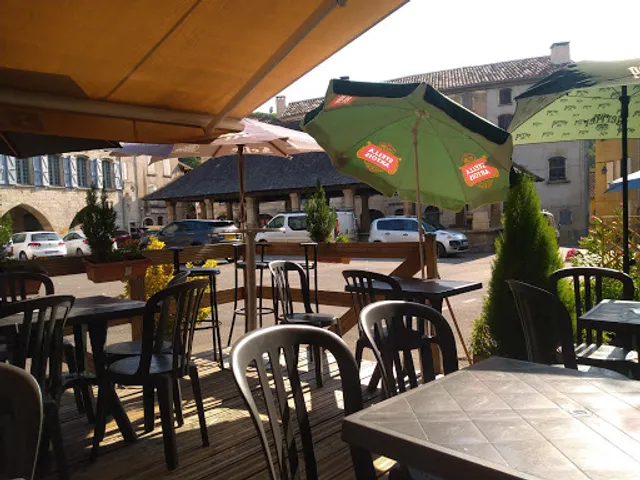
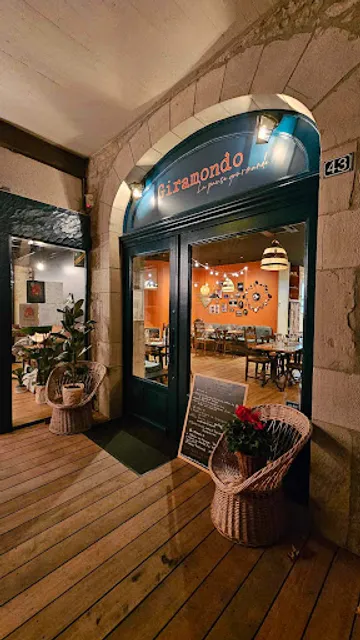
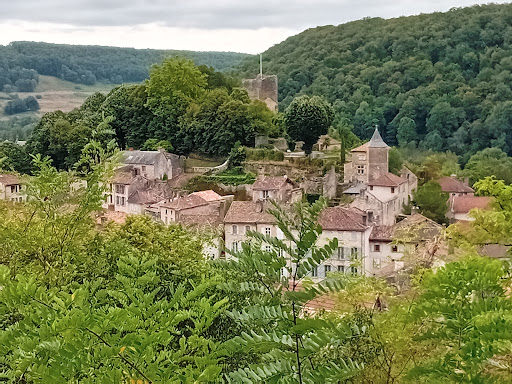
Read moreA stunning little commune with some interesting history. A few good take away Pizza places and a small but sufficient supermarket. There is a bar in the town square that does basic food and drink too. A few other places that serve drinks and coffee. A great wine and beer shop on the hill that has a good regional and national selection. A great baker for croissants, cakes and bread and a great butcher too. There is also a general store that sells everything for DIY from Wheelbarrows to screws. There is a lake where tables and chairs are available and a pull over and stop for campervans etc too. All in all, a nice little place with just about all you need in stunning...
Read moreSmall medieval town that's worth stopping for. Placed on the slopes towards the "la Bonnette" river, it has retained its medieval structure with interlacing tiny streets. The market square offers some nice bar/restaurants with no-nonse, but honest food. Or you can just stroll around and absorb the architecture and the little art-shops .... The castle isn't accessible to the...
Read more