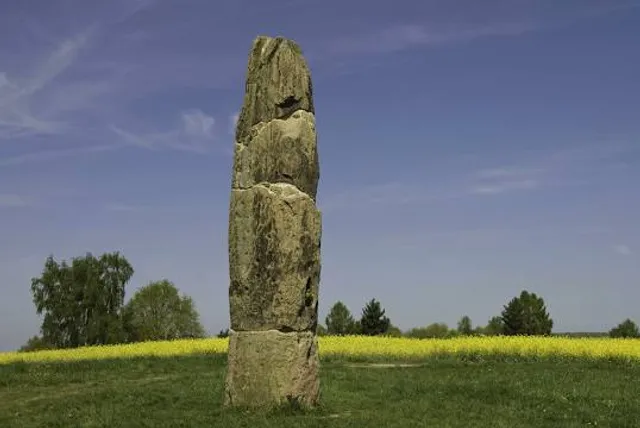
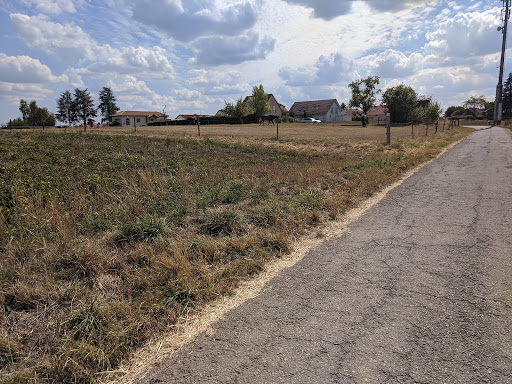
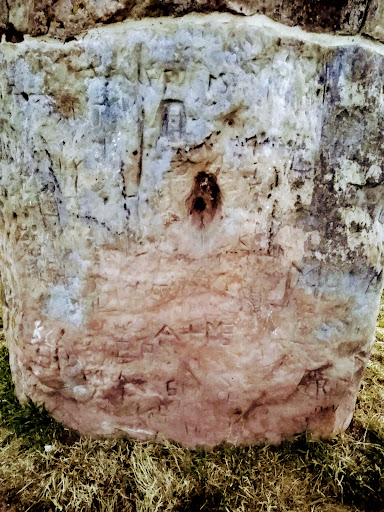
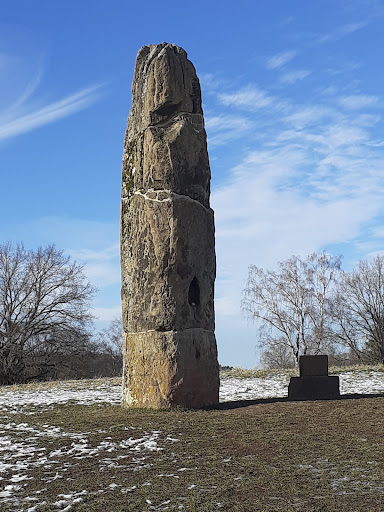
I came here today on a warm August Monday afternoon with my three children ages six, four, and two. Despite an embarrassing amount of time trying to figure out where to park in weeks leading up to our 45 minute trip here, I still wasn’t really sure where I was going to park. I had found two parking lots, one north west of the area but having to cut through the woods to get to it, and one south of it, so I having to walk 20+ minutes on the downtown streets. I ended up choosing to follow the signs for the monument, which amazingly enough was only Half a kilometer from the monument via paved walking path. There was no Google maps location established for the parking lot, so I did that today, nor was there any information on where to park on the district website. anyway, it is quite easy to get to following signs, but I will post a Photo of my pin in case he site doesn’t get added on Google Maps. There is room for 10 to 20 cars by my guess, and the road is very quiet, as it is at the end of the residential area and leading only two walking paths. There is a sign with information about the monument at this parking lot, not at the monument itself. There are clear signs pointing to the direction of the monument, and it took us about 10 minutes to get there looking at my two year old pace. Probably a five minute walk or less for an adult without children. The entire walk is very sunny with no shade other than a small patch in the shadow of the monument itself. We did not bring a stroller, as I had a baby carrier with me but my kids were able to walk with no problem given the even, flat path and short distance, but a stroller would have been completely fine on this portion of the trail. Not sure if it becomes gravel or any point. There is a single bench And a garbage receptacle near the monument, no picnic benches. It was very quiet there. We were there for a little over 30 minutes and only saw two other sightseers, a few bicyclist did zoom by on their travels. The monument itself is quite tall and impressive, with a couple of clearly defined carving carvings, no not in the shape of any images. It does look as though many people have tried to engrave their names or what not over the years but no graffiti, so there is moss growing at the back of it. Knowing the history of the monument truly makes it a site worth seeing. The entire endeavor took us a little over an hour The entire endeavor took us a little over an hour, but I am sure without small children it can be done in 30 minutes or less food in the walk and good few minutes looking at and appreciating it. I personally would not recommend bringing a snap given the proximity to parking and the summer sun, so I’m sure in the fall or winter it might even be enjoyable. The trails seem to continue on, so I imagine there’s plenty more to see if you choose to make a day‘a hike out of this. Overall, this is a great piece of history that is easy to get to and not hard for kids, though not particularly appealing for them either as there isn't much for them...
Read moreThe Gollenstein is an impressive monument shrouded in mystery from an era lost in time. The 7 m high Menhir is the landmark of Blieskastel. It is the largest of its kind in Central Europe and at the age of about 4,000 years or more it is one of the oldest cultural monuments of Germany.
The destination Menhir might be misleading, as it is the Celtic term for long stone. However, this stone had been set on top of the hill at least 1000 years before the Celts started to settle in the area.
The scenery is beautiful and at sunset one can fathom the touch of a...
Read moreDer Stein besteht aus einem hellen Sandstein und wurde wahrscheinlich am Ende der Jungsteinzeit (ca. 2000 v. Chr.) errichtet. Er wird mit einem prähistorischen Ahnenkult in Verbindung gebracht. Fast 4000 Jahre blieb der Gollenstein unversehrt, doch nach Beginn des Zweiten Weltkrieges befürchteten Offiziere der Wehrmacht, er könnte aufgrund seiner exponierten Stellung in der Landschaft als „Richtpunkt für die französische Artillerie“ dienen. Daraufhin legten Pioniere den Gollenstein im Jahre 1939 nieder. Die Soldaten richteten dafür eine mit Stroh gefüllte Grube her, die jedoch zu kurz berechnet war. Beim Umlegen riss das Seil, so dass der Stein stürzte, dabei auf der Kante der zu kurzen Grube aufschlug und in vier große und einige kleine Teile zerbrach. Auf Betreiben des Bürgermeisters Alfons Dawo wurden im November 1951 die Teile mit Beton – wegen der breiten Fugen nicht ganz fachmännisch – wieder zusammengesetzt und der Gollenstein erneut aufgerichtet. Experten schätzen, dass die Nische mit dem Kreuz wahrscheinlich erst 1809 eingemeißelt wurde und christliche Kultgegenstände (Kreuze, kleine Heiligenfiguren, Kerzen) hierin Platz fanden. Der heidnische Stein bekam so eine christliche Bedeutung. Unter der Nische sind Fragmente einer menschlichen Figur reliefartig eingehauen. Zwei Beine mit Füßen, Teile des Rumpfes, der Kopf und ein Arm mit Hand sollen eine vorgeschichtliche Götterfigur darstellen, die an den keltischen Wettergott Taranis erinnert. Im Jahre 2002 wurde der Gollenstein komplett eingerüstet und...
Read more