To fully understand the museum/Bauhaus, a look at its syllabus (Bauhaus 1919-1933) will explain much of the displays/artifacts and the different stages of collaboration and design. Together, they showcase the many efforts/leaders, distinct avant-garde lineage and versatility of its artists. From here, connect the dots from your childhood memory/exposure through the years from architectual, interior design, typography, furniture, etc. To fully appreciate such concepts true today you will find many reference points, such as Marcel Breuer's (Bauhaus' most talented furniture designer) Wassily chair, Mies van der Rohe (third and last director of Bauhaus)/Lilly Reich iconic Barcelona chair and associated designs to include Tugendhat Villa architecture/furniture. Additional references: Brno chair, Cesca chair, Gropius armchair, LC3 armchair,Eileen Gray end-table, LC4 Chaise Lounge, Bibendum armchair, Thonet b9 chair, S 285 Marcel Breuer, Wilhelm Wagenfeld lamp, Isokon Chair, to name a few.
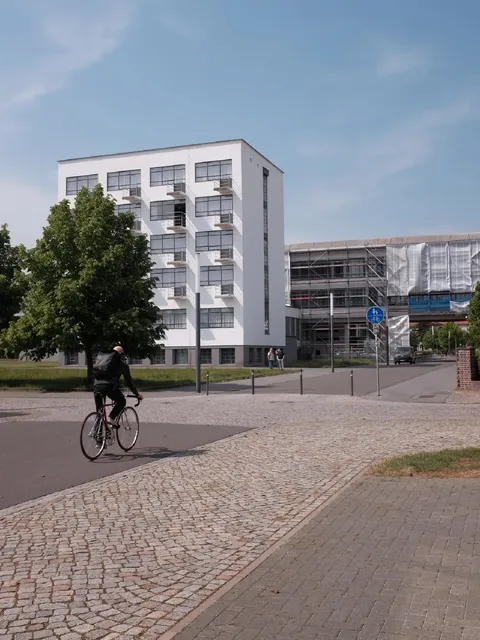
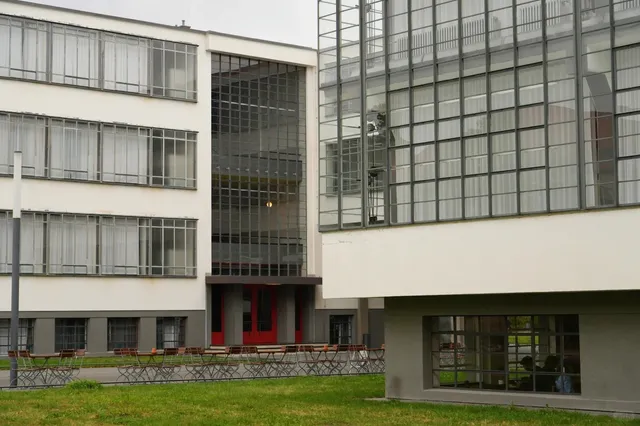
Frame your mindset as you approach the museum, imagine secular events 1919-1933, with that, it will be challenging to find a better example. After the closure of Dessau Bauhaus, all the talented students, instructors, etc. migrated, influencing the arts/design across the globe. Bauhaus founder Walter Gropius migrated to Boston Mass and continued as a professor at Harvard University graduate studies of design. Harvard carries the largest collection of Bauhaus artifacts outside of Germany. Todays Bauhaus museum exterior, a very dramatic/extrapolated design of the original Bauhaus School curtain wall by Gropius. Laszlo Maholy-Nagy, a Bauhaus professor advocated integration of technology and industry into the arts. Most notably was his inspiration behind the new typography. He would eventually migrate to Chicago, IL as director of the New Bauhaus School. Albert Einstein was a member of Bauhaus Dessau, Gropius' cultural policy lobby called, 'Society of Friends of the Bauhaus' which provided intellectual and moral support.
Steve Jobs (Apple) in 1981, attended his first conference at the Aspen Institute where Austrian artist and architect Herbert Bayer in the 1940s and ’50s, then the last surviving Bauhaus master showcased distilled, sleek design concepts. Today, Steve Job's product legacy designs were influenced by the "less is more", the slim designs many carry on our person, i.e. iPhone, laptops, mp3, etc. You can see the lineage influence as the early lcell phone.
The 1961 Neue Klasse BMW 1500 was the Bauhaus-on-wheels and established a BMW design language that was to last for 40 years. The Bauhaus-inspired BMW design language begun by Paul Bracq and developed by Wilhelm Hofmeister.
Mercedes-Benz Gorden Wagener, Head of Design at Daimler AG, "Bauhaus is one of the most influential stylistic movements and has been considered a revolutionary trailblazer in the fields of art, architecture and design. Its simplicity of form and reduction to the essential is also reflected in Mercedes-Benz Design," says Wagener specifying the links to...
Read moreThe Bauhaus Museum Dessau is a fascinating, if paradoxical, experience. It is a must-see for anyone interested in the movement, but it challenges one's expectations from the moment of arrival. The collection itself is nothing short of incredible, offering a comprehensive and deeply impressive look into the history, thought, and work of the Bauhaus school. The inclusion of original sliding plans and elevations is a particularly a standout feature, providing a tangible connection to the creative process of the masters. It is within this collection that the true spirit of Bauhaus lives. However, the architecture of the museum building presents a profound disappointment. From an outsider's point of view, it feels like an antithesis to the very principles it houses. The building is a sterile composition of glass and steel, a modern box that seems to abandon the core tenets of Bauhaus philosophy. For me, Bauhaus is not defined by these industrial materials alone, but by the thoughtful application of proportion and the golden ratio—a design heritage that can be traced back to the ancient temples of Egypt and Greece. This architectural language of harmony and carefully considered space feels entirely absent. The internal journey, however, tells a different, more compelling story, following the five-act structure of a classical drama. The visit begins with an introduction, a gentle and informative entry into the world of Bauhaus. The collection then builds, escalating into a rising action as you delve deeper into the works. The climax arrives as you encounter the core of the exhibition, a moment of profound revelation. It is this curated narrative, rather than the building's shell, that delivers the true essence of the Bauhaus legacy. Ultimately, while the architecture misses the mark, the Bauhaus Museum Dessau is a powerful experience. Its collection is a triumph of curatorial work, and the narrative flow it creates within the space is a testament to the enduring ideas of the school. Go for the art, and be prepared to be both impressed and provoked by the building that...
Read moreI had been very eager to visit this museum for a long time now and found myself leaving confused and feeling disappointed. The curation of the exhibits leaves much to be desired. To understand the exhibit, you really need to have a foundational understanding of the Bauhaus, architectural movements preceding it, and those following it. Without this, you'll be utterly lost. You will enter not knowing anything, and you will exit not understanding.
There is little context setting to understand: Poor Context Setting: why the Bauhaus was such a radical and pivotal design movement (for those of us who weren't alive and around to witness the 1910's/1920's, providing some context to what design rationale was like prior to the Bauhaus would give a better sense to viewers of why the Bauhaus was considered 'disruptive') What is the context of the Bauhaus in the larger arts/architecture/design movement? I saw one sign casually mention the 'Charter of Athens' - explain this for visitors and its significance. Don't just casually drop significant bombs of information in text without expanding on it. Provide a timeline and map of Bauhaus outputs (e.g. buildings) early on denoting time periods these were built during and provide a narrative to illustrate how design thinking changed. The signs used language/terminology that is not easy for non-architectural/art historians to understand. I would highly recommend testing the wording on lay-people in the future to gauge what they take away from reading the information boards. I would highly recommend providing visitors with information on the key players in the Bauhaus - despite famous within the arts, it's important not to assume that everyone is aware of who Gropius, Klee, etc. are. The main hall has a lot of artifacts in it, but these are not synced up via a cohesive narrative. This leaves visitors lost as they walk through the space and don't know what...
Read more