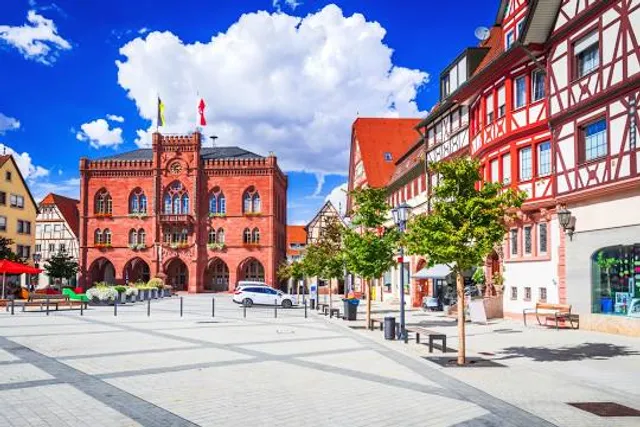
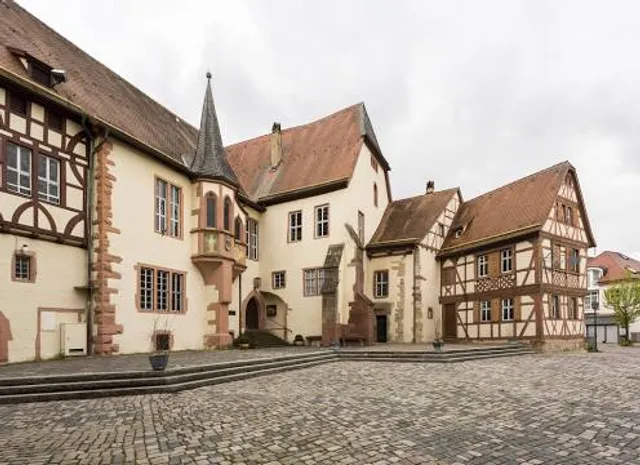
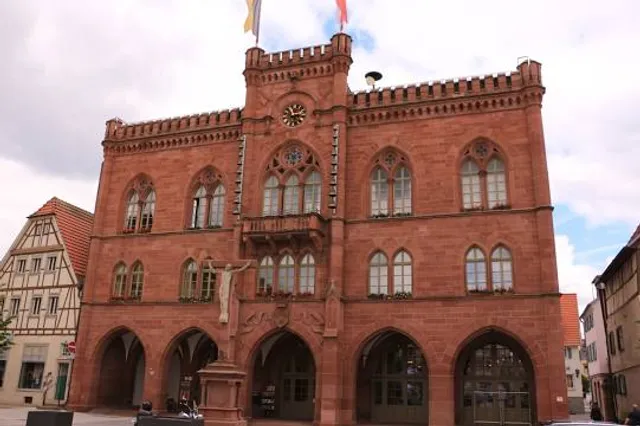
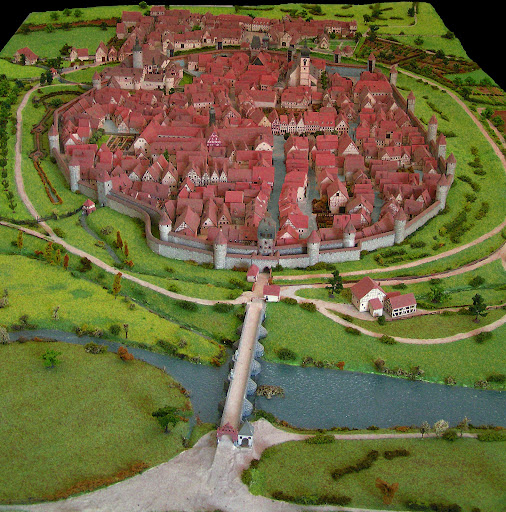
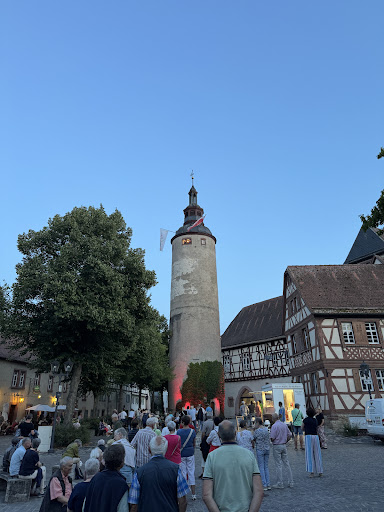
A maquette of 18th century Bischofsheim as shown in the town museum. The historic downtown survived the ravages of time comparably unscathed. Foreground, the Tauber, the stone pillared bridge (wooden planking) still sports a toll bar. Focal points, the market square with the narrow gabled houses (where space was at a premium), the Kurmainzer Schloss (the location of the museum, full title, 'Tauberfränkisches Landschaftmuseum'), the watchtower [Turmstürmer] and the Martinskirche with its Baroque tower cap (sometimes called a 'bonnet'). The spire of the church tower tops the watchtower. The hoisted flags convey a fairground atmosphere. The carousel in the sky.
Castle yard. 'Hans' [dyslexia version 'Hnas'] in his green jerkin stands for spring. Nobody claims that the allegory is quite as sophisticated as something from Botticelli. - A Yamaha parked beside one of the numerous toad ponds near the town wall. Duly flummoxed knight, what kind of prank is this. Where is my white steed.
Bischofsheim (the Tauber prefix was added in the 19th century) belonged for most of its history to Kurmainz (the wheel in its town flag was taken from the flag of the Electorate of Mainz). 'Amtsstadt' status. It was an independent city under the Saufer dynasty. Possible reminders, the white and red fields in the flag. The Staufer were fairly liberal with granting free city status (at least North of the Alps). The clergy was no longer deemed fully reliable.
Personal highlights of the museum visit, the handmade mouse traps in modular, 'multi-barrel' form. Crushed and garroted by the dozens.
One display case is dedicated to wafer making equipment. A childhood déjà-vu. In the same room, votive molds. Not shown, drillholes in ancient stones (for making powders with medical properties).
Tauberbischofsheim may not be as well known as Gettysburg or Königgrätz [Sadowa], but it was the site of a fateful battle (actually a series of engagements) in the summer of 1866 (July 24th to be exact). When the bridges of Bischofsheim and Werbach became chokepoints. A competent commander would have had mined these river crossings. In hindsight, unification is probably like everything else, the advantage goes to the first movers. The lower floor of the museum hosts rifle and field artillery collections. The later are from a different period. The field guns of Württemberg in 1866 were breechloading affairs (wedge lock) with rifled barrels and adjustable elevation, crank operated. It even sported a pair of trundle seats for footsore crews. One of these is still showcased on the ramparts of the Asperg. Contemporary lithographic renderings of the events are also on display (from predictable perspective - the side commanded by Freiherr von Manteuffel did win handsomely). Many were first published in 'Daheim', the illustrated journal for the homemaker.
The related war memorial (at the site of a mass grave), was inaugurated by king Karl of Württemberg in person at the first anniversary of the battle. It is located in a small green zone in the Albert-Schweitzer-Strasse (at the junction with the Kapellenstrasse). The names were originally engraved in copper plates according to 'das-wurttemberg-denkmal/Wandern in Tauberfranken'. Visible building material, locally quarried red redstone.
King Karl coped somewhat better with the demotion than his colleague in Bavaria. He spent most of his remaining years in spas in Southern France and left the actual governing in the hands of a capable minister (von Mittnacht by name).
The border post from the Republic of Baden. 1848 or Weimar timeline? Probably the latter. Hecker's geofencing was...
Read moreIm Kurmainzischen Schloss am Schlossplatz in ist das Tauberfränkisches Landschaftsmuseum beheimatet. Die Sammlung des Museum ist umfangreich. Im großen Saal im Obergeschoss kann man sich auch standesamtliche trauen lassen. Diese Lokation bietet einen eleganten Rahmen für eine Hochzeit, befindet sich abseits des Rathauses und wäre für meine eigene Hochzeit die 1. Wahl in Tauberbischofsheim. Im Schlosskeller kann man wunderbar die anschließende Hochzeitsfeier...
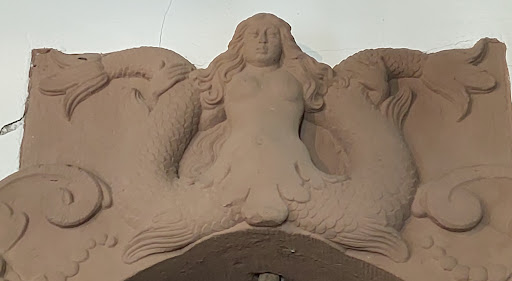
Read moreIm Museum im Schloss ist eine große Melusine zu sehen. Sie zierte den Brunnen am einstmaligen sogenannten Templerhaus. Dies Haus liegt ostwärts, etwas versteckt, hinter der Martinskirche und ist schön renoviert. Die Templer scheinen hier nie gewohnt zu haben, doch die Melusine und auch zwei Kragenfiguren regten Fantasievorstellungen an . Die Melusine ist ein Kosename für die schöpferische Kraft der Brunnen und der Tauber. Die Flüsse wurden in alter Zeit...
Read more