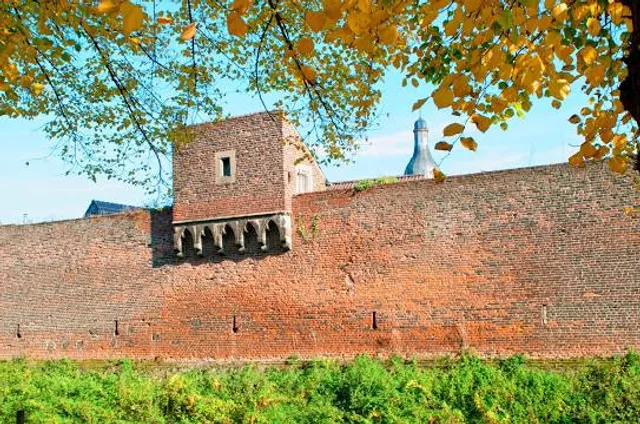
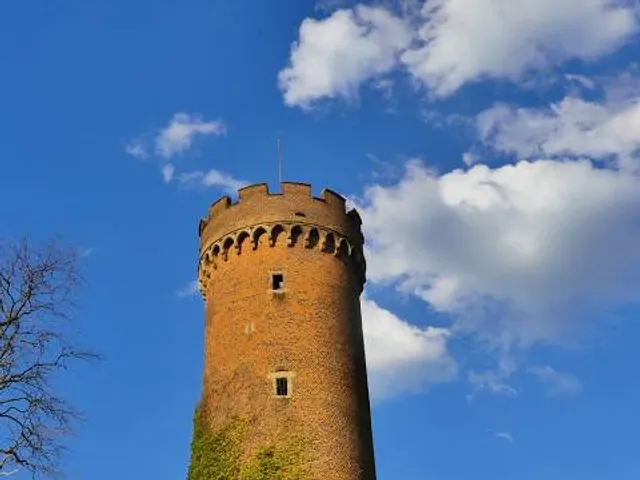
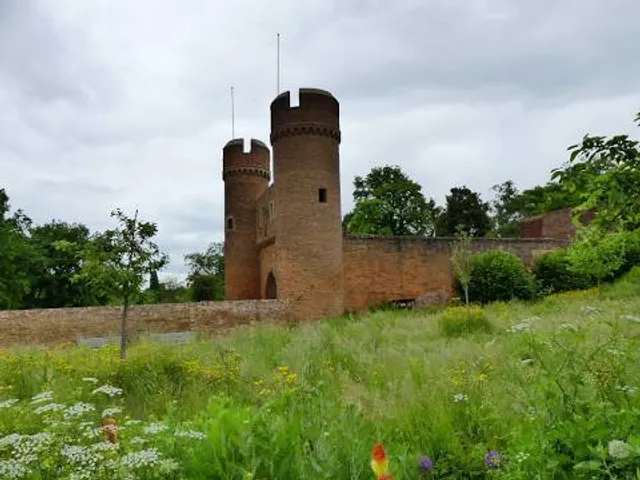
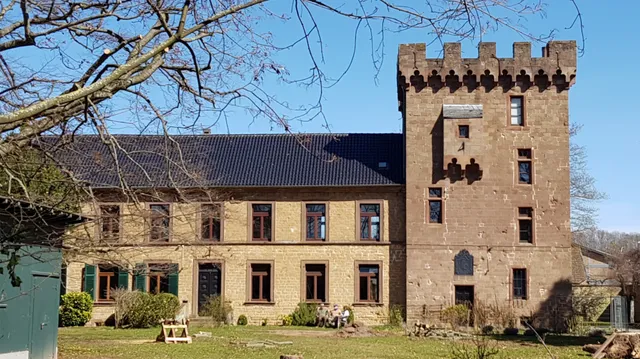
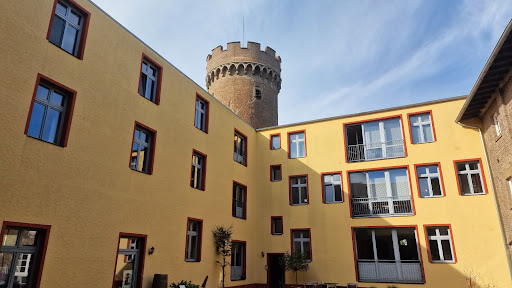
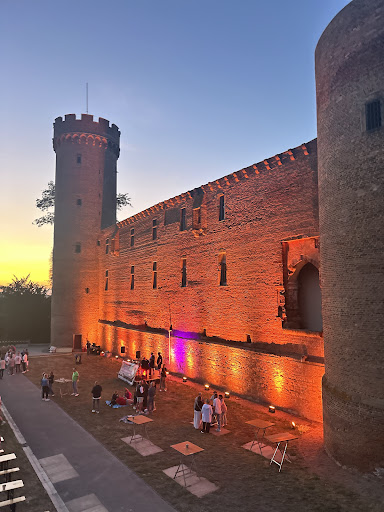
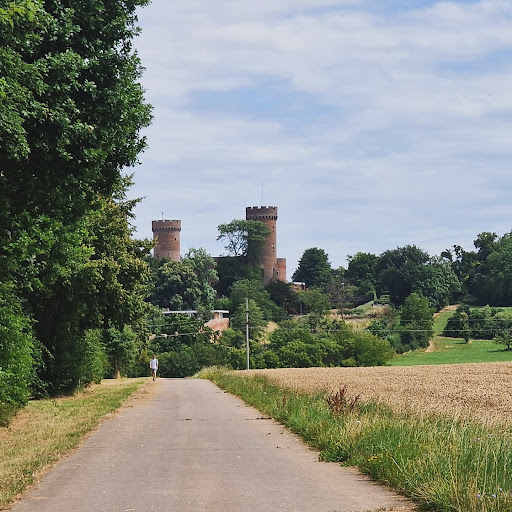
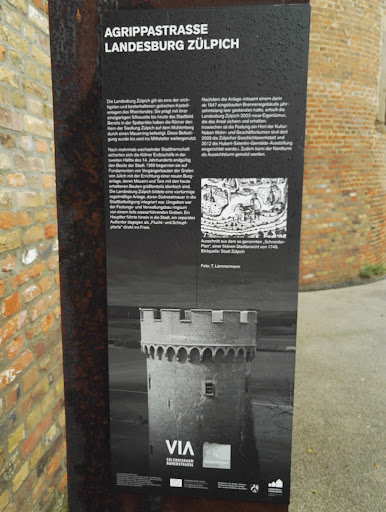
Zülpich Castle is a modest brick building with an almost rectangular plan with high towers at the corners. It is one of the classic quadrangular castles of a type ideal for the Late Middle Ages. Its austere-looking defences are almost entirely devoid of architectural features and underline its fortress-like character which befits its location at the southwestern corner of the medieval town of Zülpich and its incorporation into the town's fortifications. The enclosed quadrangular structure was originally surrounded by a moat up to twelve metres wide.[1] At its southern, western and eastern corners are round towers that were all once four storeys high. The southern one was reduced to two storeys high in the 19th century[2] as it had fallen into disrepair.[3] In the north and at right angles is a square tower measuring 10×10 metres[4] with corner ashlars that is the only survivor of an older castle.[2] Its shape clearly shows that it was given its present appearance in the 17th century.[5] The two full-height round towers are topped by protruding, open fighting platforms with brick battlements. The corbels also use trachyte as a material, while the ogival arched frieze above is made of tuff. All the round corner towers once had residential rooms with fireplaces and garderobes. In the walls (which are up to three metres thick)[6] are spiral staircases. The western tower facing the town also acted as a dungeon.
The four wings were formerly two-storey residential ranges with high basement vaults. Today only the thick outside walls have survived; these served a dual purpose as defensive walls with projecting chemins de ronde. The remaining structure of the present-day wing dates to a later period because the original roofs and interior walls from the 17th century have not survived.[6] The external façade of the southwest wall is divided into regular axes by high, narrow, Gothic rectangular windows with lighter cut stone frames that are only interrupted by two garerobes.
The best preserved exterior wall is on the southeast side with the main gate made from carefully cut bunter sandstone ashlars to which the drawbridge used to lead. Witnesses thereof are a deep blind niche, which frames the ogival arch of the gateway and used to house the drawbridge, and the still visible roller holes for the chains. Above the portal are two angled coats of arms whose details were probably destroyed by French soldiers in 1794.[7] They used to depict the arms of Frederick of Saarwerden and probably the Archbishopric of Cologne.[7]
In addition there is another drawbridge on the southwest side, which gave access to the castle without having to enter the town. For the support buttresses of this bridge, building material from Jülich Palace was used, a building that had stood on the same spot...
Read moreBEATZ AN DER BURG
Man geht mit gewissen Erwartungen zu einer Veranstaltung, die „Beatz an der Burg“ heißt. Zum Beispiel erwartet man Beats. Und eine Burg. Beides war da. Zumindest technisch gesehen.
Die Burg Zülpich – immer wieder ein schöner Anblick. Eine dieser Locations, bei der man sich fragt, ob sie sich angesichts mancher Veranstaltungen nicht leise in den Burggraben werfen möchte. Und dann war da: DJ Paytrick. Und hier muss man klar sagen: Der Mann hat’s drauf. Coole Musikauswahl, keine Charts von vorgestern, sondern wirklich ein gelungener Mix, der von Afro Beats über House bis zu smoothen Club-Sounds reichte – mit Stil, mit Ohr und offenbar mit mehr Gespür für Timing als die komplette Organisation der Veranstaltung.
Denn jetzt kommt das große ABER: Die Musikanlage. Es war, als hätte jemand eine Bluetooth-Box aus der Grabbelkiste von Aldi auf halbe Lautstärke gestellt und gehofft, dass sich der Bass irgendwie von allein dazudichtet. DJ Paytrick hat tapfer dagegen aufgelegt, als wolle er beweisen, dass man mit Leidenschaft und Können selbst aus einer müden PA noch Atmosphäre herausquetschen kann. Und das hat er auch. Nur leider kam das bei vielen Gästen nicht mehr an als ein entferntes Wummern – irgendwo zwischen „Kellerparty bei Oma“ und „Frequenzstörung in der Radiowerbung“.
Und dann war da noch das Thema: Eintritt. Auch für Kinder. FÜNF Euro. Für Kinder, die… ja was eigentlich dort tun sollen? Es gab nichts für sie. Kein Spielangebot, kein Kinderprogramm, nicht mal ein trauriges Maskottchen auf Nikotinentzug. Aber fünf Euro durften sie trotzdem zahlen – quasi als Spende an die Leere.
Die Getränkepreise waren ambitioniert, um es vorsichtig zu sagen. Man hätte für weniger Geld auch eine ganze Woche in der Eifel campen und sich dabei selbst mit Quellwasser versorgen können. Und irgendwie blieb der ganze Abend in einer merkwürdigen Schwebe: tolle Location, engagierter DJ – aber eben eingebettet in ein Konzept, das keins war.
Fazit: DJ Paytrick war der musikalische Lichtblick in einem sonst recht faden Event. Wer nur für ihn gekommen ist, wurde zumindest musikalisch nicht enttäuscht – sofern er nah genug an der Box stand. Alle anderen bekamen: eine Burg, keine Stimmung und ein Eintrittsmodell, das vermutlich von einem gelangweilten Excel-Sheet ausgewürfelt wurde.
🌟🌟 Zwei von fünf Sternen – beide für DJ Paytrick. Die Burg ist eh...
Read moreDie #Burg #Zülpich wird auch kölnische Landesburg genannt, Wahrzeichen der Stadt. Die heutige Burg wurde auf einem ehemaligen #römischen Kastell errichtet. Sie beherbergt jetzt unter anderem die Zülpicher Geschichtswerkstatt, ein Heimatkundemuseum. Hier findet man die Hubert Salentin Gemäldeausstellung und die Skulpturensammlung von Franz Kött. Das Museum hat Samstag und Sonntag nachmittags bis 17 Uhr geöffnet. Auch alte Schriften können bewundert werden. Die Burg an sich, ist bereits durch seine Türme weithin sichtbar und sehenswert. Im Südwesten wurde ein schöner Park angelegt. Auch ein Abenteuerspielplatz ist für Kinder 👶 vorhanden. Gegenüber des Burgeingangs befindet sich die Katholische Kirche Sankt Peter deren gotische Schnitzaltäre flandrischer Herkunft und romanische Krypta durchaus einen Besuch lohnend machen. Krönender Abschluss bildet das Museum römische Badethermen hinter der Kirche Sankt Peter. Besterhaltene römische Badetherme jenseits der nördlichen Alpen. 1930 bereits entdeckt und 2008 kunstvoll als Museum überbaut. Geschichte pur. Teile der Stadtmauer und die Stadttore lohnen ebenfalls besichtigt zu werden. Das Kölntor im Osten der Stadt diente bereits zur Römerzeit vermutlich als Durchfahrtstor. Durch sie führte die Römerstrasse von Köln nach Trier. Der Straßenname ist heute noch ein Zeugnis...
Read more