🏞️ UNESCO Heritage & Historical Significance
Champaner–Pavagadh Archaeological Park is a vast 1,329-hectare landscape that preserves nearly two millennia of history—from Chalcolithic settlements to a 16th-century Sultanate capital. It's the only fully intact Islamic pre‑Mughal city in existence today.
Pavagadh Hill, reaching about 800 m above the plains, served as an ancient Hindu fortress and today hosts the sacred Kalika Mata Temple, drawing pilgrims year-round.
🕌 Architecture & Key Monuments
Jami Masjid (Jama Masjid)
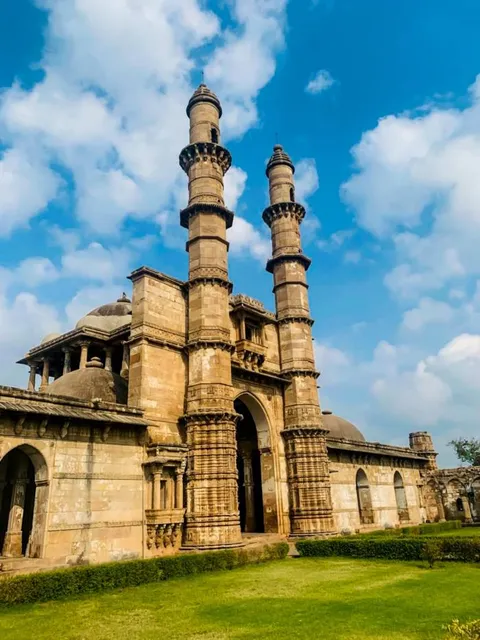
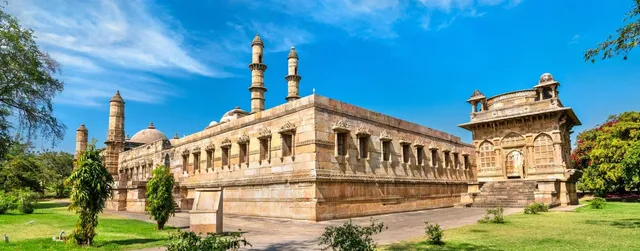
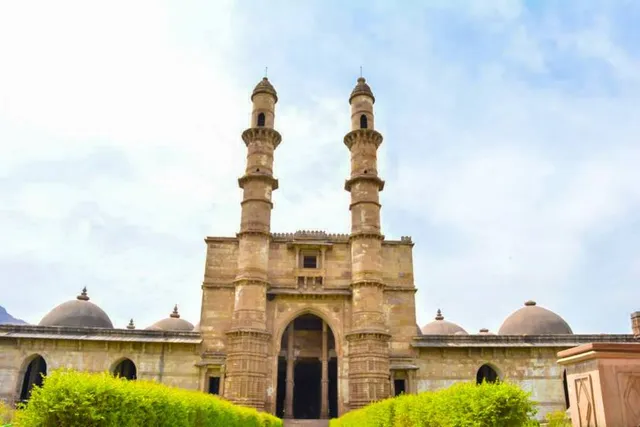
Built under Sultan Mahmud Begada (completed ~1513), this grand mosque is a prime example of Indo-Islamic architecture.
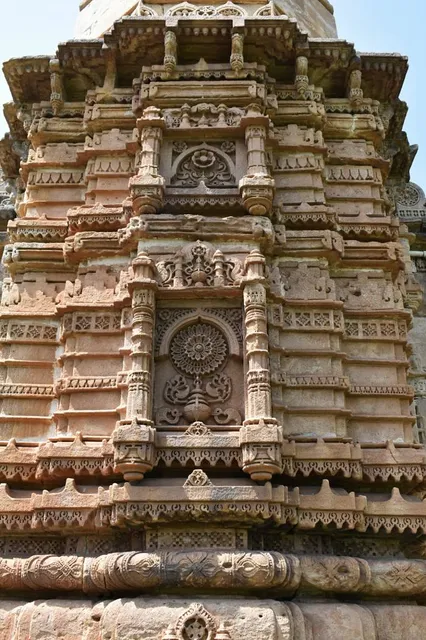
Boasts two 30 m minarets, 172 pillars, seven mihrabs, multiple domes, and intricate carvings blending Hindu and Islamic motifs.
Other Notable Mosques
Saher ki Masjid (Bohrani) – Former royal mosque with elegant arches and garden setting.
Kevada Mosque – Five domes and twin minarets with nature-inspired carvings.
Nagina Mosque – ‘Jewel Mosque’ in white stone, exquisite geometric latticework.
Lila Gumbaj Ki Masjid – Elevated platform with a fluted central dome.
Pre-Medieval Heritage
The Lakulisa Temple (10th–11th century) on Pavagadh Hill is one of the oldest, showcasing Nagara-style sculpture and Shaiva iconography.
Jain temples (13th–14th century) dedicated to Suparshwanath, Chandraprabha, and Parshwanath also dot the hilltop complex.
A total of 114 monuments are listed by the Baroda Heritage Trust, with 39 maintained by ASI.
🧗 Visiting Info & Experience
Champaner town lies at the foot of Pavagadh and showcases remains of its short-lived 15th-century sultanate rule, fortified walls, palace ruins, stepwells, and water systems.
Pavagadh Hill ascent is accessible via walking trails and a ropeway leading to the Kalika Mata Temple. The climb offers scenic views and ancient fort gates (Atak, Moti, Budhiya, etc.).
Best time to visit: Early daylight hours or late afternoon; especially lively during Navratri when tens of thousands visit the hill shrine.
⭐ Why It Matters
Unique Historical Testimony – Offers both Hindu and early Sultanate heritage in astonishing original form.
Architectural Excellence – The Jami Masjid and other monuments blend Hindu craftsmanship with Islamic aesthetics.
Continued Living Culture – The Kalika Mata Temple atop Pavagadh is a vibrant pilgrimage site today.
✅ Suggested Google Review
⭐⭐⭐⭐⭐
Champaner–Pavagadh Archaeological Park is a breathtaking UNESCO site in Gujarat that seamlessly merges prehistoric settlements, medieval temples, forts and monuments. From the tranquil Champaner town to the awe-inspiring Jami Masjid with its intricate carvings and elegant pillars, and up to the sacred Kalika Mata Temple on Pavagadh Hill—it’s a journey through multiple layers of faith and history.
Highlights: • Well-preserved Indo-Islamic mosques (Jami, Nagina, Kevada, Saher ki Masjid) • Ancient Hindu and Jain temples on Pavagadh Hill • Cable car access and scenic hiking trails bound to cultural gates • Ideal for history lovers, religious pilgrims, architecture buffs, and casual tourists • Particularly animated during Navratri, yet peaceful at other times
A sublime heritage destination that captures Gujarat’s layered past. Truly...
Read moreChampaner-Pavagadh Archaeological Park, a UNESCO World Heritage Site, is located inPanchmahal district in Gujarat, India. It is located around the historical city ofChampaner, a city which was built by SultanMahmud Begada of Gujarat. The heritage site is studded with forts with bastions starting from the hills of Pavagadh, and extending into the city of Champaner. The park's landscape includes archaeological, historic and living cultural heritage monuments such aschalcolithic sites, a hill fortress of an earlyHindu capital, and remains of the 16th-century capital of the state of Gujarat. There are palaces, entrance gates and arches, mosques, tombs and temples, residential complexes, agricultural structures and water installations such as stepwells and tanks, dating from the 8th to the 14th centuries. The Kalika Mata Temple, located on top of the 800 metres (2,600 ft) high Pavagadh Hill, is an importantHindu shrine in the region, attracting large numbers of pilgrims throughout the year The transition between Hindu and Muslimculture and architecture in the late 15th to early 16th century is documented in the park, particularly the early Islamic and pre-Mughalcity that has remained without any change.[4]It was inscribed by UNESCO as a World Heritage Site in 2004.
Early history
Judging by early archaeological remains and according to records, the area had already been inhabited in the chalcolithic period; however, it remained neglected until approximately 400 AD. The history also reports a local legend that the divinity of the hills was derived from the right toe of the goddess Kalika, which had apparently fallen on the hill.[2]
The name Champaner is derived fromChampa, who was either a Vania or a Kanbi. He established this city during the rule ofVanraj Chavda of Anhilwad Patan (from 746 to 806 AD). In the eleventh century, Ram Gaur Tuar ruled, and Champaner was under the Anhilwad until 1297 or so when they were defeated by Alauddin Khalji, who made it their stronghold. During this period, the Chauhan Gurjars had also settled in Champaner. The Pavagadh Hill was where the Solanki kings and Khichi Chauhans built fortresses and ruled from. However, they lost their authority in Champaner in 1484. The Gurjars ruled on the northeastern side of the foothills of Pavgarh Hill below the fortress of Pavgadh. In 1418 and in about 1450, they managed to fight off their neighbour, Rao of Idar, and the Muslim rulers of Ahmedabad, thanks to the protection provided by the hill. However, in 1483, when Mahmud Begada’s captain, Malik Asad, was raiding through Champaner, he was attacked and killed by Raval Jaisingh. What ensued in the following years was the complete defeat of the Rajputs by Sultan Begada. The hill was surrounded and the fort held under siege for more than a year and was finally captured on 17 November 1484, when Kivamul Mulk and Malik Ayaz Sultani penetrated the walls and broke the main gate, destroyed the army and injured the leaders of the Gurjars. Raval Jaisingh was wounded and for six months was given amnesty but was then killed since he refused to...
Read moreAt a distance of 49 km from Vadodara, Champaner-Pavagadh Archaeological Park is a UNESCO World Heritage Site, located in the ancient city of Champaner. It is one of the popular places of heritage in Gujarat, and among the prime places to visit as part of Vadodara.
Covering over an area of 1,329 hectares, Champaner - Pavagadh Archeological Park is located around the historical city of Champaner, founded by the Rajput King Vanraj Chavda in the 8th century. Due to its strategic point on the trade routes, it lured many invaders including Khalji Dynasty, Chauhan Gurjars, Solanki kings, Khichi Chauhans. Later Mahmud Begada captured the city in 1484 and rebuilt Champaner into a splendid new capital. The region faced major devastation in 1535 CE when looted by Mughal Emperor, Humayun who made Ahmedabad the capital city again to control Gujarat. This marked the start of the decline of Champaner, which slowly fell into ruins. Later, ASI had rediscovered the city with 39 standing monuments that are a beautiful confluence of Hindu, Jain, and Islamic architectural styles.
Among the prominent heritage sites near Ahmedabad, it was inscribed by UNESCO as a World Heritage Site in 2004. The heritage site is studded with prehistoric (chalcolithic) sites, a hill fortress of the early Hindu capital, and remains of the 16th-century capital of the state of Gujarat. The site also includes other vestiges, fortifications, palaces, Jain and Hindu temples, mosques, residential precincts, agricultural structures, and water installations such as step wells and tanks dating from the 8th to the 14th centuries. The transition between Hindu and Muslim culture and architecture in the late 15th to early 16th century is documented in the park, particularly the early Islamic and pre-Mughal city that has remained without any change.
Every corner of Champaner-Pavagadh Archeological Park is worth exploring as it is one of the must-visit Vadodara. There are generally eleven types of monuments at Champaner-Pavagadh and these buildings are situated on the plains of Champaner and on the hills of Pavagadh. Jami Masjid, Sahar ki Masjid, Kalika Mata Temple, Tomb of Sikander Shah, Ek Minar ki Masjid, Kevada Masjid, Helical stepped well, Mandvi or Custom House, Nagina Masjid, Pavagadh Hill, and Citadel Walls are the prominent structures inside the park. Currently, all these historical monuments are under the care of the Archaeological Survey of India. The Kalika Mata Temple, located on top of the 800 m high Pavagadh Hill, is an important Hindu shrine in the region, attracting large numbers of pilgrims...
Read more