HTML SitemapExplore
logo
Find Things to DoFind The Best Restaurants

Jami Masjid, Champaner — Attraction in Gujarat

Name
Jami Masjid, Champaner
Description
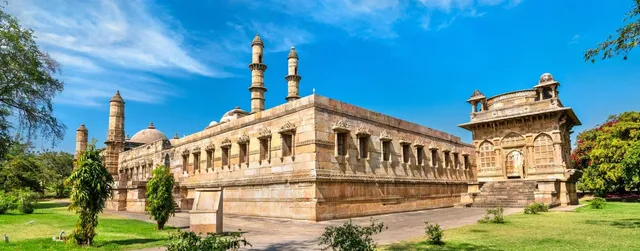
Jami Masjid in Champaner, Gujarat state, western India, is part of the Champaner-Pavagadh Archaeological Park, a UNESCO World Heritage Site, and is among the 114 monuments there which are listed by the Baroda Heritage Trust. It is located about 150 feet east of the city walls, near the east gate.
Nearby attractions
The Champaner-Pavagadh Archaeological Park
Champaner, Gujarat 389360, India
Kevada Masjid مسجد
FGQM+PCF, Champaner, Gujarat 389360, India
Nearby restaurants
Chapaner
FGPP+2Q6, Champaner, Gujarat 389360, India
Harsiddhi Nasta House
Shop No 5, Pavagadh, Halol - Pavagadh Rd, Champaner, Gujarat 389360, India
Shiv Shakti Hotel
Shiv Shakti Hotel, near bus stop, Champaner, Gujarat 389360, India
Ravechi restaurant and cold drinks
bus station, next to Pavagadh, Pavagadh, Champaner, Gujarat 389360, India
SHIV PUNJABI CORNER
Pavagad Bas Stand, Halol - Vadodara Rd, Gujarat 389360, India
Vijay Laxmi Paubhaji
FGMM+44Q, Champaner Pavagadh, Vadodara, Gujarat 389360, India
Jay Ranchhodray Bhojanalay
FGJM+M5X, Pavagadh Bus Stand, Pavagadh Rd, Vadodara, Gujarat 389360, India
Nearby hotels
Harsiddhi niwas dharmshala
Jepura rod Champaner-Pavagadh Archaeological Park ni bajuma, Champaner, Gujarat 389360, India
Related posts
Keywords
Jami Masjid, Champaner tourism.Jami Masjid, Champaner hotels.Jami Masjid, Champaner bed and breakfast. flights to Jami Masjid, Champaner.Jami Masjid, Champaner attractions.Jami Masjid, Champaner restaurants.Jami Masjid, Champaner travel.Jami Masjid, Champaner travel guide.Jami Masjid, Champaner travel blog.Jami Masjid, Champaner pictures.Jami Masjid, Champaner photos.Jami Masjid, Champaner travel tips.Jami Masjid, Champaner maps.Jami Masjid, Champaner things to do.
Jami Masjid, Champaner things to do, attractions, restaurants, events info and trip planning
Jami Masjid, Champaner
IndiaGujaratJami Masjid, Champaner

Basic Info

Jami Masjid, Champaner

FGPP+8V, Champaner, Gujarat 389360, India
4.4(343)
Open 24 hours
Save
spot

Ratings & Description

Info

Jami Masjid in Champaner, Gujarat state, western India, is part of the Champaner-Pavagadh Archaeological Park, a UNESCO World Heritage Site, and is among the 114 monuments there which are listed by the Baroda Heritage Trust. It is located about 150 feet east of the city walls, near the east gate.

Cultural
Scenic
Family friendly
Accessibility
attractions: The Champaner-Pavagadh Archaeological Park, Kevada Masjid مسجد, restaurants: Chapaner, Harsiddhi Nasta House, Shiv Shakti Hotel, Ravechi restaurant and cold drinks, SHIV PUNJABI CORNER, Vijay Laxmi Paubhaji, Jay Ranchhodray Bhojanalay
logoLearn more insights from Wanderboat AI.

Plan your stay

hotel
Pet-friendly Hotels in Gujarat
Find a cozy hotel nearby and make it a full experience.

hotel
Affordable Hotels in Gujarat
Find a cozy hotel nearby and make it a full experience.

hotel
The Coolest Hotels You Haven't Heard Of (Yet)
Find a cozy hotel nearby and make it a full experience.

hotel
Trending Stays Worth the Hype in Gujarat
Find a cozy hotel nearby and make it a full experience.

Reviews

Nearby attractions of Jami Masjid, Champaner

The Champaner-Pavagadh Archaeological Park

Kevada Masjid مسجد
The Champaner-Pavagadh Archaeological Park

The Champaner-Pavagadh Archaeological Park

4.4

(2.7K)

Open 24 hours
Click for details
Kevada Masjid مسجد

Kevada Masjid مسجد

4.4

(145)

Open 24 hours
Click for details

Nearby restaurants of Jami Masjid, Champaner

Chapaner

Harsiddhi Nasta House

Shiv Shakti Hotel

Ravechi restaurant and cold drinks

SHIV PUNJABI CORNER

Vijay Laxmi Paubhaji

Jay Ranchhodray Bhojanalay

Chapaner

Chapaner

4.0

(5)

Click for details
Harsiddhi Nasta House

Harsiddhi Nasta House

3.2

(4)

Click for details

Shiv Shakti Hotel

Shiv Shakti Hotel

4.1

(41)

Click for details
Ravechi restaurant and cold drinks

Ravechi restaurant and cold drinks

4.4

(6)

Click for details
Get the Appoverlay
Get the AppOne tap to find yournext favorite spots!
Wanderboat LogoWanderboat

Your everyday Al companion for getaway ideas

CompanyAbout Us
InformationAI Trip PlannerSitemap
SocialXInstagramTiktokLinkedin
LegalTerms of ServicePrivacy Policy

Get the app

© 2025 Wanderboat. All rights reserved.
logo

Reviews of Jami Masjid, Champaner

4.4
(343)
avatar
4.0
2y

Jami Masjid, Champaner A UNESCO World Heritage Site “Jami Masjid, also known as Jama Masjid in Champaner, is a part of the Champaner-Pavagadh Archaeological Park. The historical city of Champaner was founded in the 8th century by Vanraj Chavda, the most prominent king of the Chavda Dynasty.

A UNESCO World Heritage Site, it is amongst the 114 monuments the Baroda Heritage Trust listed. The Jami Masjid is located about 150 feet east of the city walls near the eastern gate.

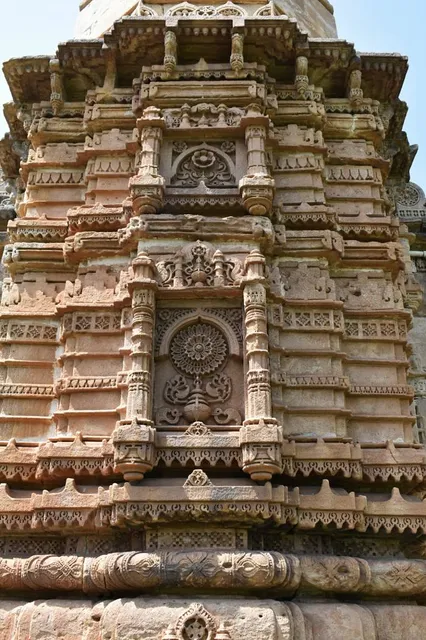
It is considered one of the finest mosques in western India with its elegant interiors. The ornamentation on the facade of mosques and tombs consists of symbols and motifs of the sun, diamond, pots, vines and lotus insignia, which were used in the earlier temples. The craftsman had imbibed their craft from their forefathers, who passed on the knowledge of Hindu, Muslim and Jain motifs.

Mahmud Begarha, born Fath Khan Mahmud (1445-1511), was among the most capable Sultans of Gujarat. In his long and prosperous reign (1458 onward), he expanded the borders of his domains, clashed successfully with the Portuguese, routed Malabar pirates, and established a new capital city at Champaner. Although his achievements laid a firm foundation for future rulers to build upon, his successors were not as capable. A mere 24 years after Mahmud Bergarha's death, the realm was annexed by Humayan of the newly-rising Mughal dynasty and lost any semblance of independence.

In 1484, when the Sultan defeated Chauhan Rajputs and occupied the site of Champaner, all that lay in the future. For the next 23 years, Bergarha spent untold resources rebuilding Champaner as a worthy capital of his domains, renaming it Muhammadabad. To those ends, he established heavily fortified walls enclosing palaces, mosques, gardens, tombs, and military garrisons. Although it was partly intended as a refuge for the Sultan in times of war, the city was not as strong as it appeared. When Humayan, the young emperor of the Mughals, laid siege to the city in 1535, his scouts were able to discover a deserted section of fortifications, allowing his soldiers to enter covertly. His forces then ransacked the city. Following his victory, the surviving population fled into the countryside, abandoning its buildings and surrounding fields. When a British surveying crew entered the ruins of Champaner in 1803, they found only 500 inhabitants in a city built for tens of thousands.

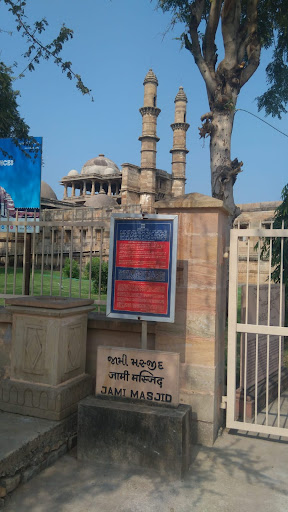
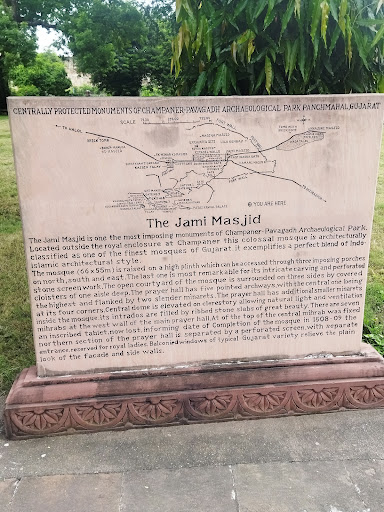
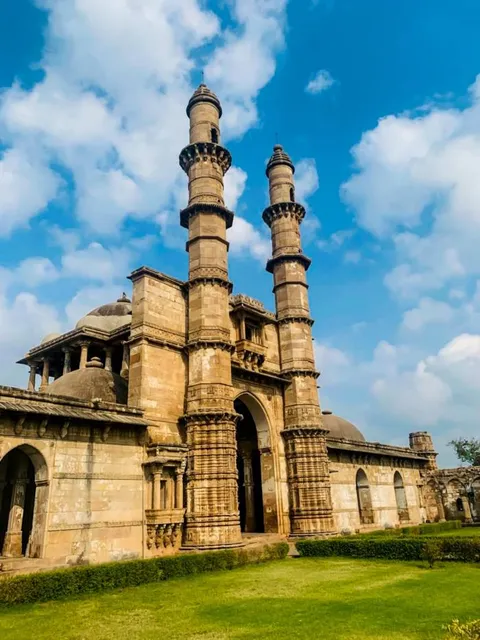
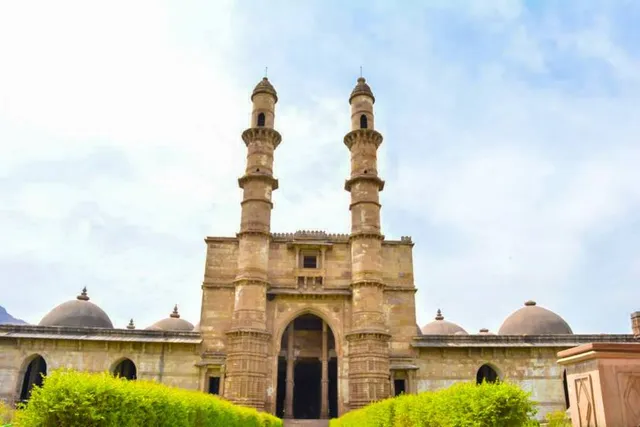
The mosque is located a mere 40 meters inside the city's east gate. It is oriented almost precisely east-west, with the qibla wall canted off-axis slightly to Mecca (although close enough to satisfy liturgical requirements). It comprises a rectangular main building facing a large courtyard surrounded by arcades. The front (east) facade is decorated with twin minarets, 36 meters high, flanking a central iwan with a five-meter wide opening. The octagonal minarets are deeply incised with horizontal moldings and small vertical niches infused with floral patterns. To either side of the minarets are flanking oriel windows supported by S-shaped Hindu-style brackets. The remainder of the building, extending to the north and south, includes two arches on each side, such that the whole ensemble reads as a five-part facade. Finally, anchoring the corners of the monument are cylindrical guldastas (corner turrets) topped by conical roofs.

Inside, the overall floor area measures 66 x 27 meters, about three-quarters the size of its antecedent in Ahmedabad. As is typical of congregational mosques the world over, the vast space is supported by columns, numbering here 176 in all. As the central mihrab can not be seen from all angles within the building (due to the presence of the columns), six additional mihrabs are placed on the qibla wall for the benefit of worshippers, three to each side. Short turrets on the outside of the west wall mark the location of each mihrab from...

   Read more
avatar
5.0
15w

​The Jami Masjid, located in the heart of the UNESCO World Heritage Site of Champaner-Pavagadh Archaeological Park, is a masterpiece of Indo-Islamic architecture. Commissioned by Sultan Mahmud Begada, this colossal mosque was built in the early 16th century and stands as one of Gujarat's most magnificent religious structures. It is a key monument showcasing the architectural grandeur of the Gujarat Sultanate's capital city. ​The mosque's design is a beautiful blend of Islamic architectural principles with local Gujarati styles. The intricate carvings on the facade, pillars, and domes are a sight to behold. A central dome is elevated on a clerestory, allowing for natural light and ventilation. The prayer hall is surrounded by an open courtyard, and the exterior features two towering minarets at the main entrance. ​Inside, the prayer hall is a spectacle of light and shadow, with delicate screens (jali) and intricate details. The main mihrab is particularly noteworthy, a stunning focal point adorned with elaborate, delicate carvings of floral and geometric patterns. The use of perforated stone work creates an ethereal atmosphere, enhancing the spiritual experience of the space. ​The Jami Masjid is a major attraction for tourists, attracting history and architecture lovers from around the world. It provides a profound insight into the region's historical and cultural significance. A visit here is an immersive journey through time, allowing one to appreciate the intricate workmanship and spiritual ambiance of this ancient...

   Read more
avatar
4.0
2y

Jami Masjid, also known as the Great Mosque of Champaner, is a historical mosque located in the city of Champaner in the state of Gujarat, India. Champaner is now a UNESCO World Heritage Site and is known for its rich architectural heritage.

Jami Masjid was built in the late 15th century during the rule of Sultan Mahmud Begada, who was a part of the Gujarat Sultanate. It is considered one of the finest examples of Indo-Islamic architecture. The mosque is constructed using a combination of Islamic and Hindu architectural styles, reflecting the fusion of cultures during that era.

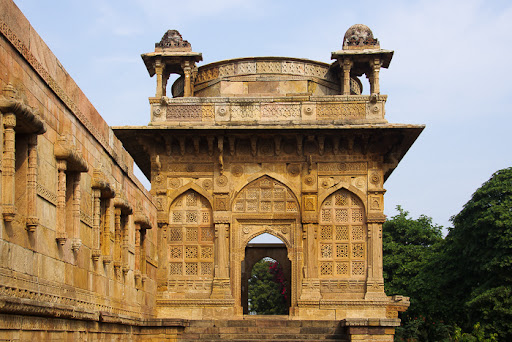
The Jami Masjid is built on a high plinth and has a large courtyard surrounded by a colonnade of domed arcades. The entrance to the mosque is through a magnificent entrance gate known as the "Bhavanis gate," which is adorned with intricate carvings and decorative elements. The mosque's prayer hall has a spacious central dome supported by pillars and is flanked by smaller domed chambers.

The mosque is known for its intricate stone carvings, which depict various geometric patterns, Arabic calligraphy, and floral motifs. The carvings also feature Hindu and Jain architectural elements, showcasing the syncretic nature of the period.

Visiting Jami Masjid provides a glimpse into the architectural grandeur of the bygone era. The complex is well-preserved and offers a serene ambiance for visitors to explore and appreciate the artistry and cultural amalgamation reflected in its design.

Overall, the experience...

   Read more
Page 1 of 7
Previous
Next

Posts

Hitendra VankaniHitendra Vankani
Jami Masjid, Champaner A UNESCO World Heritage Site “Jami Masjid, also known as Jama Masjid in Champaner, is a part of the Champaner-Pavagadh Archaeological Park. The historical city of Champaner was founded in the 8th century by Vanraj Chavda, the most prominent king of the Chavda Dynasty. A UNESCO World Heritage Site, it is amongst the 114 monuments the Baroda Heritage Trust listed. The Jami Masjid is located about 150 feet east of the city walls near the eastern gate. It is considered one of the finest mosques in western India with its elegant interiors. The ornamentation on the facade of mosques and tombs consists of symbols and motifs of the sun, diamond, pots, vines and lotus insignia, which were used in the earlier temples. The craftsman had imbibed their craft from their forefathers, who passed on the knowledge of Hindu, Muslim and Jain motifs. Mahmud Begarha, born Fath Khan Mahmud (1445-1511), was among the most capable Sultans of Gujarat. In his long and prosperous reign (1458 onward), he expanded the borders of his domains, clashed successfully with the Portuguese, routed Malabar pirates, and established a new capital city at Champaner. Although his achievements laid a firm foundation for future rulers to build upon, his successors were not as capable. A mere 24 years after Mahmud Bergarha's death, the realm was annexed by Humayan of the newly-rising Mughal dynasty and lost any semblance of independence. In 1484, when the Sultan defeated Chauhan Rajputs and occupied the site of Champaner, all that lay in the future. For the next 23 years, Bergarha spent untold resources rebuilding Champaner as a worthy capital of his domains, renaming it Muhammadabad. To those ends, he established heavily fortified walls enclosing palaces, mosques, gardens, tombs, and military garrisons. Although it was partly intended as a refuge for the Sultan in times of war, the city was not as strong as it appeared. When Humayan, the young emperor of the Mughals, laid siege to the city in 1535, his scouts were able to discover a deserted section of fortifications, allowing his soldiers to enter covertly. His forces then ransacked the city. Following his victory, the surviving population fled into the countryside, abandoning its buildings and surrounding fields. When a British surveying crew entered the ruins of Champaner in 1803, they found only 500 inhabitants in a city built for tens of thousands. The mosque is located a mere 40 meters inside the city's east gate. It is oriented almost precisely east-west, with the qibla wall canted off-axis slightly to Mecca (although close enough to satisfy liturgical requirements). It comprises a rectangular main building facing a large courtyard surrounded by arcades. The front (east) facade is decorated with twin minarets, 36 meters high, flanking a central iwan with a five-meter wide opening. The octagonal minarets are deeply incised with horizontal moldings and small vertical niches infused with floral patterns. To either side of the minarets are flanking oriel windows supported by S-shaped Hindu-style brackets. The remainder of the building, extending to the north and south, includes two arches on each side, such that the whole ensemble reads as a five-part facade. Finally, anchoring the corners of the monument are cylindrical guldastas (corner turrets) topped by conical roofs. Inside, the overall floor area measures 66 x 27 meters, about three-quarters the size of its antecedent in Ahmedabad. As is typical of congregational mosques the world over, the vast space is supported by columns, numbering here 176 in all. As the central mihrab can not be seen from all angles within the building (due to the presence of the columns), six additional mihrabs are placed on the qibla wall for the benefit of worshippers, three to each side. Short turrets on the outside of the west wall mark the location of each mihrab from the exterior.
Rizwan UddinRizwan Uddin
​The Jami Masjid, located in the heart of the UNESCO World Heritage Site of Champaner-Pavagadh Archaeological Park, is a masterpiece of Indo-Islamic architecture. Commissioned by Sultan Mahmud Begada, this colossal mosque was built in the early 16th century and stands as one of Gujarat's most magnificent religious structures. It is a key monument showcasing the architectural grandeur of the Gujarat Sultanate's capital city. ​The mosque's design is a beautiful blend of Islamic architectural principles with local Gujarati styles. The intricate carvings on the facade, pillars, and domes are a sight to behold. A central dome is elevated on a clerestory, allowing for natural light and ventilation. The prayer hall is surrounded by an open courtyard, and the exterior features two towering minarets at the main entrance. ​Inside, the prayer hall is a spectacle of light and shadow, with delicate screens (jali) and intricate details. The main mihrab is particularly noteworthy, a stunning focal point adorned with elaborate, delicate carvings of floral and geometric patterns. The use of perforated stone work creates an ethereal atmosphere, enhancing the spiritual experience of the space. ​The Jami Masjid is a major attraction for tourists, attracting history and architecture lovers from around the world. It provides a profound insight into the region's historical and cultural significance. A visit here is an immersive journey through time, allowing one to appreciate the intricate workmanship and spiritual ambiance of this ancient place of worship.
Sakshi PatelSakshi Patel
Jami Masjid, also known as the Great Mosque of Champaner, is a historical mosque located in the city of Champaner in the state of Gujarat, India. Champaner is now a UNESCO World Heritage Site and is known for its rich architectural heritage. Jami Masjid was built in the late 15th century during the rule of Sultan Mahmud Begada, who was a part of the Gujarat Sultanate. It is considered one of the finest examples of Indo-Islamic architecture. The mosque is constructed using a combination of Islamic and Hindu architectural styles, reflecting the fusion of cultures during that era. The Jami Masjid is built on a high plinth and has a large courtyard surrounded by a colonnade of domed arcades. The entrance to the mosque is through a magnificent entrance gate known as the "Bhavanis gate," which is adorned with intricate carvings and decorative elements. The mosque's prayer hall has a spacious central dome supported by pillars and is flanked by smaller domed chambers. The mosque is known for its intricate stone carvings, which depict various geometric patterns, Arabic calligraphy, and floral motifs. The carvings also feature Hindu and Jain architectural elements, showcasing the syncretic nature of the period. Visiting Jami Masjid provides a glimpse into the architectural grandeur of the bygone era. The complex is well-preserved and offers a serene ambiance for visitors to explore and appreciate the artistry and cultural amalgamation reflected in its design. Overall, the experience was wonderful.
See more posts
See more posts
hotel
Find your stay

Pet-friendly Hotels in Gujarat

Find a cozy hotel nearby and make it a full experience.

Jami Masjid, Champaner A UNESCO World Heritage Site “Jami Masjid, also known as Jama Masjid in Champaner, is a part of the Champaner-Pavagadh Archaeological Park. The historical city of Champaner was founded in the 8th century by Vanraj Chavda, the most prominent king of the Chavda Dynasty. A UNESCO World Heritage Site, it is amongst the 114 monuments the Baroda Heritage Trust listed. The Jami Masjid is located about 150 feet east of the city walls near the eastern gate. It is considered one of the finest mosques in western India with its elegant interiors. The ornamentation on the facade of mosques and tombs consists of symbols and motifs of the sun, diamond, pots, vines and lotus insignia, which were used in the earlier temples. The craftsman had imbibed their craft from their forefathers, who passed on the knowledge of Hindu, Muslim and Jain motifs. Mahmud Begarha, born Fath Khan Mahmud (1445-1511), was among the most capable Sultans of Gujarat. In his long and prosperous reign (1458 onward), he expanded the borders of his domains, clashed successfully with the Portuguese, routed Malabar pirates, and established a new capital city at Champaner. Although his achievements laid a firm foundation for future rulers to build upon, his successors were not as capable. A mere 24 years after Mahmud Bergarha's death, the realm was annexed by Humayan of the newly-rising Mughal dynasty and lost any semblance of independence. In 1484, when the Sultan defeated Chauhan Rajputs and occupied the site of Champaner, all that lay in the future. For the next 23 years, Bergarha spent untold resources rebuilding Champaner as a worthy capital of his domains, renaming it Muhammadabad. To those ends, he established heavily fortified walls enclosing palaces, mosques, gardens, tombs, and military garrisons. Although it was partly intended as a refuge for the Sultan in times of war, the city was not as strong as it appeared. When Humayan, the young emperor of the Mughals, laid siege to the city in 1535, his scouts were able to discover a deserted section of fortifications, allowing his soldiers to enter covertly. His forces then ransacked the city. Following his victory, the surviving population fled into the countryside, abandoning its buildings and surrounding fields. When a British surveying crew entered the ruins of Champaner in 1803, they found only 500 inhabitants in a city built for tens of thousands. The mosque is located a mere 40 meters inside the city's east gate. It is oriented almost precisely east-west, with the qibla wall canted off-axis slightly to Mecca (although close enough to satisfy liturgical requirements). It comprises a rectangular main building facing a large courtyard surrounded by arcades. The front (east) facade is decorated with twin minarets, 36 meters high, flanking a central iwan with a five-meter wide opening. The octagonal minarets are deeply incised with horizontal moldings and small vertical niches infused with floral patterns. To either side of the minarets are flanking oriel windows supported by S-shaped Hindu-style brackets. The remainder of the building, extending to the north and south, includes two arches on each side, such that the whole ensemble reads as a five-part facade. Finally, anchoring the corners of the monument are cylindrical guldastas (corner turrets) topped by conical roofs. Inside, the overall floor area measures 66 x 27 meters, about three-quarters the size of its antecedent in Ahmedabad. As is typical of congregational mosques the world over, the vast space is supported by columns, numbering here 176 in all. As the central mihrab can not be seen from all angles within the building (due to the presence of the columns), six additional mihrabs are placed on the qibla wall for the benefit of worshippers, three to each side. Short turrets on the outside of the west wall mark the location of each mihrab from the exterior.
Hitendra Vankani

Hitendra Vankani

hotel
Find your stay

Affordable Hotels in Gujarat

Find a cozy hotel nearby and make it a full experience.

Get the Appoverlay
Get the AppOne tap to find yournext favorite spots!
​The Jami Masjid, located in the heart of the UNESCO World Heritage Site of Champaner-Pavagadh Archaeological Park, is a masterpiece of Indo-Islamic architecture. Commissioned by Sultan Mahmud Begada, this colossal mosque was built in the early 16th century and stands as one of Gujarat's most magnificent religious structures. It is a key monument showcasing the architectural grandeur of the Gujarat Sultanate's capital city. ​The mosque's design is a beautiful blend of Islamic architectural principles with local Gujarati styles. The intricate carvings on the facade, pillars, and domes are a sight to behold. A central dome is elevated on a clerestory, allowing for natural light and ventilation. The prayer hall is surrounded by an open courtyard, and the exterior features two towering minarets at the main entrance. ​Inside, the prayer hall is a spectacle of light and shadow, with delicate screens (jali) and intricate details. The main mihrab is particularly noteworthy, a stunning focal point adorned with elaborate, delicate carvings of floral and geometric patterns. The use of perforated stone work creates an ethereal atmosphere, enhancing the spiritual experience of the space. ​The Jami Masjid is a major attraction for tourists, attracting history and architecture lovers from around the world. It provides a profound insight into the region's historical and cultural significance. A visit here is an immersive journey through time, allowing one to appreciate the intricate workmanship and spiritual ambiance of this ancient place of worship.
Rizwan Uddin

Rizwan Uddin

hotel
Find your stay

The Coolest Hotels You Haven't Heard Of (Yet)

Find a cozy hotel nearby and make it a full experience.

hotel
Find your stay

Trending Stays Worth the Hype in Gujarat

Find a cozy hotel nearby and make it a full experience.

Jami Masjid, also known as the Great Mosque of Champaner, is a historical mosque located in the city of Champaner in the state of Gujarat, India. Champaner is now a UNESCO World Heritage Site and is known for its rich architectural heritage. Jami Masjid was built in the late 15th century during the rule of Sultan Mahmud Begada, who was a part of the Gujarat Sultanate. It is considered one of the finest examples of Indo-Islamic architecture. The mosque is constructed using a combination of Islamic and Hindu architectural styles, reflecting the fusion of cultures during that era. The Jami Masjid is built on a high plinth and has a large courtyard surrounded by a colonnade of domed arcades. The entrance to the mosque is through a magnificent entrance gate known as the "Bhavanis gate," which is adorned with intricate carvings and decorative elements. The mosque's prayer hall has a spacious central dome supported by pillars and is flanked by smaller domed chambers. The mosque is known for its intricate stone carvings, which depict various geometric patterns, Arabic calligraphy, and floral motifs. The carvings also feature Hindu and Jain architectural elements, showcasing the syncretic nature of the period. Visiting Jami Masjid provides a glimpse into the architectural grandeur of the bygone era. The complex is well-preserved and offers a serene ambiance for visitors to explore and appreciate the artistry and cultural amalgamation reflected in its design. Overall, the experience was wonderful.
Sakshi Patel

Sakshi Patel

See more posts
See more posts