HTML SitemapExplore
logo
Find Things to DoFind The Best Restaurants

Ghiyasuddin Tughlaq's Tomb — Attraction in Delhi

Name
Ghiyasuddin Tughlaq's Tomb
Description
Nearby attractions
Tughlakabad Fort, Delhi
G766+9W9, Tughlaqabad Fort, Tughlakabad, New Delhi, Delhi 110044, India
Tughlakabad District Park
G759+R73, Mehrauli - Badarpur Rd, Tughlaqabad Village, Tughlakabad, New Delhi, Delhi 110044, India
Adilabad Fort, Delhi
G749+63M, Tughlakabad, New Delhi, Delhi 110044, India
Nearby restaurants
Pushpendra Fast Food Corner
A/55, Tughlaqabad Village, Laxmi Nagar, New Delhi, Delhi 110044, India
Apna Thapa Fast Food
Unnamed Road, Tughlaqabad Village, Tughlakabad, New Delhi, Delhi 110044, India
Peacock Restaurant
GROUND FLOOR,RZ-35/36,,GALI NO-6, MAIN, Okhla Rd, A Block, Talimabad, Tughlakabad, New Delhi, Delhi 110019, India
MR. MOMOS
Shop no, 3, Bazar Mohalla, Tughlaqabad Village, Tughlakabad, New Delhi, Delhi 110044, India
The pizza point
House No 333, Street No 12, Block G, Talimabad, Sangam Vihar, New Delhi, Delhi 110080, India
Nearby hotels
Related posts
Keywords
Ghiyasuddin Tughlaq's Tomb tourism.Ghiyasuddin Tughlaq's Tomb hotels.Ghiyasuddin Tughlaq's Tomb bed and breakfast. flights to Ghiyasuddin Tughlaq's Tomb.Ghiyasuddin Tughlaq's Tomb attractions.Ghiyasuddin Tughlaq's Tomb restaurants.Ghiyasuddin Tughlaq's Tomb travel.Ghiyasuddin Tughlaq's Tomb travel guide.Ghiyasuddin Tughlaq's Tomb travel blog.Ghiyasuddin Tughlaq's Tomb pictures.Ghiyasuddin Tughlaq's Tomb photos.Ghiyasuddin Tughlaq's Tomb travel tips.Ghiyasuddin Tughlaq's Tomb maps.Ghiyasuddin Tughlaq's Tomb things to do.
Ghiyasuddin Tughlaq's Tomb things to do, attractions, restaurants, events info and trip planning
Ghiyasuddin Tughlaq's Tomb
IndiaDelhiGhiyasuddin Tughlaq's Tomb

Basic Info

Ghiyasuddin Tughlaq's Tomb

Fort Main Entrance, opposite Tughlakabad, Airforce Residential Quarters, Tughlakabad, New Delhi, Delhi 110044, India
4.2(613)
Open 24 hours
Save
spot

Ratings & Description

Info

Cultural
Scenic
Family friendly
Accessibility
attractions: Tughlakabad Fort, Delhi, Tughlakabad District Park, Adilabad Fort, Delhi, restaurants: Pushpendra Fast Food Corner, Apna Thapa Fast Food, Peacock Restaurant, MR. MOMOS, The pizza point
logoLearn more insights from Wanderboat AI.

Plan your stay

hotel
Pet-friendly Hotels in Delhi
Find a cozy hotel nearby and make it a full experience.

hotel
Affordable Hotels in Delhi
Find a cozy hotel nearby and make it a full experience.

hotel
The Coolest Hotels You Haven't Heard Of (Yet)
Find a cozy hotel nearby and make it a full experience.

hotel
Trending Stays Worth the Hype in Delhi
Find a cozy hotel nearby and make it a full experience.

Reviews

Nearby attractions of Ghiyasuddin Tughlaq's Tomb

Tughlakabad Fort, Delhi

Tughlakabad District Park

Adilabad Fort, Delhi

Tughlakabad Fort, Delhi

Tughlakabad Fort, Delhi

4.2

(5.4K)

Open 24 hours
Click for details
Tughlakabad District Park

Tughlakabad District Park

4.2

(644)

Open until 12:00 AM
Click for details
Adilabad Fort, Delhi

Adilabad Fort, Delhi

4.2

(146)

Open 24 hours
Click for details

Things to do nearby

Old Delhi Food-Temples-Spice Market & Rickshaw
Mon, Dec 8 • 10:00 AM
New Delhi, Delhi, 110006, India
View details
Tuk Tuk Delhi Experience India
Mon, Dec 8 • 10:00 AM
New Delhi, Delhi, 110001, India
View details
Taj Mahal & Agra Tour from Delhi by Express Train
Tue, Dec 9 • 5:30 PM
New Delhi, Delhi, India
View details

Nearby restaurants of Ghiyasuddin Tughlaq's Tomb

Pushpendra Fast Food Corner

Apna Thapa Fast Food

Peacock Restaurant

MR. MOMOS

The pizza point

Pushpendra Fast Food Corner

Pushpendra Fast Food Corner

4.0

(1)

Click for details
Apna Thapa Fast Food

Apna Thapa Fast Food

4.9

(6)

Click for details
Peacock Restaurant

Peacock Restaurant

4.3

(10)

Closed
Click for details
MR. MOMOS

MR. MOMOS

5.0

(2)

Click for details
Get the Appoverlay
Get the AppOne tap to find yournext favorite spots!
Wanderboat LogoWanderboat

Your everyday Al companion for getaway ideas

CompanyAbout Us
InformationAI Trip PlannerSitemap
SocialXInstagramTiktokLinkedin
LegalTerms of ServicePrivacy Policy

Get the app

© 2025 Wanderboat. All rights reserved.
logo

Reviews of Ghiyasuddin Tughlaq's Tomb

4.2
(613)
avatar
5.0
6y

"Like a miniature expression of the whole, the tomb is defended on all sides by its own set of machicolated walls, built to keep the Angles of Death at bay; they represent perhaps the most elaborate set of defenses ever raised to protect a corpse." William Dalrymple, City of Djinns

The massive fortified Tomb of Ghiyas ud – Din Tughluq lies in the shadows of the massive Tughlaqabad Fort, also a creation of Ghiyas ud – Din Tughluq. Like an umbilical cord, a causeway once linked the mother fort with the miniature fort like tomb of the emperor.

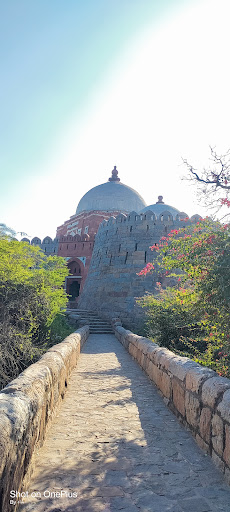
Although a portion of he causeway has long been demolished for the construction of the Mehrauli – Badarpur Road but the Tomb of Ghiyas ud – Din Tughluq’s tomb is approached by a broad causeway that winds up the small hillock housing the fortified tomb. The tomb was once surrounded by a lake but sadly it has long dried up.

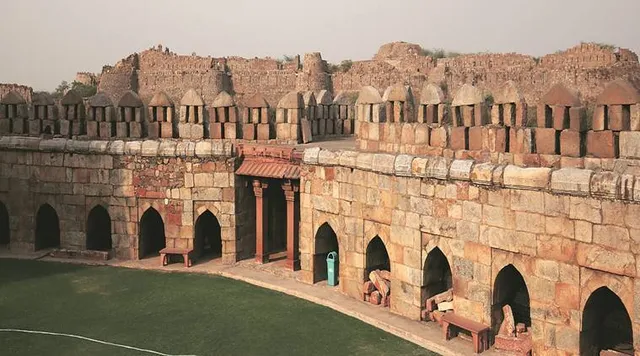
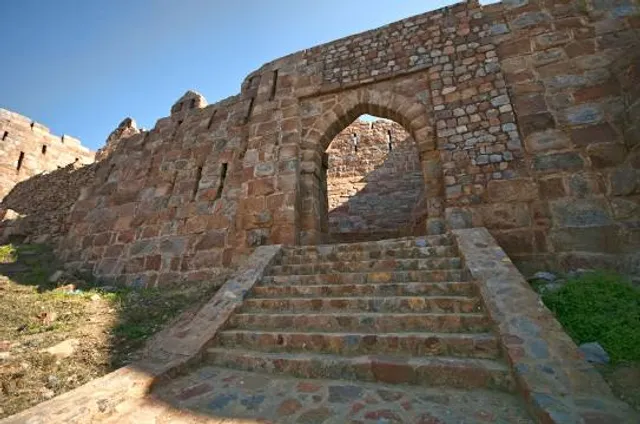
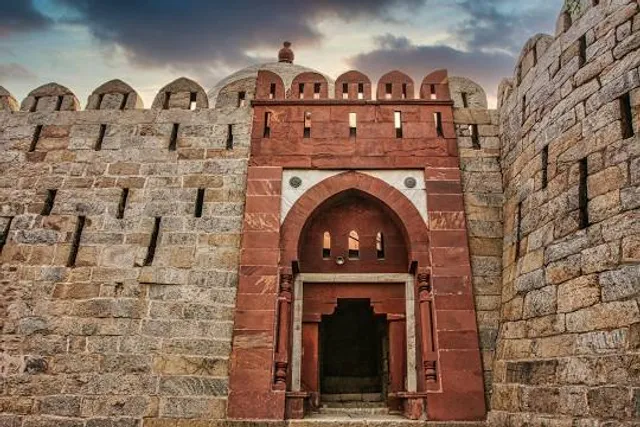
The causeway, supported by arches and pillars lead to a small opening leading to a huge sandstone gateway leading to the pentagonal fortified complex complete with bastions and battlements.

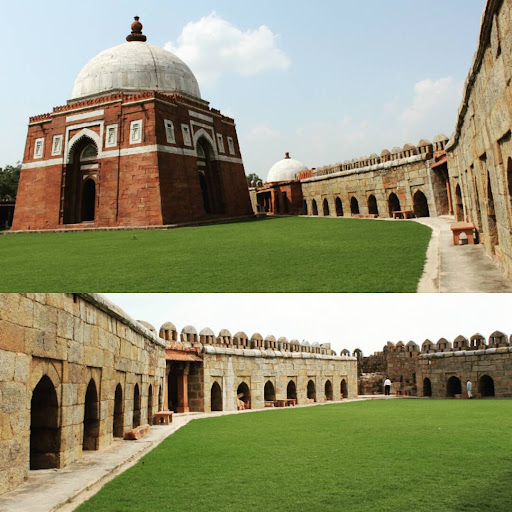
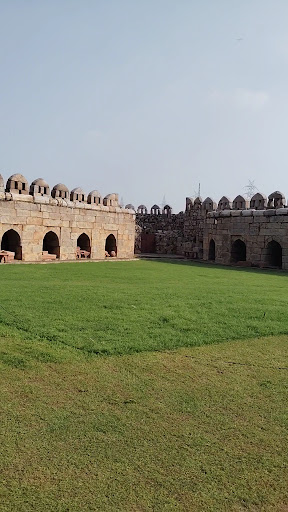
The tomb stands on beautiful manicured lawn art the center of the irregular pentagonal fortification.

The tomb was commissioned by Ghiyas ud – Din Tughluq, himself during his lifetime and follows the typical Tughluq style of architecture.

Ghiyas ud – Din Tughluq had an unfortunate death. After the annexation of Bengal, on his way to Delhi, he was given a reception in 1325 in Afghanpur (present day Bihar) by his eldest son Muhammad bin Tughlaq. The stage collapsed killing Ghiyas ud – Din Tughluq and his second son. Some historian opine that it was a conspiracy hatched by Muhammad bin Tughlaq.

The simple red sandstone square tomb with sloping walls is crowned with a massive white marble dome.

The tomb is largely devoid of ornamentation except for white marble inlay, medallions, carved red sandstone pillars & thick arches.

Decorative battlements atop the truncated pyramid base adds to the ornamental elements.

There are arched entrances on three of the four sides. The forth, western, side houses a mihrab, doubling the mausoleum as a Mosque. Each of the three arched gateways comes in with redundant horizontal marble lintels, which was probably added for purely aesthetic reasons.

The white marble dome rests on an octagonal drum and is crowned with a a unique lotus finial, representing the kalassa, a common form of Hundu Temple architecture.

The tomb is on ground level and the interior is also plain and houses three graves (not cenotaphs).

The central one belongs to Ghiyas-ud-din Tughlaq, another is of Muhammad Tughlaq & the last houses Ghiyas-ud-din’s wife.

On the north eastern bastion of the fortified mausoleum is another tomb. It is topped with a marble dome and is octagonal shape.

Although similar in architecture it is much smaller in size and contains the mortal remains of Zafar Khan, a trusted general of Alauddin Khalji. Zafar Khan died in 1299 and his tomb predates that of Ghiyas ud – Din Tughluq by almost a quarter century.

Later at this very spot Ghiyas ud – Din Tughluq built his magnificent fortified mausoleum, in the process integrating the tomb of Zafar Khan within the walled complex and christened it Dar-ul-Aman (“Abode of peace”).

The tomb, surrounded by colonnaded walkways with sandstone lattice work, is dark inside and houses two graves.

The central ornamented one belongs to Zafar Khan, the simple one next to it probably belongs to his wife.

The four, out of the five corners, of the pentagonal fort houses circular bastions, including the one containing the grave of Zafar Khan. The fifth corner houses a open roofless pavilion.

The cells on the walls also contains underground passageways, which probably lead to underground prison cells. Sadly the passages have been covered with iron grill gates and kept under lock and key.

Entry Fee: Rs10 for Ghiyas ud – Din Tughluq’s Mausoleum and Tughlaqabad Fort combined,...

   Read more
avatar
4.0
6y

Built by Ghiyassuddin Tughlak in 1321.

Neat and clean, well maintained fort in the outskirts.

Guide can be taken for 100 bucks for an hour or two, from among the security people working there, to appreciate the beauty of the place. No ASI guide was seen at the fort.

Originally had 52 gates, 13 remaining today, with sloping walls of massive strength.

Don't forget to wear good pair of sports shoes to appreciate the beauty of the fort in foot.

Carry own water bottle and food, as canteen facility was missing.

Fort is quite big, though it looked pretty safe, but still avoid walking alone on secluded parts.

Adilabad part of the fort on other side is beautiful and a must visit.

Try completing the trip in first half of the day to avoid sun.

Tickets are pretty cheap.

The fort was built by Ghiyath al-Din Tughlaq in 1321. It is a huge area spread across a stretch of 6.5 km. I went by Uber hence do not know the route for public transport. Nonetheless, it is pretty well-known in Faridabad area and is one of the very few spots you can visit in that area. The mausoleum which is on the other side of road from the ruins is in much better condition and you will see people taking an afternoon siesta there or playing cards. It has the grave of Tughlaq and his wife and son. Entry fee is mere INR15 for Indian nationals and INR100 for foreign nationals (could have increased in 2017). I went there on a solo trip and hence had to later look up its history on the Internet. Not much has been written about the history of the beautiful and vast ruins at the location. It is true that a part of the ruins are cordoned off due to criminal offenses and the guard at the main gate shall inform you about it if he sees you going in that direction. Apart from that, I didn't face any problem. But is it recommended to go in day time as the place shuts in the evening at 5 pm. I would definitely suggest visiting this place because I personally love the history that every ruin speaks of and this place evokes volumes of past richness of the...

   Read more
avatar
5.0
2y

GHIYATHU’D-DiN TUGHLUG'S SELF-BUiLT TOMB WITH A MAUSOLEUM ENCLOSED WITHIN HIGH BATTERED PENTAGONAL STONE WALLS, STRENGTHENED WITH BASTIONS AND SURMOUNTED BY CUPOLAS, LOOKS LIKE A SMALL FORTRESS. ORIGINALLY IT STOOD WITHIN AN ARTIFICIAL LAKE, FED BY THE OVERFLOWING OF THE HAUZ-I-SHAMSI, AND BY SONE NATURAL ORAINAGE CHANNELS, AND WAS CONNECTED WITH THE FORT OF TUGHLURABAD BY A GAUSEWAY BORNE ON THE ARCHES. PRESENTLY THIS HAS BEEN PIERCED BY THE MEHRAULI-BADARPUR ROAD. THE ENTRANCE TO THE TOMB ENCLOSURE IS THROUGH A HIGH AND MASSIVE GATEWAY OF RED SANDSTONE, APPROACHED BY A FLIGHT OF STEPS. THE MAUSOLEUM, ABOUT 8 M. SQUARE WITH SLOPING WALLS OF RED SANDSTONE GROWNED WITH BATTLEMENTS IS SURMOUNTED BY A WHITE MARBLE DOME RAISED ON AN OCTAGONAL DRUM A STRING COURSE, INSCRIBED PANELS, ARCH BORDERS AND PERFORATED SCREENS IN TYMPANA ALL IN MARBLE TOGETHER WITH ITS LOTUS-BUD FRINGES BREAK THE MONOTONY OF THE RED SANDSTONE AND LEND IT A DECORATIVE EFFECT. THERE ARE THREE GRAVES INSIDE, THE CENTRAL ONE OF GHIMATEUD-DIN TUGHLAQ AND THE OTHER TWO BELEVED TO BE THOSE OF HIS WIFE AND HIS SON AND SUCCESSOR, MUHAMMAD BIN TUGHLUQ (A. D. 1325-51). AGAINST THE ENCLOSURE-WALLS ARE CELLS OR PILLARED CORRIDORS WITH BRACKET-AND-LINTEL OPENINGS. IN THE NORTH-WESTERN BASTION THERE IS AN OCTAGONAL TOMB WITH AN INSGRIBED SLAB OVER ITS SOUTHERN DOOR ACCORDING TO WHICH ONE ZAFAR KHÄN LIES BURIED IN IT. IT SEEMS THAT THIS TOMB WAS THE FIRST TO BE RAISED HERE AND WHILE ENGAGED ON ITS CONSTRUCTION, GHIYATHU- DIN TUGHLAQ HAD THE IDEA OF PUTTING UP AN ENCLOSURE AND SITING HIS OWN TOMB ALSO INSIDE IT. THE PLACE IS REFERRED TO AS DÂRUL-AMAN (ABODE OF PEACE) IN THE INSCRIPTION MENTIONED ABOVE AND ALSO IN THE CONTEMPORARY RECODS OF...

   Read more
Page 1 of 7
Previous
Next

Posts

Suryansh MisraSuryansh Misra
Built by Ghiyassuddin Tughlak in 1321. Neat and clean, well maintained fort in the outskirts. Guide can be taken for 100 bucks for an hour or two, from among the security people working there, to appreciate the beauty of the place. No ASI guide was seen at the fort. Originally had 52 gates, 13 remaining today, with sloping walls of massive strength. Don't forget to wear good pair of sports shoes to appreciate the beauty of the fort in foot. Carry own water bottle and food, as canteen facility was missing. Fort is quite big, though it looked pretty safe, but still avoid walking alone on secluded parts. Adilabad part of the fort on other side is beautiful and a must visit. Try completing the trip in first half of the day to avoid sun. Tickets are pretty cheap. The fort was built by Ghiyath al-Din Tughlaq in 1321. It is a huge area spread across a stretch of 6.5 km. I went by Uber hence do not know the route for public transport. Nonetheless, it is pretty well-known in Faridabad area and is one of the very few spots you can visit in that area. The mausoleum which is on the other side of road from the ruins is in much better condition and you will see people taking an afternoon siesta there or playing cards. It has the grave of Tughlaq and his wife and son. Entry fee is mere INR15 for Indian nationals and INR100 for foreign nationals (could have increased in 2017). I went there on a solo trip and hence had to later look up its history on the Internet. Not much has been written about the history of the beautiful and vast ruins at the location. It is true that a part of the ruins are cordoned off due to criminal offenses and the guard at the main gate shall inform you about it if he sees you going in that direction. Apart from that, I didn't face any problem. But is it recommended to go in day time as the place shuts in the evening at 5 pm. I would definitely suggest visiting this place because I personally love the history that every ruin speaks of and this place evokes volumes of past richness of the Tughlaq Dynasty.
Nazmul BilalNazmul Bilal
Ghiyath al-Din Tughlaq's Tomb In Delhi Ghiyas ud-Din Tughluq was the founder of the Tughluq dynasty built by Tughlaqs (Tughluq dynasty) of the Delhi Sultanate in India. Within a year of his reign he decided to build the new fortified capital of Tughluqabad very close to the previous capital in Delhi, where he moved three years later. It is believed that Ghiyas built a tomb for himself in Multan when he was the governor there. However, on becoming Sultan he decided to build another one for himself in Tughluqabad. After his death, his successor Muhammad bin Tughlaq, moved back to Delhi and left Tughluqabad to gradually crumble and decay, although the tomb of Ghiyas remains there in a very well preserved condition. Architecture The tomb was constructed in 1325 and is built of red sandstone and white marble, materials commonly used in Islamic structures at that time. It has a dome of white marble. It is considered to be one of the earliest masterpieces built of red sandstone and white marble. The square tomb is in the center of a pentagonal enclosure with high walls. There are entrances on the north, east and south sides. There are no Minarets surrounding the tomb. The architectural style of the tomb is inspired by the Khalji portal- Alai Darwaza- in the Qutb Minar complex. This is hardly surprising as Ghiyas was originally a Khalji slave who later became one of the governors.
Tushar SuradkarTushar Suradkar
The Ghiyasuddin Tughlak Tomb is an imposing structure made in red sandstone laced with white marble decorations in the right proportions adding to its beauty. A unique feature of this monument is also its tapered walls that are unusual for the architecture of those times. I visited this tomb at the same time as the Tughlakabad Fort since this place is right across the road that ruptures the causeway that originally connected the tomb with the fort. In the medieval period, there was a bog on either side of the causeway making it impossible to cross over from the tomb site to the fort. In the middle of this space is the mausoleum that hosts the tomb of Ghiyasuddin Tughlaq and his wife. The entrance suggests that this was originally a Hindu temple that was repurposed for a tomb according to the tour guide. The parts of the Kalash that adorned the original temple are well preserved and can be seen even today in one of the storage rooms within the complex. ♿ Accessibility Features: No=Ramp access. No=A wheelchair-accessible Entrance. Yes=A wheelchair-accessible Restroom/Toilet. Yes=A wheelchair-accessible Seating. Yes=A wheelchair-accessible Parking.
See more posts
See more posts
hotel
Find your stay

Pet-friendly Hotels in Delhi

Find a cozy hotel nearby and make it a full experience.

Built by Ghiyassuddin Tughlak in 1321. Neat and clean, well maintained fort in the outskirts. Guide can be taken for 100 bucks for an hour or two, from among the security people working there, to appreciate the beauty of the place. No ASI guide was seen at the fort. Originally had 52 gates, 13 remaining today, with sloping walls of massive strength. Don't forget to wear good pair of sports shoes to appreciate the beauty of the fort in foot. Carry own water bottle and food, as canteen facility was missing. Fort is quite big, though it looked pretty safe, but still avoid walking alone on secluded parts. Adilabad part of the fort on other side is beautiful and a must visit. Try completing the trip in first half of the day to avoid sun. Tickets are pretty cheap. The fort was built by Ghiyath al-Din Tughlaq in 1321. It is a huge area spread across a stretch of 6.5 km. I went by Uber hence do not know the route for public transport. Nonetheless, it is pretty well-known in Faridabad area and is one of the very few spots you can visit in that area. The mausoleum which is on the other side of road from the ruins is in much better condition and you will see people taking an afternoon siesta there or playing cards. It has the grave of Tughlaq and his wife and son. Entry fee is mere INR15 for Indian nationals and INR100 for foreign nationals (could have increased in 2017). I went there on a solo trip and hence had to later look up its history on the Internet. Not much has been written about the history of the beautiful and vast ruins at the location. It is true that a part of the ruins are cordoned off due to criminal offenses and the guard at the main gate shall inform you about it if he sees you going in that direction. Apart from that, I didn't face any problem. But is it recommended to go in day time as the place shuts in the evening at 5 pm. I would definitely suggest visiting this place because I personally love the history that every ruin speaks of and this place evokes volumes of past richness of the Tughlaq Dynasty.
Suryansh Misra

Suryansh Misra

hotel
Find your stay

Affordable Hotels in Delhi

Find a cozy hotel nearby and make it a full experience.

Get the Appoverlay
Get the AppOne tap to find yournext favorite spots!
Ghiyath al-Din Tughlaq's Tomb In Delhi Ghiyas ud-Din Tughluq was the founder of the Tughluq dynasty built by Tughlaqs (Tughluq dynasty) of the Delhi Sultanate in India. Within a year of his reign he decided to build the new fortified capital of Tughluqabad very close to the previous capital in Delhi, where he moved three years later. It is believed that Ghiyas built a tomb for himself in Multan when he was the governor there. However, on becoming Sultan he decided to build another one for himself in Tughluqabad. After his death, his successor Muhammad bin Tughlaq, moved back to Delhi and left Tughluqabad to gradually crumble and decay, although the tomb of Ghiyas remains there in a very well preserved condition. Architecture The tomb was constructed in 1325 and is built of red sandstone and white marble, materials commonly used in Islamic structures at that time. It has a dome of white marble. It is considered to be one of the earliest masterpieces built of red sandstone and white marble. The square tomb is in the center of a pentagonal enclosure with high walls. There are entrances on the north, east and south sides. There are no Minarets surrounding the tomb. The architectural style of the tomb is inspired by the Khalji portal- Alai Darwaza- in the Qutb Minar complex. This is hardly surprising as Ghiyas was originally a Khalji slave who later became one of the governors.
Nazmul Bilal

Nazmul Bilal

hotel
Find your stay

The Coolest Hotels You Haven't Heard Of (Yet)

Find a cozy hotel nearby and make it a full experience.

hotel
Find your stay

Trending Stays Worth the Hype in Delhi

Find a cozy hotel nearby and make it a full experience.

The Ghiyasuddin Tughlak Tomb is an imposing structure made in red sandstone laced with white marble decorations in the right proportions adding to its beauty. A unique feature of this monument is also its tapered walls that are unusual for the architecture of those times. I visited this tomb at the same time as the Tughlakabad Fort since this place is right across the road that ruptures the causeway that originally connected the tomb with the fort. In the medieval period, there was a bog on either side of the causeway making it impossible to cross over from the tomb site to the fort. In the middle of this space is the mausoleum that hosts the tomb of Ghiyasuddin Tughlaq and his wife. The entrance suggests that this was originally a Hindu temple that was repurposed for a tomb according to the tour guide. The parts of the Kalash that adorned the original temple are well preserved and can be seen even today in one of the storage rooms within the complex. ♿ Accessibility Features: No=Ramp access. No=A wheelchair-accessible Entrance. Yes=A wheelchair-accessible Restroom/Toilet. Yes=A wheelchair-accessible Seating. Yes=A wheelchair-accessible Parking.
Tushar Suradkar

Tushar Suradkar

See more posts
See more posts