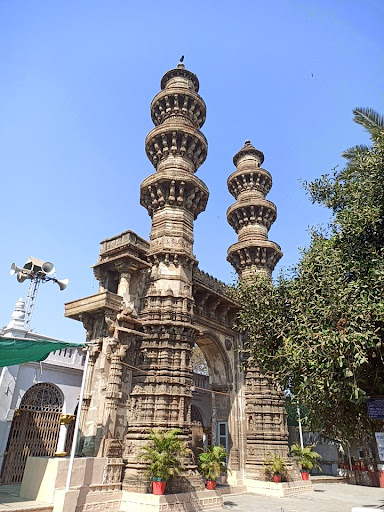
JHULTA MINAR IS ONE OF UNIQUE ARCHITECTURE
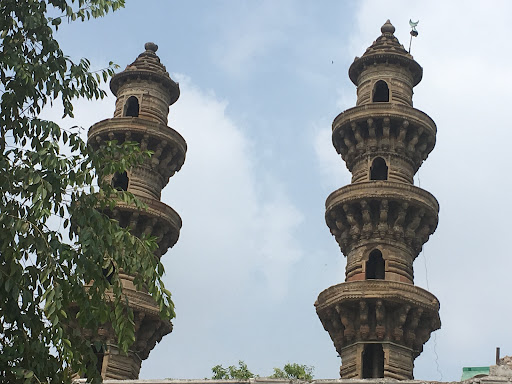
THE SWAYING MINARETS I have seen many architectural wonder-works in churches, mosques and temples the world over during my visits to many countries in different times. But I have not seen anything like Ahmedabad’s swaying minarets. India is a repository of such wonders being the cauldron of many civilisations and cultures. People already know about the Taj Mahal or the Khajuraho temple. But there are other unique places to see in the country. There are two mosques in the Ahmedabad. One is Sidi Bashir and the other is Raj Bibi. Their minarets were built in such a manner that if you shake one, which can be easily done, the other also shakes. The connecting passage between the two minarets however remains unshaken. This is a mystery that has not been solved. Sidi Bashir mosque is near the railway station. Much of it is destroyed; only the central arch and the minarets remain. No one is allowed to shake the minarets now. I was fortunate to shake one of the minarets and see the other one sway some years ago. The other mosque, Raj Bibi mosque, had similar swaying minarets. It is rumoured that one of its two minarets was dismantled by the British in a bid to unravel its mystery. They failed to find the secret of how it worked and could not put it back to its original position. The temple at Benaras; the longest corridor at the Rameswaram temple; the Tanjavore temple; the temple at Simhachalam; the Jagannath temple at Puri and the Sun temple at Konarak; as well as the Dakhineswar Kalibari have architectures unique in history. So are the Padmanabhaswamy Temple of Kerala, and the Meenakshi temple of Madurai
In Delhi, there is the famous Lotus Temple, an architectural wonder; the exquisite Lakshmi Narayan temple built with red stone, and the Akshardham temple. The Jain Temple in Ranakpur rises majestically from the slope of a hill. The temple is supported by over 1444 marble pillars, carved in exquisite detail. Each pillar is differently carved. This is also the same in Bhubaneswar’s Raja Rani temple. There are thousands of nayikas engraved thereon but no two nayikas are similar to look at. Harmandir Saheb or the Golden Temple in Amritsar is another architectural great. The famous Pasupati Nath temple in Kathmandu, Nepal; Borbodur temple in Java; Angkor Vat temple in Cambodia have no parallel. These are architectural wonders on their own merits. I have seen the world famous cathedral in Rome as also Milan’s cathedral church. It took nearly six centuries to complete it and is the world’s fifth largest church. St. Mark’s Basilica is Venice’s church is built in Byzantine style. I have seen the wonderful architectural designs of French Churches in Paris including Saint Pierre de Montmartre and Notre Dame de Paris Cathedral. They are considered to be one of the finest examples of French Gothic architecture. I have seen St. Sofia church in Sofia, Bulgaria and the Russian orthodox churches, especially St. Peter’s church in Moscow, and other churches in Kiev and elsewhere. The stunningly white Basilica of Our Lady of Delours is located in Trisur, southern India, is the tallest church in Asia. The Temple Expiatori de la Sagrada Família is a massive, privately-funded Roman Catholic Church that has been under construction in Barcelona, Catalonia, Spain since 1882 and is expected to be completed by 2026. Considered a masterpiece by architect Antoni Gaudí (1852–1926), the project’s vast scale and peculiar design have made it one of Barcelona’s (and Spain’s) top tourist attractions. Coming to the Mosque architecture, the mosque of Bibi Khanoum at Samarkhand is a wonderful symbol of architecture with blue tiles and intricate designs on it. In Cairo, there are many mosques but the great mosque of Mohammad Ali Pasha at the centre of Cairo is probably the best in architectural excellence and dimension. It is also called the Alabaster Mosque and is decorated with nicely crafted Islamic motifs. In Istanbul, Turkey, there are many beautiful mosques, but the most beautiful one is the...
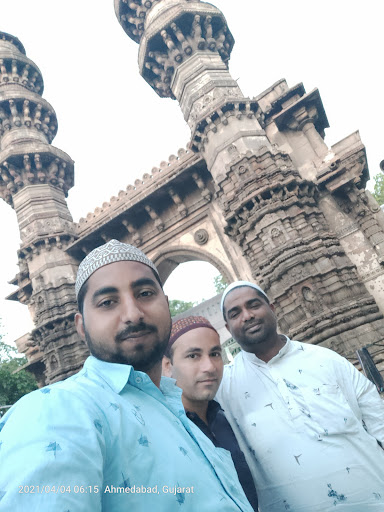
Read moreThe minarets are the tallest in Ahmedabad and are now located to the north of Ahmedabad Junction railway station. Though much damaged, especially near the foot, the stairs inside the minarets may still be used.[2] The minarets are three stories tall with carved balconies. A gentle shaking of either minaret results in the other minaret vibrating after a few seconds, though the connecting passage between them remains free of vibration[citation needed]. The mechanism of this is not known, although the layered construction is thought to be a factor. The phenomenon was first observed in the 19th century by Monier M. Williams, an English Sanskrit scholar. The minarets are able to withstand fast-moving trains passing close by. Another mosque in Ahmedabad called the Raj Bibi Mosque also had shaking minarets similar to those at the Sidi Bashir Mosque. Under the British Raj, one was dismantled in order to study the construction, but could not be put back together.
There is also one in Isfahan, Iran, called Monar Jonban (shaking minarets) with almost the same properties.
A further example is a large mosque built by Makhdu-Ma-I-Jahan, mother of Sultan Qutubuddin Ahmad Shah II in 1454 A.D. She is buried in the mausoleum situated to the east of the mosque. Entry to the shaking minaret was prohibited following an incident in 1981 at Qutb Minar in Delhi, when a stampede resulted in the deaths of many children. There is also damage to the...
Read moreAlso known as the Shaking Minarets, they are playful but with a whir of quivering mystery. They have left the best of architects and pioneering design engineers intrigued and in unresolvable wonder. What they cannot unravel is when one minaret is shaken the other begins to vibrate, though the connecting passage between the two remains vibration-free; what causes this vibration is unknown. There are two well-known pairs of Shaking Minarets in Ahmedabad, one located opposite the Sarangpur Darwaja and the other near the Kalupur Railway Station Area. The one near Sarangpur Darwaja is within the vicinity of the Sidi Bashir Mosque built in 1452 AD by Sidi Bashir, a slave of Sultan Ahmed Shah. They are three storeys talls with carved balconies where visitors were once allowed to climb all the way up. The other set of minarets near the Railway Station is taller in height. However, these are not in a very good condition as it is believed that the British had dismantled them to understand the cause of vibrations. They could not resolve the engineering and it was not possible to put them back in their original condition. Demonstrations of the minarets shaking or vibrating are not carried...
Read more