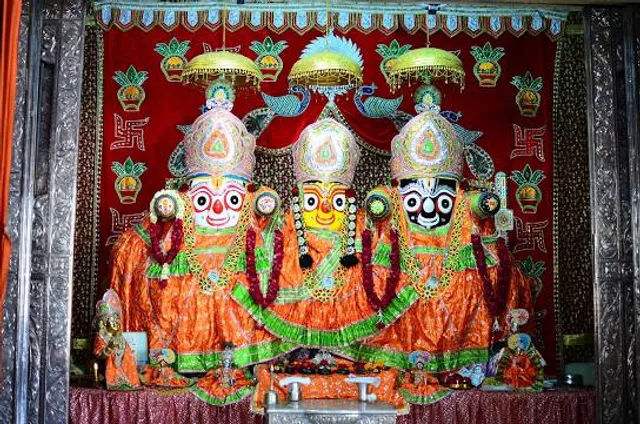
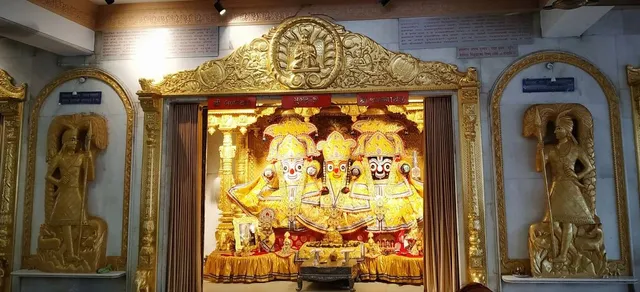
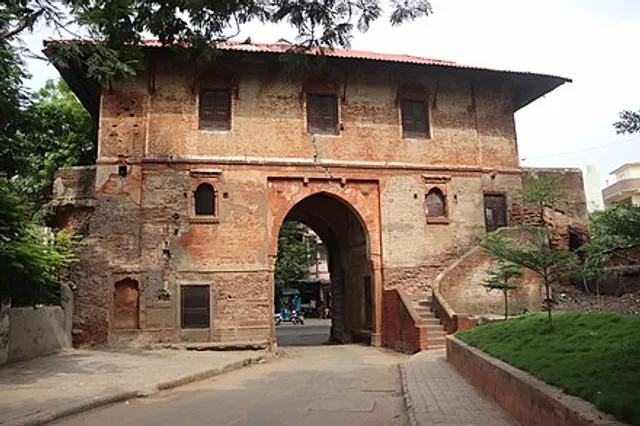
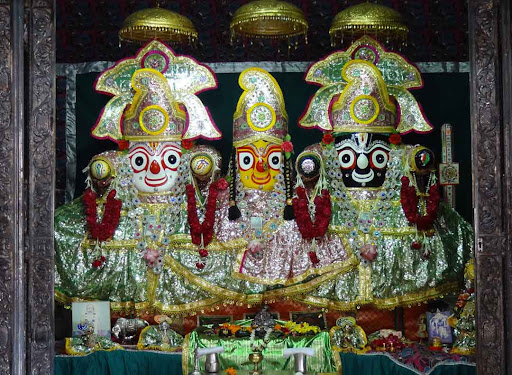
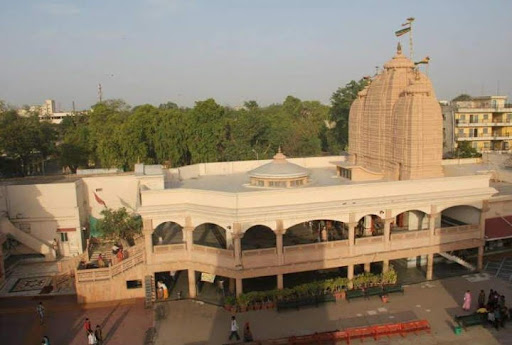
About 450 years ago this area where now stands SHREE JAGANNATHJI MANDIR CAMPUS, was a thick forest beside the river SABARMATI in the East and the city limit ended at the Jamalpur Darwaja in the North. Sadhus normally seek places of solitude beside rivers away from the noise of cities. Thus an itinerant sadhu Shree HANUMANDASJI by name happened to visit Ahmedabad and found this jungle area suitable for his stay. Being a devotee of RAMBHAKT MARUTI, he laid his deity’s idol, which is worshiped till this day. During his stay some miraculous happening attracted people from the neighbouring areas, which has become the root cause to developed this place into a modest temple. His successor sadhu Shree SARANGDASJI happened to be a devotee of Lord Jagannath . He had an urge to pay a visit to the Jagannath Mandir at PURI (Orissa) and some local associates of his joined him in the pilgrimage. One night while he was sleeping at the Dharmshala of the Puri temple , he had visionary instruction from Lord Jagannath to go back to Ahmedabad and install there the idols of the Holy Trinity Lord Jagannath with his elder brother Lord BALDEVJI and sister Goddess SUBHADRAJI. Thus, the Maruti temple became Shree Jagannathji Mandir. A cowshed was built and since then began the GAU SEVA. The next successor was sadhu Shree BALMUKUND DASJI and Shree NARSINHDASJI was the fourth Mahant known for his dedicated enthusiasm for multifarious religious activities aided by his equally generous devotees. Shree NARSINHDASJI got the temple renovated, a fully developed Gaushala started rendering yeoman service, ‘‘SADAVRAT’’ was started ensuring two meals a day for the needy, irrespective of caste and creed distinctions. In 1957 in SINHASTH KUMBHA MELA at Prayag Mahant Shree Narsinhdasji was honoured by the title “MAHAMANDALESHWAR’’ by the SADHU SAMAJ. The fifth Mahant was Shree SEVADASJI who was succeeded by Shree RAMHARSHDASJI known among his devotees as “GAUSEVI SANT’’ and ‘’DINBANDHU’’. The present GADIPATI is MAHAMANDALESHWAR MAHANT SHREE RAMESHWAR DASJI. During the period 1996-2000, the entire temple complex at Ahmedabad was renovated and the idols of the Holy Trinity were ritually laid on a special raised pedestral called “RATNA-VEDI“, with the idol of Garuda situated in front of the sacred altar, so that its attention is sighted at the feet of Lord Jagannath. On the RATNAVEDI the Goddess SHREEDEVI and BHUDEVI are laid. A marble statue of Mahamandaleshwar Mahant Shree Narsinhdasji is near the Garuda, facing the Holy Trinity. And next is the region of the “GADI” with an uninterrupted “ DHOONI” from where devotees collect the Bhasma and blessings of the MahantShree. Opposite to Gadi on the first floor is built a spacious auditorium for bhajans lectures and such other religions functions and next to it is GAUSHALA. Opposite to the entrance of the main temple is RATHKHANA, SANTNIVAS, APANG ASHRAM and SAMADHI are region situated. This is the short history of shree Jagannathji...
Read moreJagannath Temple is a prominent Hindu place of worship which is located in the city of Ahmedabad, Gujarat. This shrine which is dedicated to Holy deity Lord Jagannath was constructed by Sadhu Sarangdasji about four hundred and fifty years ago. It is also the primary venue for hosting the famous chariot festival named ‘Ratha Yatra’. This temple is opened to the public daily from 04: 30 AM in the morning till 09: 00 PM in the evening.
RATHA YATRA THE BIGGEST FESTIVAL
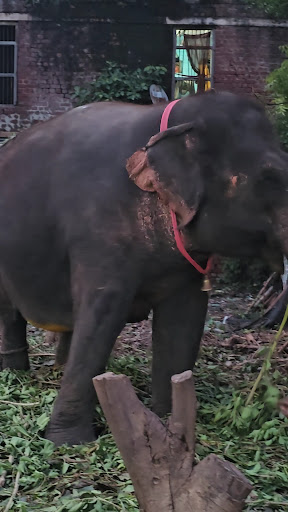
The famous ‘Ratha Yatra’ which is organized annually is quite familiar to the ‘Ratha Yatra’ in Puri. According to the custom and age-old tradition, the elephants are given the first preference to bow before the Holy Deity Lord Jagannath. Later, the then Chief Minister of Gujarat inaugurates the procession of ‘Rath Yatra’ by cleansing the path for the Chariot of Jagannath.
The procession of ‘Ratha Yatra’ covers almost each and every city of Gujarat at a distance of about fourteen kilometers. The procession concludes at a place named Saraspur where the local residents deliver ‘Mahabhoj’ to the devotees present in the procession. ‘Ratha Yatra’ is observed as a ‘Lokotsav’ or public festival amongst the local residents of Gujarat. The Ahmedabad ‘Rath Yatra’ is believed to be one of the major ‘Ratha Yatra’ festivals when compared to similar festivals in Kolkata and Puri.
HOW TO REACH
By Road: – Ahmedabad is well connected to all other cities in Gujarat. It is only 10 min far from Central Bus Station (Geeta Mandir). There is no dearth of transportation in Ahmedabad. Private buses ply regularly to Jagannath temple. By Train: – Tourists who prefer to travel by train may head straight to Ahmedabad Railway Station. Tourists are required to book their train tickets to Jagannath Temple from Ahmedabad well in advance where they can avail attractive discounts. By Flight: – Those who wish to travel by air to reach Jagannath Temple may proceed to Sardar Vallabhai Patel...
Read moreLord Jagannathji Temple, located in Jamalpur, Ahmedabad, Gujarat, is a spiritual haven that houses a unique amalgamation of deities. The temple complex is home to not only Lord Jagannath but also Lord Shiva, Lord Rama, Lord Ganesha, Lord Hanuman, Laxmi Mata, and Parvati Mata temples, all within the same sacred premises.
This temple is not just a place of worship; it's a serene sanctuary where devotees can find solace and connect with various deities under one roof. It's a testament to the rich religious diversity of India, where different faiths coexist harmoniously.
One of the most remarkable aspects of Jagannathji Temple is its grand annual chariot festival, the Rath Yatra. This event is a spectacle to behold, drawing crowds from far and wide. It's the third most important and largest Rath Yatra in India, trailing only behind the renowned Puri Rath Yatra. The Rath Yatra is a vibrant celebration, featuring elaborately decorated chariots carrying the idols of Lord Jagannath, Lord Balabhadra, and Subhadra Devi. The procession is a true visual treat, with devotees singing hymns and pulling the massive chariots through the city streets.
The temple's spiritual aura is palpable, and it's a place where devotees from all walks of life gather to seek blessings, offer prayers, and immerse themselves in the divine energy that fills the air. The peaceful coexistence of multiple deities in one temple symbolizes the unity and inclusivity that defines India's spiritual heritage.
Jagannathji Temple is not just a place of worship; it's a cultural and spiritual landmark that resonates with the heartbeats of countless devotees. Its annual Rath Yatra is a testimony to the city's rich cultural tapestry and religious fervor. Whether you seek spiritual solace or wish to witness the grandeur of Indian festivals, this temple is a must-visit destination...
Read more