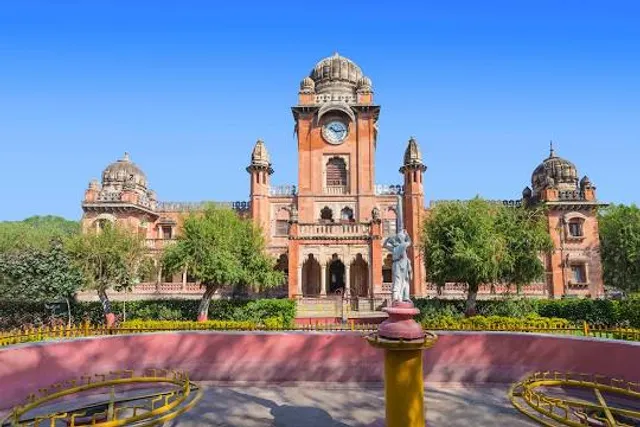
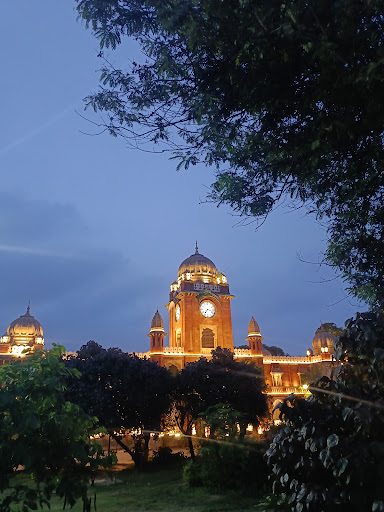
Gandhi Hall is a prime example of British influence on Indian architecture in Indore. Originally known as King Edward Hall when it was built in 1904, the monument was renamed to its present title by Yeshwant Rao Holkar (1926-1948) following the assassination of Mahatma Gandhi in 1948.
The Hall was designed by a Bombay-based British architect, Charles Frederick Stevens, who imbued the building with an Indo-Gothic style. The material was locally sourced; white sandstone from Seoni and red sandstone from Patan, both in Madhya Pradesh. Interestingly, leftover material from the incomplete Phooti Kothi, also in Indore, was used to construct this hall. The building was inaugurated by the Prince of Wales, George V, in 1905, and in those days, cost Rs 2,50,000 to build.
The Hall, which measures 112 feet in length, also features a stage and gallery surrounded by an open verandah, with the four corners of the building meeting at Rajput-style minarets topped with domes, while the entrance is from the south. The surrounding complex also features a children’s park, a temple and a library. The Hall’s high ceiling is remarkable, made of white plaster of paris and painstakingly adorned with gold, with palladian arches, a terraced roof and ornamental moldings adding to the grandeur of the building. However, perhaps the most noteworthy feature of the monument is its clock tower, at a height of ninety feet and capped by a large 15x15 feet dome housing the clock itself.
The 116 year old clock tower would chime everyday, playing a major role in Indori life and helping citizens time their activities. The clock stopped chiming about two decades ago, given that the heritage structure was delicate due to lack of upkeep, and the bell’s chiming was considered unsafe due to the vibrations it created, contributing to the deterioration of the building. In 2020, 83 year old watchmaker P.B. Lapalikar, who had repaired the clock in 1956 and 2013 previously, requested the authorities to allow him to restore it once again, and accompanied by his sons and grandson, managed to repair two of them in a week. Anchoring work was carried out in the building to make it safe for the bell to chime, and as of July 2020, the citizens of Indore once again welcomed the sound of the clock ringing every fifteen minutes.
Today, the Hall comes under the jurisdiction of the Indore Municipal Corporation (IMC). It serves as a popular venue in the city for art and cultural exhibitions and book fairs, and can accommodate up to 2,000 people within the building itself, while the grounds surrounding it can fit many more. It is noticeably lit up with the Indian tri-colour of orange, white and green on national holidays, including Independence Day and Republic Day. However, caretakers and conservationists have repeatedly expressed concern over the neglect and the lack of upkeep of the heritage building; according to some, the ceiling is crumbling and in need of desperate attention, while others feel that the building should be renovated and opened...
Read moreMahatma Gandhi Hall is one of the landmark buildings of Indore City🌆. It was built in the year 1904 and was named the King Edward Hall. After India gained independence🇮🇳, this grand hall was renamed as Mahatma Gandhi Hall in 1948😄. The hall was designed in Indo-Gothic architectural style by Charles Frederick Stevens of Bombay👍, is an architectural wonder. It is also known as the town hall. The hall holds major attraction for the tourists in the form of a clock tower.
This four-faced tower is built in the centre of the building🏢 and has a dome covering it. The hall is also known as the clock tower or Ghanta Ghar among the locals. The terraced roof, ornamental moldings, high ceilings, furnished rooms, minarets all work together to give the place a grand look.🤩 The spacious hall can easily accommodate more than 2000 people. The hall houses a children’s park🎠 and a library📚.
The Gandhi Hall was formerly known as King Edward Hall, but Maharaja H. H. Yeshwant Rao Holkar II (reign: 1926 - 1948) renamed it in 1948,😎 after the death of Mahatma Gandhi. This town hall was designed & constructed by architect Mr. Charles Frederick Stevens from Mumbai at a cost of Rs. 2,50,000 and was inaugurated by Prince of Wales, George V in 1905. Yr It was made in the Indo-Gothic style, made of White stones from Seoni & Red stones from Patan in M. P., has magnificent domes and minarets, and a huge clock-tower.
This town hall, known as Gandhi Hall, is a major venue for art and cultural exhibitions, with a central hall of capacity to accommodate 2,000 people and grounds for even bigger events ! The State Government lights up this building in tri-colour on all three national festivals. Nowadays it is been used for exhibitions.
A very imposing and beautiful building, however age is showing and many parts are in disrepair. Some renovations are in progress, which we hope will be done well. A historically important project that the Archeological Survey of India should take up.
The surrounding space is empty and needs gardening, repaving in some areas etc. But do not miss to visit this place. The walk around the...
Read moreIn the eyes of millions of his fellow Indians, Gandhi was the Mahatma (“Great Soul”). The unthinking adoration of the huge crowds that gathered to see him all along the route of his tours made them a severe ordeal; he could hardly work during the day or rest at night. “The woes of the Mahatmas,” he wrote, “are known only to the Mahatmas.” His fame spread worldwide during his lifetime and only increased after his death. The name Mahatma Gandhi is now one of the most universally recognized on earth.
Youth
Gandhi was the youngest child of his father’s fourth wife. His father—Karamchand Gandhi, who was the dewan(chief minister) of Porbandar, the capital of a small principality in western India (in what is now Gujarat state) under British suzerainty—did not have much in the way of a formal education. He was, however, an able administrator who knew how to steer his way between the capricious princes, their long-suffering subjects, and the headstrong British political officers in power.
Gandhi’s mother, Putlibai, was completely absorbed in religion, did not care much for finery or jewelry, divided her time between her home and the temple, fasted frequently, and wore herself out in days and nights of nursing whenever there was sickness in the family. Mohandas grew up in a home steeped in Vaishnavism—worship of the Hindu god Vishnu—with a strong tinge of Jainism, a morally rigorous Indian religion whose chief tenets are nonviolence and the belief that everything in the universe is eternal. Thus, he took for granted ahimsa(noninjury to all living beings), vegetarianism, fasting for self-purification, and mutual tolerance between adherents of various...
Read more