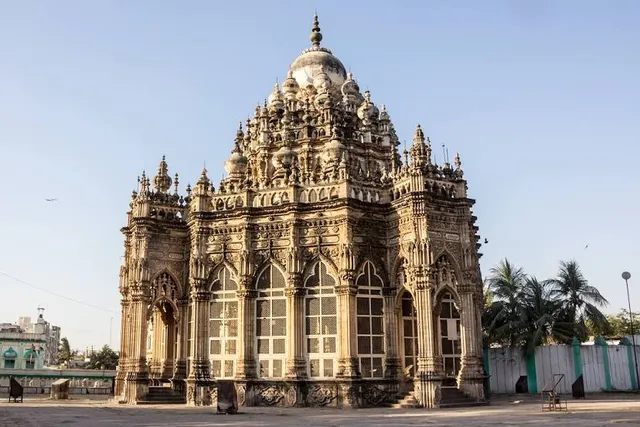
Very Beautiful Monument. Harritag Site. Great architecture work. Mahabat Maqbara and Bahauddin Maqbra are mausoleums in Junagadh, Gujarat, India. They were completed in 1892 and 1896 respectively and are dedicated to Mahabat Khan II, the Nawab of Junagadh State, and his minister Bahauddin Hussain Bhar respectively. The Nawabs of Babi dynasty ruled the erstwhile Junagadh State. The construction of the Mahabat Maqbara was started in 1878 by Nawab Mahabat Khan II (1851–82) and ended in 1892 during the reign of Nawab Bahadur Khan III (1882–92). It houses grave of Mahabat Khan II.13] It is a State Protected Monument under Gujarat Ancient Monuments and Archaeological Sites and Remains Act, 1965. The adjacent mausoleum in north was constructed by Mahabat Khan II's Vizier (minister) Sheikh Bahauddin Hussain Bhar with his own funds during 1891–1896. It is known as the Bahauddin Maqbara or Vazir's Maqbara. These mausoleums are known for amalgamation of Indo-Islamic, Gothic and European style.[2
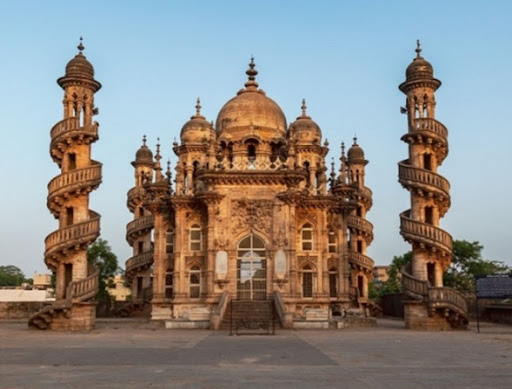
These mausoleums have the carvings on its inner and outer façades and arches with yellowish light brown exterior. They have onion-shaped domes, French windows, sculptures, marble tracery work, marble columns, marble jalis and silver doorways. The minarets on four sides of one of these mausoleums has winding staircases around them.[3]
The Jama Mosque is located nearby with similar architectural style.
ALONG A BUSY ROAD IN the heart of Junagadh city lies one of India’s least-known, yet most jaw-dropping architectural oddities. A smashing blend of Gothic and Islamic ornamentation, the Mahabat Maqbara complex remains one of India’s best kept secrets.
This striking structure rising from out of nowhere is the mausoleum of Wazir Bahaduddinbhai Hasainbhai, one of the chief nobles in the Court of Nawab Mahabat Khan II of Junagadh. Construction on the yellow-walled complex began in 1878 by Mahabat Khanji and was completed in 1892 by his successor, Bahadur Khanji. Over a decade’s worth of work culminated in elaborate carvings on the buildings’ inner and outer façades, fine arches, French-style windows, columns and shining silver doorways. On the adjacent mosque, each minaret is encircled from top to bottom with winding staircases. Both buildings topped with distinctive “onion dome” rooflines. The monument’s seemingly perplexing mixture of Indo-Islamic, European, and Gothic architecture makes a bit more sense when considered in the larger context of the complex history of the district of Junagadh itself. Founded in 1748, Junagadh had officially become a British Protectorate in 1807 though was handed over to the East India Company’s control in 1818. For the rest of Great Britain’s colonial rule of India, the Saurashtra region escaped direct administration of British India. Instead, the British divided the territory into more than 100 princely states – including Junagadh – which remained in existence until 1947. The city’s present old town, built during the 19th and 20th centuries, existed in a sort of gubernatorial no man’s land. It is in this very spot that the Mahabat Maqbara complex was built, during the period of Britain’s...
Read moreMahabat (not Mohabbat) Maqbara Palace, also Mausoleum of Bahaduddinbhai Hasainbhai, is a mausoleum in Junagadh, India, that was once home to the muslim rulers, the Nawabs of Junagadh. It was built by Nawab Mahabat Khan II of Junagadh (1851–82).
Mahabat Maqbara Palace Bahaduddinbhai Hasainbhai Maqbara Mausoleum Tomb of Bahar-ud-din Bahar Tomb of Bahar-ud-din Bahar The city of Junagadh has other 18th-century mausoleums built by the Nawabs in the area around Chittakhana Chowk. This architectural marvel is known for amalgamation of Indo Islamic, Neo Gothic and European style. The minars and dome are Islamic in nature, the sculpture and pillars are gothic in style. The most unique and interesting fact about this mausoleum is that it has stairs from outside of minars, unlike others minars, like the Qutub Minar which has stairs from inside of minar.
At the time of India’s independence from British rule in 1947, incumbent ruler Mahabat Khan III elected to join Pakistan despite Junagadh having no common boundary with the new country. Under pressure from the Indian government he fled to Pakistan, and Junagadh reunited with India just three short months after declaring its independence. [05/08, 6:09 PM] Raj Padariya: ALONG A BUSY ROAD IN the heart of Junagadh city lies one of India’s least-known, yet most jaw-dropping architectural oddities. A smashing blend of Gothic and Islamic ornamentation, the Mahabat Maqbara complex remains one of India’s best kept secrets.
This striking structure rising from out of nowhere is the mausoleum of Wazir Bahaduddinbhai Hasainbhai, one of the chief nobles in the Court of Nawab Mahabat Khan II of Junagadh. Construction on the yellow-walled complex began in 1878 by Mahabat Khanji and was completed in 1892 by his successor, Bahadur Khanji. Over a decade’s worth of work culminated in elaborate carvings on the buildings’ inner and outer façades, fine arches, French-style windows, columns and shining silver doorways. On the adjacent mosque, each minaret is encircled from top to bottom with winding staircases. Both buildings topped with distinctive “onion dome” rooflines. [05/08, 6:10 PM] Raj Padariya: Ever seen or heard of a monument that is built on the lines of Gothic, Hindu and Islamic architecture? At Junagadh in Gujarat, you will find a striking mausoleum that stands like silent witness of the political and cultural disturbances that have happened and continues to happen around it.
Mahabat Maqbara, a 19th-century mausoleum is a renowned landmark of Junagadh. The monument was built on the behest of Mahabat Khanji, and later in 1892 his successor Bahadur Kanji got the construction completed under his regime.
Be it the pillars, arches, windows or stone carved walls, Mahabat Maqbara is an awesome architectural wonder that has not got much press in modern times. It has staircases that encircle the minarets and the domes that add much beauty to the monument.
Photo by: Geet Shah, Creative Commons Attribution Licence
Located on a busy road, this is the resting place of Wazir Bahaduddinbhai Hasainbhai, one among the chief nobles in the court of Nawab Mahabat Khan II...
Read moreThe Reconstruction of this marvelous building is now completed and with its polished look it is looking like taj mahal complex, this is a simple presantation of love and peace from mohabbatkhan nawab of Junagadh, and creatice support by his brother un low Bahauddin Bhai.
These mausoleums are known for amalgamation of Indo-Islamic styles (mainly Gujarat Sultanate and Mughal) with considerable European (Gothic) influence.
These mausoleums have the carvings on its inner and outer façades and arches with yellowish light brown exterior. They have onion-shaped domes, French windows, sculptures, marble tracery work, marble columns, marble jalis and silver doorways. The minarets on four sides of one of these mausoleums has winding staircases around them.[3] The Jama Mosque is located nearby with similar architectural At a distance of 1 km from Junagadh Junction, Mahabat Maqbara is a mausoleum situated in Mullawada locality of Junagadh. Also called Mausoleum of Bahaduddinbhai Hasainbhai, it is one of the historical monuments in Gujarat and among the prime places to visit in Junagadh.
Often considered as the most imposing architectural monument in Junagadh, Mahabat Maqbara was originally the residential palace of Babi Nawabs. The construction of the palace was started by Mahabat Khanji in 1878 CE and was completed by his successor Bahadur Kanji in 1892 CE. The palace complex is now houses the tombs of Mahabat Khan II, the 6th Nawab of Junagadh and Bahaduddinbhai Hasainbhai, the minister of Nawab Rasul Khanji.
Both mausoleums at Mahabat Maqbara palace complex are the fine examples of art and architecture, typical of the late 19th century royal monuments of Junagadh. Mahabat Maqbara, the mausoleum of Mahabat Khan, is a fusion of Indo-Islamic, European and Gothic architecture and was built in 1982 CE by Bahadur Khan III for his father Mahabat Khan II. The most striking feature of the monuments is its floor-to-lintel French windows and the Gothic columns alongside silver inner doors. It also boasts of an intricate cluster of bulbous domes supported by columns built in Gothic style.
Standing on the left of the Mahabat Maqbara is the elaborately designed Bahauddin Maqbara, the tomb of Wazir Bahaduddinbhai Hasainbhai. It was constructed by Sheikh Bahauddin with his own funds during the period 1891-1896 AD. A sight to behold, the Bahauddin Maqbara resembles the Taj Mahal in structural design, with its bubbled domes and four minarets on the four corners with whirling spiral staircase. The minarets have rich stone carvings and large silver doors. A cautious climb up the narrow stairs gives an awe-inspiring view of the domes and other vintage buildings in the neighbourhood. There are also a number of Haveli's inside the Maqbara which have some best wooden carvings and jharokhas which resemble the Gujarat domestic architecture.
The Mahabat Maqbara is generally kept under lock and key, but can be glimpsed into by obtaining the keys from the mosque situated beside...
Read more