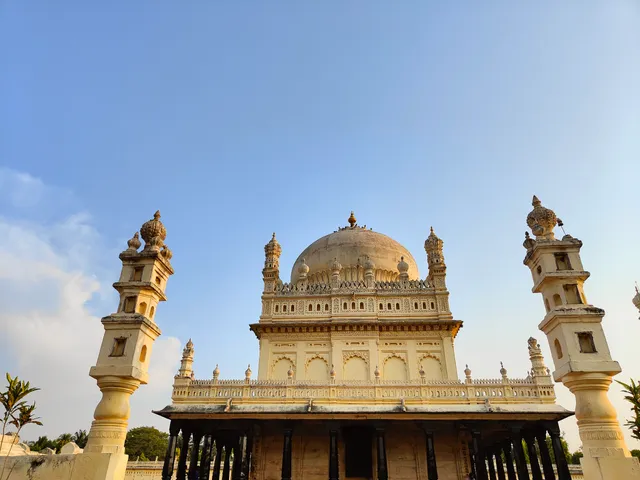
The Gumbaz at Srirangapattana is a Muslim mausoleum at the centre of a landscaped garden, holding the graves of Tippu Sultan, his father Hyder Ali, and his mother Fakhr-Un-Nisa. It was built by Tippu Sultan to house the graves of his parents. The British allowed Tippu to be buried here after his death in the Siege of Srirangapatna in 1799.
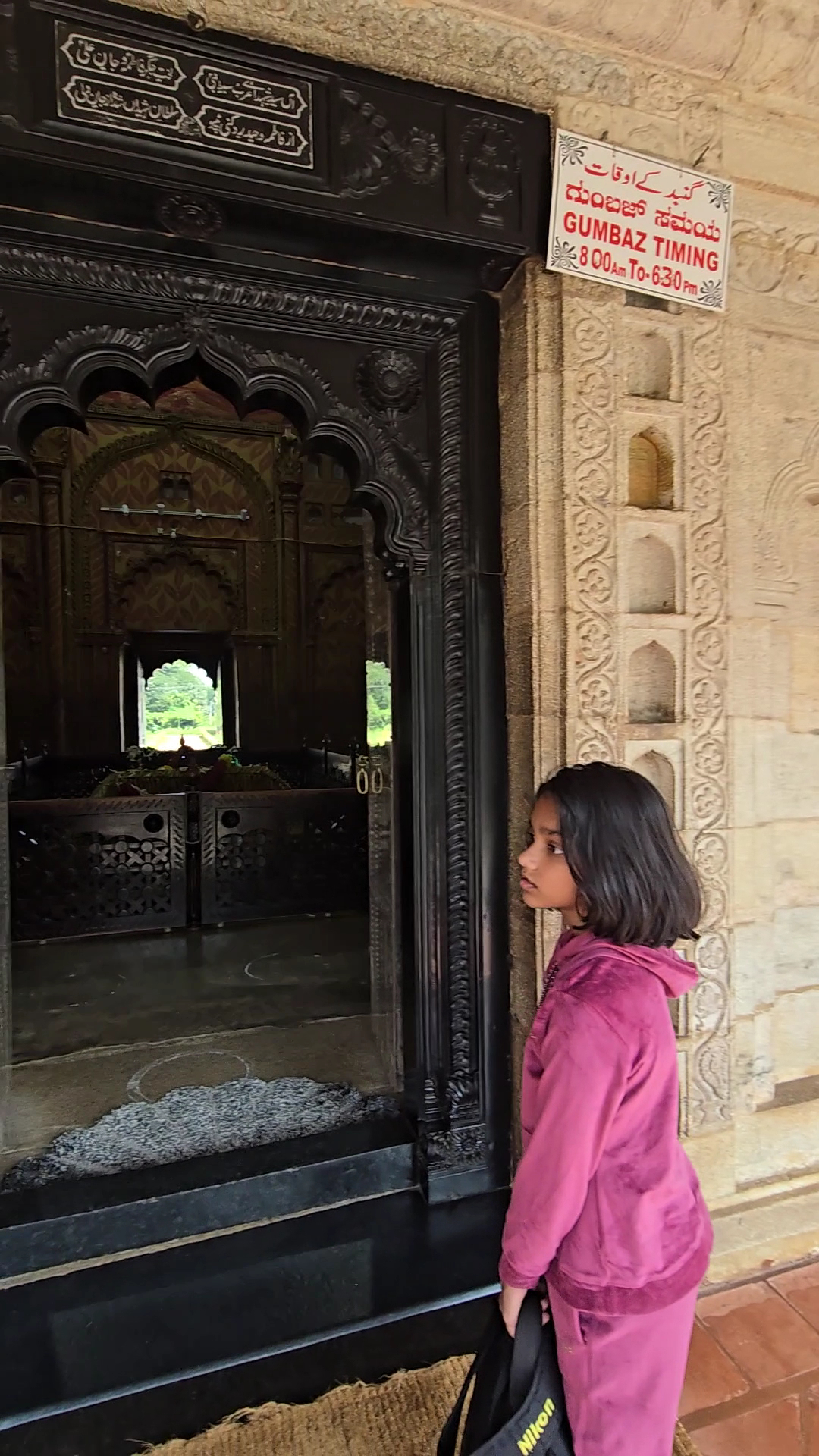
The Gumbaz was raised by Tipu Sultan in 1782-84 at Srirangapattana to serve as a mausoleum for his father and mother. The mausoleum was surrounded by a cypress garden which is said to have different species of flowering trees and plants collected by Tippu Sultan from Persia, Ottoman Turkey, Kabul and French Mauritius. The original carved doors of the mausoleum have been removed and are now displayed at the Victoria and Albert Museum, London. The present doors made of ebony and decorated with ivory were gifted by Lord Dalhousie.
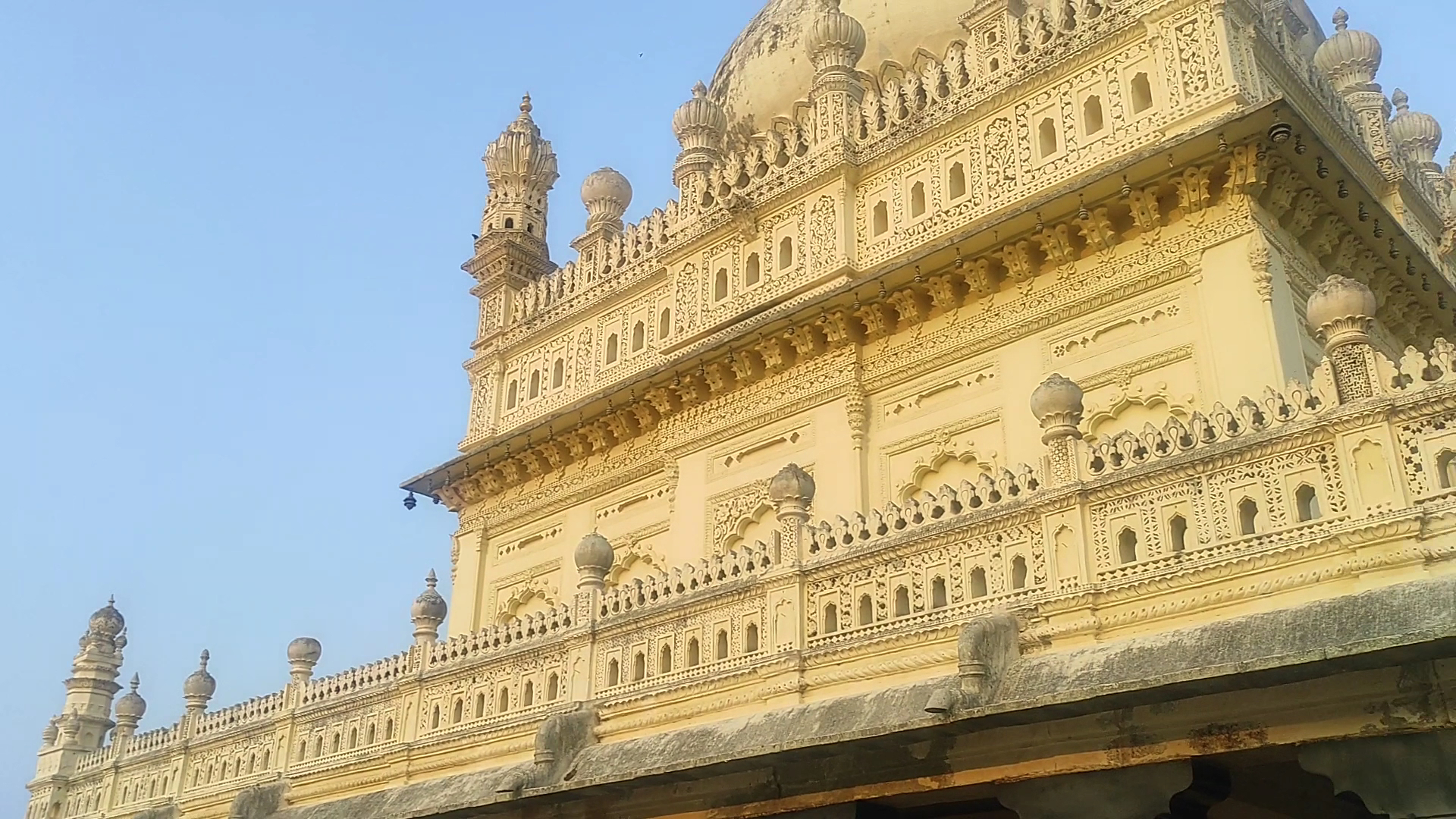
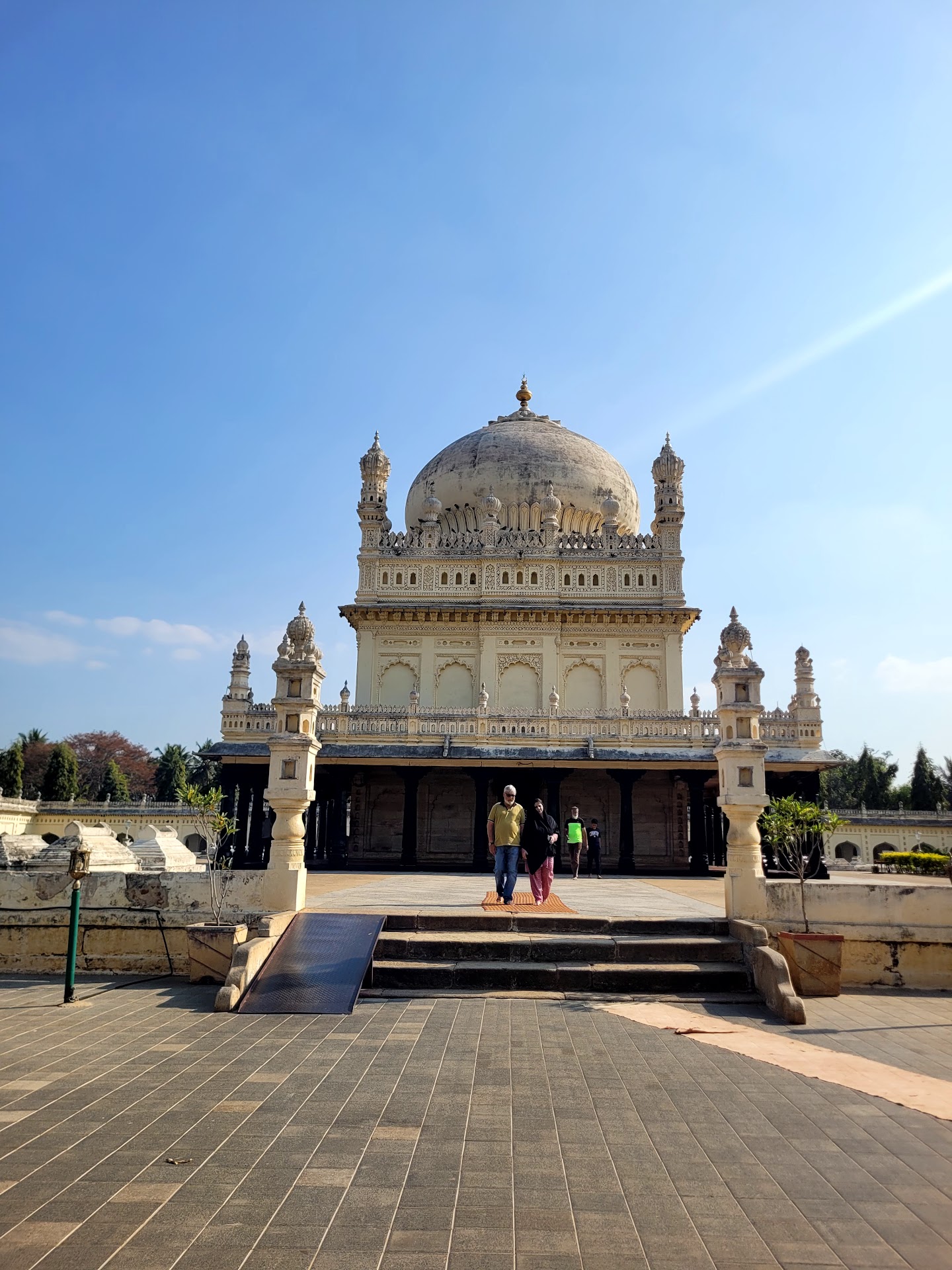
The Gumbaz is designed in the Persian style, with a large rectangle shaped garden, having a path leading to the mausoleum. In the middle of the garden, the Gumbaz stands on an elevated platform. The dome is supported by sharply cut black granite pillars. The doors and windows have latticework cut through in stone on the same black granite material. The walls inside are painted with tiger stripes, the colours of Tippu Sultan. The three graves of Tippu Sultan, his father Hyder Ali and his mother Fakr-Un-Nisa are located inside the mausoleum. Many of Tippu's relatives are buried outside the mausoleum in the garden. Most of the grave inscriptions are in Persian. Next to the Gumbaz is the Masjid-E-Aksa, which was also built by Tippu Sultan. The Gumbaz uses the Bijapur style of construction, and consists of a dome placed on a cubical structure, with ornamental railings and turrets decorated with finals which are spherical. The dome is supported by 36 black granite pillars, and has an east facing entrance.
Inside the mausoleum, the middle grave is that of Hyder Ali, to his east is Tipu Sultan's mother, and to his West Tipu Sultan is buried. On the southern side of the veranda outside are the graves of Sultan Begum - Tipu's sister, Fatima Begum - Tipu's daughter, Shazadi Begum - infant daughter, Syed Shahbaz - Tipu's son-in-law, Mir Mahmood Ali Khan, and his father and mother. On the East side is the black grave supposedly of Tipu's foster mother Madina Begum. There is an elevation on the veranda with 3 rows of graves, with the first having no headstones. Another row has 14 graves - 8 women and 6 men, including that of Malika Sultan e Shaheed or Ruqia Banu, Burhanuddin Shaheed - brother-in-law of Tipu and brother of Ruqia Banu, Nizamuddin and 1 unmarked grave. The third row consists of 14 graves, 9 women and 5 men and includes Nawab Muhammad Raza Ali Khan or Ban Ki Nawab who was killed in the Battle for Coorg, and an unidentified grave. On the northern side, there are many rows of graves of both sexes, with only a few...
Read moreGumbaz e Shahi in Srirangapatna is a historically significant and architecturally stunning mausoleum that houses the tombs of Tipu Sultan, his father Hyder Ali, and his mother Fakhr-Un-Nisa. This site is a must-visit for history enthusiasts, as it stands as a reminder of Tipu Sultan’s legacy and his resistance against British rule.
The structure is a fine example of Persian and Indo-Islamic architecture, with its grand dome, intricately carved pillars, and beautiful floral motifs. The black granite tombstones inside are simple yet powerful, reflecting the dignity of the rulers buried here. Surrounding the mausoleum is a well-maintained garden, adding to the peaceful ambiance. The lush greenery, combined with the historical significance of the place, makes it a great spot for reflection and photography.
One of the best aspects of Gumbaz e Shahi is its calm and less commercialized atmosphere compared to other tourist sites. However, the lack of proper restroom facilities and limited seating areas can be a slight inconvenience for visitors, especially seniors. Also, while the monument itself is well-maintained, the entry pathways and parking area could be improved, particularly during peak tourist seasons.
Located near other historical sites like Tipu Sultan’s Summer Palace and the Ranganathaswamy Temple, Gumbaz e Shahi can be easily included in a day trip to Srirangapatna. Whether you’re a history buff, an architecture enthusiast, or someone looking for a peaceful place to visit, this mausoleum is definitely worth exploring. It’s not just a monument—it’s a tribute to one of India’s most...
Read moreGumbaz-e-Shahi – Srirangapatna: Review
Gumbaz-e-Shahi, located in Srirangapatna, is a prominent historical landmark and the tomb of Sultan Tipu and his family. Situated amidst lush greenery and serenity, the monument is an embodiment of Indo-Islamic architecture and holds immense historical significance. Visitors are often struck by the intricate design, large dome, and beautiful carvings that reflect the grandeur of the era.
The structure is relatively simple yet regal, with large arches and beautiful lattice work that immediately captures attention. The tombs of Sultan Tipu and his family are located within, along with the graves of his relatives. The interior of the Gumbaz is equally impressive, with striking ornamental details, including marble floors and finely crafted ceilings. The structure is surrounded by a well-maintained garden, making it a peaceful spot for visitors.
However, there are a few drawbacks. The place tends to be quieter compared to other historical sites in the area, which may make it less engaging for some. Additionally, there is limited information available on-site about the history and significance of the monument. The surrounding area, though serene, may seem slightly underdeveloped.In conclusion, Gumbaz-e-Shahi is a must-visit for history enthusiasts and those looking to explore a peaceful, historically rich site in Srirangapatna. It's a hidden gem that offers an insightful glimpse into...
Read more