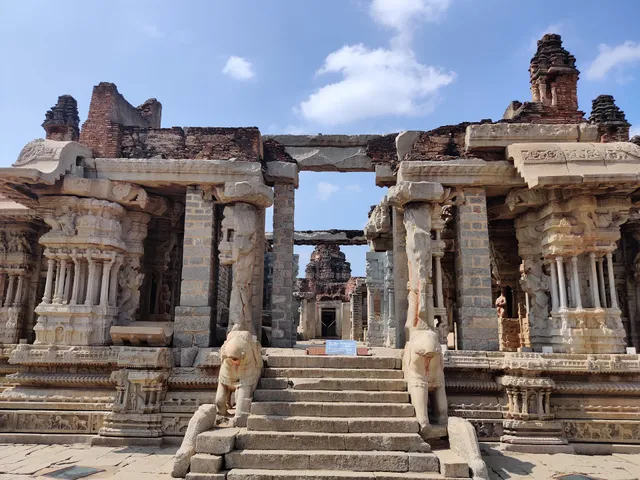
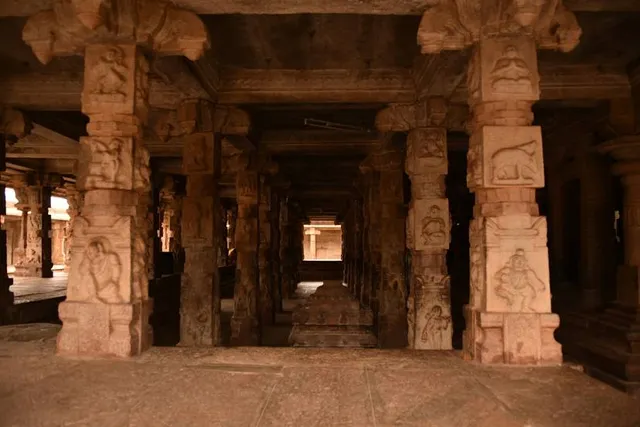
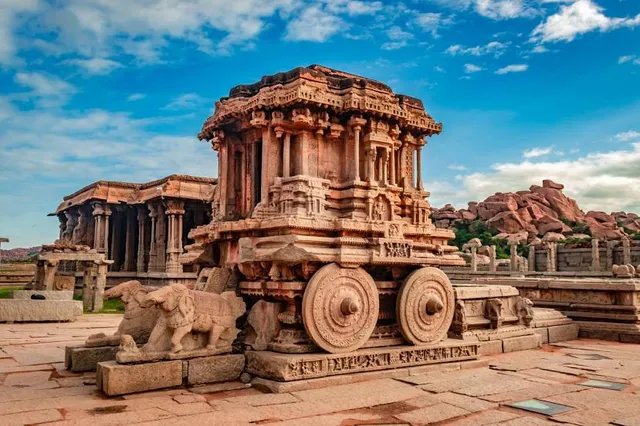
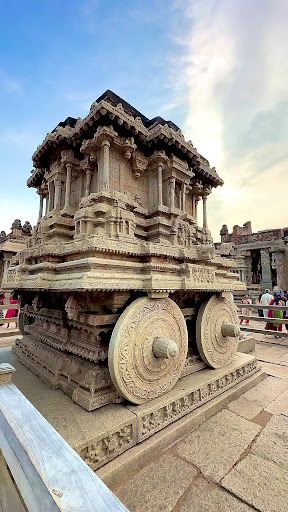
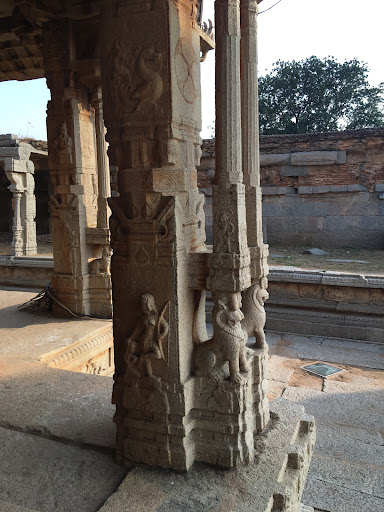
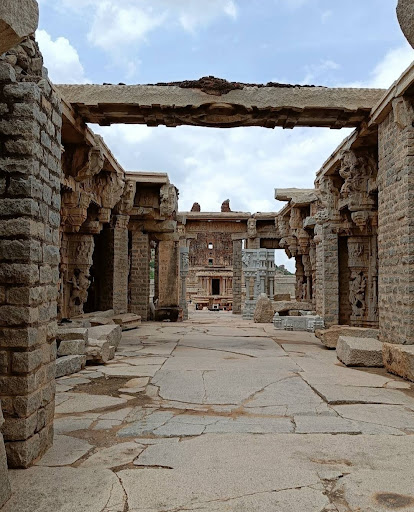
The main highlight of the Maha-Mantapa is its richly carved giant monolithic pillars. The outermost of the pillars are popularly called the musical pillars. These slender and short pilasters carved out of the giant pillars emit musical tones when tapped. Probably these do not belong to any of the standard musical notes, but the musical tone of the vibes earned it’s the name. Unmindful curiosity of the visitors has damaged many of these pilasters and tapping on it is banned for the sake of preservation.
The eastern hall which is called the musicians hall is notable for sculptures of musicians on the pillars. Each of the pillars surrounding this hall is sculptured with musicians, drummers and dancers.
The southern hall is dominated with the rampant mythical creatures called Yalis. The capitals of each of the pillars branches into heavily ornate corbels with terminating with lotus buds.
The northern hall is surrounded with a series of pillars with the Narasimha (the man-lion incarnation of Vishnu) themes. The most notable ones are that of Narasimha slaying Hiranyakashipu on his lap. Prahlada is seen sitting at the base in a praying posture.
The ceilings of the halls too are of interest with the lotus like carving at the centre.
Further west is a closed hall with two porches on either side. Further ahead is the sanctum.
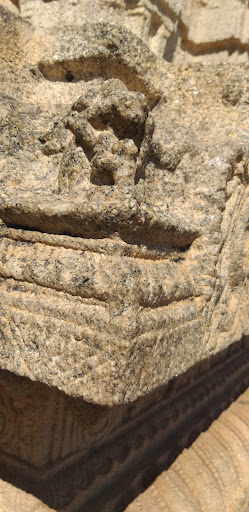
The inner sanctum is devoid of any idol. A narrow and unlit passageway encircles the inner sanctum. A few steps on either sides of the sanctum’s main door give access to this passage. The outer wall of the sanctum that one can only sees from this passageway is richly decorated with the Kumbha-Pankajas (the motifs where lotus flower flows out of a pot) Mischief (?) by the architects. A image of a bull and elephant with a shared head. The left portion is complete as a bull and the right as an elephant!
The other attractions include the Goddess’s shrine in the northwest, the 100-pillared hall at the southwest, the Kalayna Mantapa (the ceremonial marriage hall) in the southeast and the pillared cloisters all around the enclosure wall.
You can reach Vittala temple in two ways. The first is by the road and the second is by a walk along the riverbank from Hampi Bazaar. You can take and auto rickshaw from Hampi bus stand (Rs40) to Vittala temple. Or catch a local bus first from Hampi bus stand to Kamapapura and then from Kamaplapura to Vittala temple (ask any one at the Kamalapura bus stand to spot you the right bus)
Admission fee Rs10 for Indian citizens; USD5 or equivalent for foreign nationals. Preserve this ticket. You can use the ticket for the same day to enter the Zenena Enclosure area in the Royal Centre. Admission is free for children under age of fifteen.
Pay at the ticket counter Rs25 for use of video camera. You can use still camera free of cost. Use of tripods is not permitted inside the temple campus.
The monument opens from 8.30 in the morning to 5.30 in the evening. Try to visit this place soon it opens in the morning. You can practically see & photograph peacefully before the crowd (and noise!) builds up slowly...If this was helpful👍🏻Check out YouTube channal...
Read moreThe Ranga Mantapa is one of the main attractions of the Vittala Temple. The large mantapa is renowned for its 56 musical pillars. These musical pillars are also known as SAREGAMA pillars, indicating the musical notes emitted by them. The musical notes and emanated when the pillars are tapped gently.
There are a set of main pillars and several sets of minor pillars inside the Mantapa. Each main pillar provides support to the ceiling of the Ranga Mantapa. The main pillars are designed as musical instruments.
Every main pillar is surrounded by 7 minor pillars. These 7 pillars emit 7 different musical notes from the representative musical instruments. The notes emanating from these pillars vary in sound quality depending on whether the instrument is a percussion, string or wind instrument.
The cluster of musical pillars inside the Vittala Temple complex was carved out of huge single pieces of resonant stone.
The emission of musical notes from stone pillars was a mystery that fascinated many people down the centuries.
Even the British rulers of India were wonderstruck and wanted to discover the secret behind the musical pillars. To satisfy their curiosity and to unravel the mystery behind the amazing pillars they cut two of the musical pillars of Vittala Temple to check whether anything existed inside the stone pillars that resulted in the emission of musical notes. However, they found nothing inside the pillars.
The two pillars cut by the British rulers still exist inside the temple complex and can be seen by...
Read moreOne of the best monuments to be visited - if you're in HAMPI 🥰🥰🥰🥰 It’s our heritage to praise such a birthplace of Lord Hanuman ji🙏🙏🙏🙏🫶🫶 I will recommend people to buy tickets prior - before visiting this place to save time and money, As you need to get scanned before entering the place. Lots of parking space is there to park your two and four wheekers👌 and inside section they have made arrangement of Vehicle (electric buggy types) to take visitors inside - which is again chargeable and paid one of 20 rupees per person. Even though they don’t allow to tap on the pillars which are located at centre. You can tap on side pillars and listen to sounds which really astonishes and surprises you 🥰🥰🥰🥰🥰🥰 Do not miss to see the temple behind, where you can see the special architecture of god and where the light rays falls on the space - which was made for water, and it will illuminate the whole temple (its an ancient belief).... One more thing - this musical pillars are inside "Vijaya Vitthala Temple" so you need to visit here, before experiencing musical...
Read more