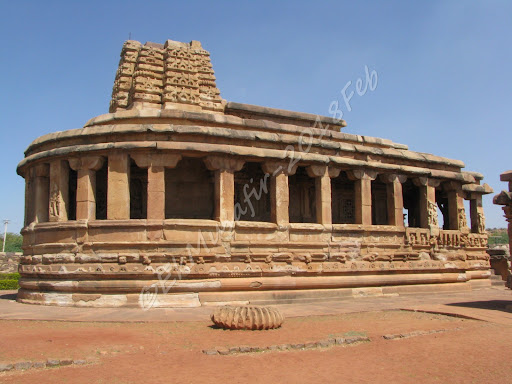
Durga Temple, is located at Aihole, Karnataka at a distance of 35 kms from Badami. Durga temple is the primary attraction in Aihole and most spectacular representations of Aiholë temples. Durga temple complex houses an archaeological museum and art gallery.
Aihole's original name 'Ayyavole' has a legendary connection; the name is associated with the story of Parashurama slaying the entire Kshatriya race with his axe. It is said that Parashurama washed his bloodied axe in Malaprabha turning the river's water red. At that time few women from the village had come to the river to take water; at the sight of red water they all shouted 'Ayya Holi!' meaning 'Oh the river!'. Hence the place came to be known as Ayyahole ~ Aihole. As per inscriptions Aihole was also known by the name Aryapura.
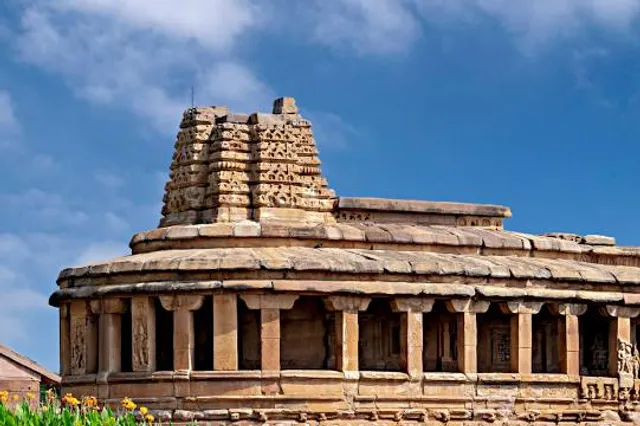
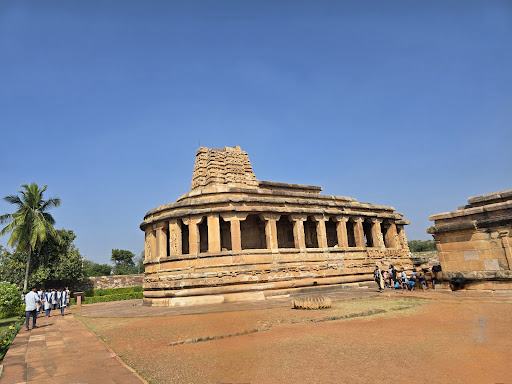
Heralded as the ‘cradle of Hindu/ Dravidian temple architecture’, Aihole is a tranquil village on the banks of Malaprabha River. Hundreds of temples pepper the villages and fields nearby. The most noteworthy among them is the Durga Temple composed of a semicircular apse, an elevated plinth and a gallery encircling the sanctum.
The Durga temple is the best known and studied of the Aihole temples. It has a misleading name, because the temple is not named after goddess Durga. According to one theory, it stands near the ruins of a fort-like enclosure or durg during a time of late medieval era Hindu Muslim conflict in the region. According to another local tradition, a stone rubble durg and lookout was assembled on its flat roof and locals therefore began calling it the Durga temple. The temple was originally dedicated to Hindu gods Surya and Vishnu.The temple was dated by early scholars to the 5th century CE, but variously revised to be from between the late 6th and early 8th century.
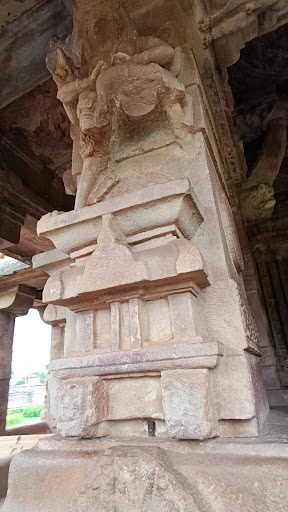
Originally it was a Surya temple. This temple was built by Aatada Ale Komarasingha during the days of Vikramaditya II. It is one of the examples of experiments in temple designing that took place at Aihole,and it is apsidal in shape with its back resembling the hind part of an elephant (gajaprishtha).Standing on a high pedestal. It has a fallen Rekhanagara Shikhara; Its collonade divideds the temple into apse and ailes, and the columns pass behind the apsidal sanctum. It has a frontalMantapa with steps to reach the temple from the east and the west. The temple is surrounded by aparapet and short pillars support its roof together with the inner Colonnade. Its exterior has fine Ramayana scenes. The Mantapa pillars have fi gures of gods and goddesses and amorous couple.The Devakoshtas on the exterior have Shiva riding Nandi, Vishnu, Mahishamardini and othervigorous images.
The Durga temple is the principal attraction for Aihole visitors and iconic in its apsidal layout.This shape is similar to 2nd or 1st century BCE Buddhist chaitya halls found in Ajanta Caves. The Durga temple stands on a high moulded adisthana and a damaged tower that had a curvilinear shikhara. The damaged tower's amalaka crown lies on the ground. A colonnaded and covered ambulatory passage with major carvings runs around the sanctum. The mukha mandapa (main hall) and the sabha mandapa (community hall for functions) show intricate carvings.
The Durga temple reverentially displays gods and goddesses from Shaivism, Vaishnavism and Shaktism traditions of Hinduism. The included near life-size statues include Shiva, Vishnu, Harihara (half Shiva, half Vishnu), Durga in her Mahishasuramardini form killing the buffalo demon, goddesses Ganga and Yamuna, Brahma, Surya, avatars of Vishnu such as Varaha and Narasimha.The temple has friezes to tell the story of the Ramayana and the Mahabharata. Further, the temple has artwork showing scenes of daily life and couples, including several amorous couples in various stages of courtship...
Read moreBeautiful temple Aihole is referred to as Ayyavole and Aryapura in its inscriptions and Hindu texts from 4th to 12th century CE, as Aivalli and Ahivolal in colonial British era archaeological reports.1]
Aihole has been a part of Hindu mythologies. It has a natural axe-shaped rock on the Malaprabha river bank north of the village, and a rock in the river show a footprint.[17Parashurama, the sixth Vishnu avatar, is stated in these legends to have washed his axe here after killing abusive Kshatriyas who were exploiting their military powers, giving the land its red color.1118] A 19th-century local tradition believed that rock footprints in the river were those of Parashurama.[17] A place near the Meguti hillocks show evidence of human settlement in prehistoric period. Aihole has historical significance and has been called a cradle of Hindu rock architecture.[20]
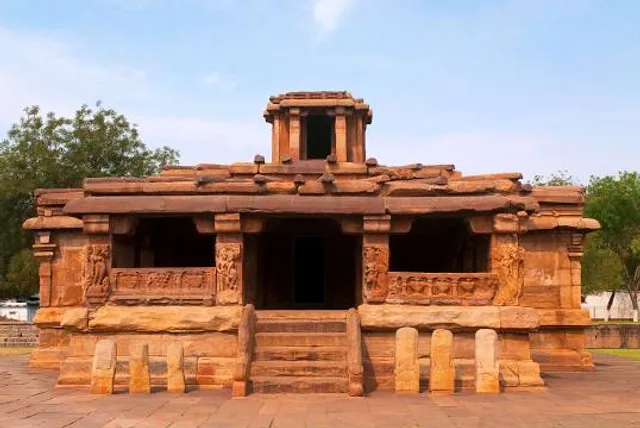
The documented history of Aihole is traceable to the rise of the Early Chalukya dynasty in 6th century.[21] It became, along with nearby Pattadakal and Badami, a major cultural center and religious site for innovations in architecture and experimentation of ideas.[6 The Chalukyas sponsored artisans and built many temples in this region between the 6th and 8th centuries.23 Evidence of wooden and brick temples dating to 4th-century have been unearthed. Aihole started the experimentations with other materials such as stone around the 5th century when the Indian subcontinent saw a period of political and cultural stability under the Gupta Empire rulers. Badami refined it in 6th and 7th centuries. The experimentations culminated in Pattadakal in the 7th and 8th centuries becoming a cradle of fusion of ideas from South India and North India In the 13th century and thereafter, the Malprabha valley along with much of Deccan became a target of raids and plunder by the Delhi Sultanate armies devastating the region.25 From the ruins emerged the Vijayanagara Empire which built forts and protected the monuments, as evidenced by inscriptions in the fort at Badami. However, the region witnessed a series of wars between Vijayanagara Hindu kings and Bahmani Muslim sultans. After the collapse of Vijayanagara Empire in 1565, Aihole became a part of the Adil Shahi rule from Bijapur, with some of the Muslim commanders using the temples as residence and their compounds as garrison for storing weapons and supplies. A Hindu temple dedicated to Shiva came to be called Lad Khan temple, named after the Muslim commander who used it as his operational hub, and a name that has been used ever since.[25] In late 17th-century, the Mughal Empire under Aurangzeb gained control of the region from Adil Shahis, after which Maratha Empire gained control of the region. It again changed hands with Haider Ali and Tipu Sultan conquering it in late 18th century, followed by the British that defeated Tipu Sultan and annexed the region.[25]
The monuments at Aihole-Badami-Pattadakal show the existence and a history of interaction between the early northern style and early southern style of Hindu arts.[29]According to T. Richard Blurton, the history of temple arts in north India is unclear as the region was repeatedly sacked by invaders from Central Asia, particularly the Muslim incursion into the subcontinent from 11th-century onwards, and "warfare has greatly reduced the quantity of surviving examples". The monuments in this region are amongst the earliest surviving evidence of these early religious...
Read moreThe Durga Temple at Aihole is one of the finest examples of early Indian temple architecture, showcasing the brilliance of the Chalukya dynasty. Located in the quaint village of Aihole, often referred to as the "Cradle of Indian Temple Architecture," this temple stands as a testament to the artistic and spiritual legacy of ancient India.
The Unique Design
Contrary to its name, the Durga Temple is not dedicated to Goddess Durga but gets its name from the term ‘Durga’, meaning ‘fort’ in Sanskrit, as it is part of a fortification. The temple’s most distinctive feature is its apsidal (semi-circular) shape, resembling a Buddhist chaitya hall. This unique design sets it apart from most Hindu temples and highlights the cultural synthesis of architectural traditions.
Architectural Highlights
Pillared Sabha Mandapa (Hall): The temple boasts intricately carved pillars that depict various deities, scenes from Hindu mythology, and celestial beings.
Curvilinear Shikhara: The towering vimana (shikhara) above the sanctum is an early representation of South Indian Dravidian temple architecture.
Intricate Sculptures: The outer walls are adorned with exquisite carvings of gods, goddesses, and battle scenes, reflecting the artistic genius of the Chalukyan era.
Corridor with Colonnades: A circumambulatory path with beautifully sculpted columns surrounds the temple, offering a serene space for devotees.
Spiritual and Historical Significance
Built between the 7th and 8th centuries, the Durga Temple is dedicated to Lord Vishnu and Lord Shiva, making it a sacred site for devotees of both deities. Its apsidal structure and artistic details also indicate the influence of early Buddhist architecture, symbolizing a period of cultural amalgamation.
Why Visit the Durga Temple?
Architectural Wonder: Witness the evolution of Indian temple architecture in its early stages.
Cultural Insight: Learn about the Chalukyan dynasty’s contributions to art and spirituality.
Tranquil Setting: The serene ambiance of Aihole makes it a perfect spot for history buffs, architecture enthusiasts, and peace seekers.
Travel Tips
Best Time to Visit: October to February for pleasant weather.
How to Reach: Aihole is about 34 km from Badami, which is well-connected by road.
Entry Timings: Open daily from 9:00 AM to 5:00 PM.
Entry Fee: 30 rupees
The Durga Temple at Aihole is more than just a historical site—it’s a journey into the past, where art, religion, and culture come together. Whether you're a traveler, a history enthusiast, or someone seeking inspiration from ancient craftsmanship, this architectural gem promises a fulfilling experience. Visit Aihole and let the Durga Temple narrate its timeless tale of devotion...
Read more