Koodalmanickyam is the Malayalam translation of the Sanskrit word Sangameswara. There is, however, another tale about the name. One day the idol was found to emanate an unusual bright light from its forehead. Unable to identify the source of the brightness, some brought a Quartz (manikam) in the possession of the Raja of Kayamkulam for comparison. As they were comparing the brightness of the two, it is said that the stone brought from Kayamkulam mysteriously slipped from the hand and merged with the one on the idol. The merging of two manikyams led to the name ‘Koodalmanikyam’. A similar brightness is reported to have appeared on the idol once again According to the early history, in 854 A.D.,Koodalmanikyam temple is mentioned in a stone inscription, attributed to the Chera king Stanu Ravi Varman, who donated vast areas of land for the temple. It is accepted that the temple must have been in existence for some time before this date and that even then Koodalmanikyam occupied a place of importance among temples of Kerala. Shri Koodalmanikyam temple plays a key role in the history of Irinjalakuda, as most of the lands in and around the region belonged to the Koodalmanikyam temple . Shri Koodalmanikyam Devaswom has allotted land to accommodate Government institutions, Christ College and for public use to facilitate development activities in the region.
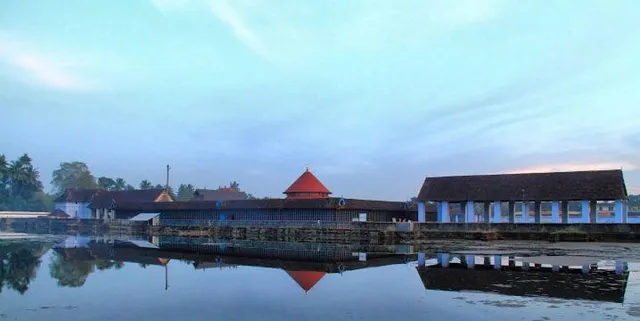
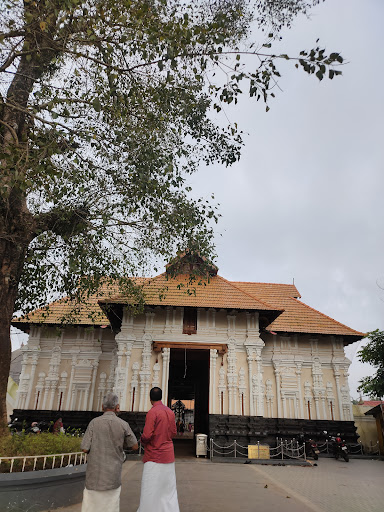
Shri Koodalmanikyam temple is a marvel in architectural beauty. The impressive gateways, round shaped sanctum sanctorum, the majestic Koothambalam and the carvings in wood and stone on the walls all attract students of art and architecture.
The temple holds its annual festival for ten days each year in the Malayalam month of Medam (April/May). The first day of the festival is calculated by the appearance of the Uthram asterism and signified by hoisting a ceremonial flag. Each day of the festival, temple elephants seeveli is held twice, once in the morning and once at night, with the accompaniment of Panchari melam. Seventeen elephants take part. Two features of the seeveli are unique to the Koodalmanikyam Temple: two baby elephants are included in the procession, one standing on each side of the elephant carrying the deity. While the head dresses of seven elephants are made of pure gold, the rest are made of pure silver. The last two days of the festival feature Panchavadyam (sacred music from an orchestra of five instruments), and the festival ends at the Thiruvonam asterism.
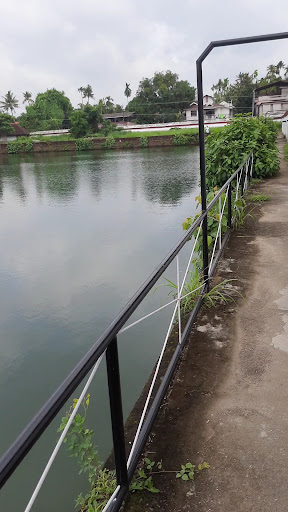
The temple is surrounded by four ponds. The largest of the four are Kuttan Kulam, located outside the compound on the eastern side, and Kulipini Theertham, located inside the compound. Kulipini Theertham is believed to be sanctified by the sage Kulipini Maharshi, who held a great ritual sacrifice. Priests are allowed to take part in the ceremonies after cleansing themselves at the "Kuttan Kulam" outside the temple and then after taking a dip in "Kulipini Theertham" before entering sanctum sanctorum. The pond outside the compound located at the western side, is called "Padinjare Kulam" and the pond outside the compound located at the southern side is called "Thekke Kulam".
It is believed that worship at all these four temples on the same day is especially meritorious. Ardent devotees used to make it even in those days, when they had to cover the entire distance by foot or in bullock carts. In the Malayalam month of arkidakam (July 15th to August 15th) – the Ramayana Masa, thousands of devotees do this special pilgrimge, which is popularly known as Nalambalam Thozhal – a pilgrimage to the four temples.
Triprayar is about 23 kms away from Guruvayoor Krishna temple and Moozhikulam is 30 kms away from...
Read moreWe were at the Sree Koodal Manikyam temple in the month of August 2024. An amazing place. The huge expanse of area hits you. As it was drizzling then, the ground around the temple had turned lush green. Supposed to be the ONLY temple for Bharat, the brother of Lord SriRam, it is a visual treat. Brightly coloured wall murals welcome us into a long stone paved pathway. An old wooden door with a round wooden sculpture on the top welcomes you. Sharing a thought that came to my mind as I circumbulated the temple. Now a days, we walk 10k steps a day for good health, I am sure in the good old days, when people circumbulated this huge temple it was prayer plus exercise.
This is the only temple in India for worshipping BHARATHA, Younger brother of lord SRIRAMA..
This temple is the second temple to visit in Naalambala Yatra in kerala.. This is one of the rare temples where only one idol is there. The temple has a private devaswom.
Very Spacious temple with a huge tank inside the temple..
Darshan 3am – 12 noon, and 5pm to 8pm .
On the other side
Situated at Irinjalakuda in Thrissur district, Kerala, Koodalmanikyam Temple is the only temple in India dedicated to Bharata, the brother of Lord Rama. One of the distinctive feature of Koodalmanikyam temple is that there is only one single Prathista (single deity). According to the legend, thousands of years ago, Irinjalakuda was a dense forest . Kulipini Maharshi and some other sages did a great Yagna to please Lord Vishnu. Pleased with their devotion, the Lord Vishnu appeared before them. As boon, Kulipini Maharshi and other sages wanted the eternal presence of the Lord at that place. The Lord readily agreed. Happy with the presence of the Lord, all the sages prayed to Goddess Ganga to bless the sacred Yagnabhoomi with her presence. All the sages immersed themselves in the sacred waters and became one with the Lord. The temple itself was not built immediately after the incident. The place was not inhabited for many hundred years probably. According to the legends, a local Chieftain, Vakkay Kaimal, had a dream one night in which some mysterious person appeared before him and told him that the four idols have been washed ashore and that these idols are to be consecrated at such and such places. Next day, Kaimal hastened to the seashore and he saw four idols laying there as indicated in the dream. As per the instructions in the dream, the four idols were duly installed in four temples. Lord Rama at Thriprayar (22 Km North west of Irinjalakuda), Bharata at Irinjalakuda, Lakshmana at Moozhikulam (30 KM south west of Irinjalakuda) and Shatrughna at Payammal (5 KM south of Irinjalakuda). It is believed that worshiping at these four temples on the same day is especially meritorious. This temple is part of the famous Nalambala Darshana Yatra.The eastern gate way (Gopuram) is an impressive structure in the typical Kerala style of architecture with tiled roof and white washed walls.
This is a part of the Nalambalam. The others being Triprayar, Moozhikulam and Payyamal temples. Do visit this at Irinjalikuda . Highly...
Read moreKoodalmanikyam Temple or Kudal Manikkam Temple / Koodalmanikkam Temple is a Hindu temple which is situated in Manavalassery village, Irinjalakuda, Trissur district, Kerala state, India. The temple comprises the main structure, walled compound with citadels, four ponds around the main structure where in one of the ponds is situated within the walled structure. Koodalmanikyam Temple is the only ancient temple in India dedicated to the worship of Bharata, the third brother of Rama, however the idol is that of Vishnu. "Sangameshwara"(Lord of the Confluence) is another name associated with the deity at Koodalmanikyam. The temple is one of four in Kerala state that form a set called "Nalambalam",each temple dedicated to one of the four brothers in Ramayana: Rama, Bharata, Lakshmana and Shatrughna.
The custom in most of the temples in Kerala is to have five poojas and three sivelis a day. But in Koodalmanikyam there are only three poojas and no siveli. There is no Usha Puja and Pantheeradi Puja at this shrine. The deity is taken out for ceremonial procession only during the annual festival. There is no deeparadhana. There are plans to start deeparadhana here. This is the only temple without Deeparadhana.
Sticks and camphor are not used for the pooja. The floral offerings to the deity consist of lotus, tulasi (ocimum sanctum) and thechi (ixora). But they are not grown in the temple compound. No other flower is taken for pooja or for making garlands. Lotus garland is an important offering to the deity. A garland will be offered to the deity which does have not less than 101 lotus flowers.[citation needed]
The temple holds its chief annual festival for ten days each year in the month of Medam (April/May). The first day of the festival is calculated by the appearance of the Uthram asterism and signified by hoisting a ceremonial flag. (The start day falls one day after the famous Thrissur Pooram festival in nearby Thrissur.)
Each day of the festival, a seeveli (procession of caparisoned temple elephants) is held twice, once in the morning and once at night, to the accompaniment of Panchari melam (sacred music). Seventeen elephants take part. Two features of the seeveli are unique to the Koodalmanikyam Temple: first that two baby elephants are included in the procession, one standing on each side of the elephant carrying the deity. Second, while the headdresses ('Netti pattam' in Malayalam) of seven elephants are made of pure gold, the rest are made of pure silver. The last two days of the festival feature Panchavadyam (sacred music from an orchestra of five instruments), and the festival ends at the...
Read more