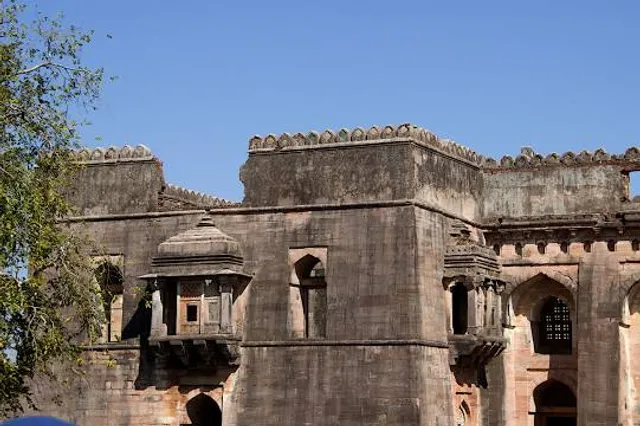
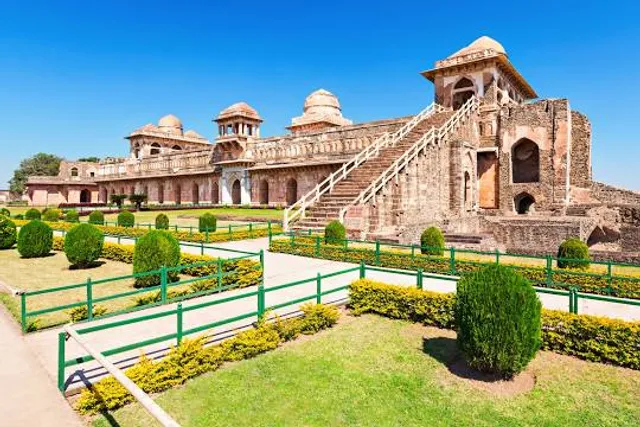
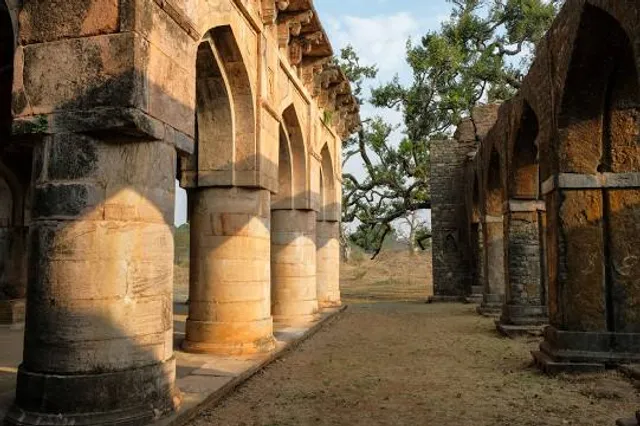
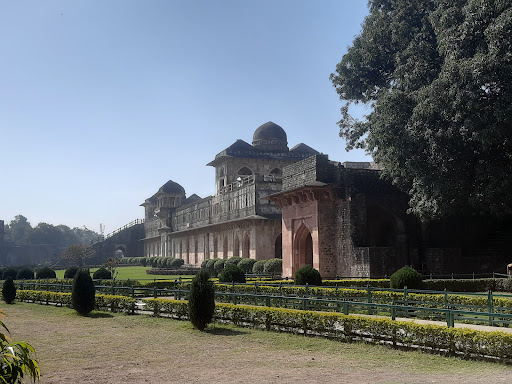
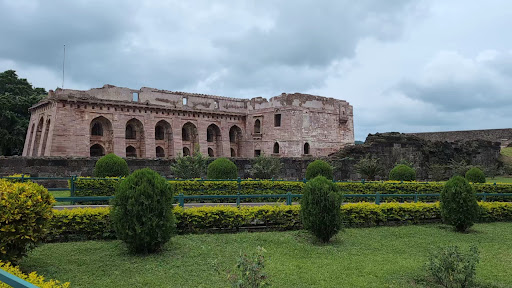
Hindola Mahal in Mandu represents the characteristic elements of the architectural style that was prevailing in Mandu region during the second-half of 15th century (1400-1550). It involves simplicity, boldness, and having a definite aesthetic appeal. The Hindola Mahal given an impression of architectural simplicity with minimal ornamentation and stands out boldly through massive inclined buttresses. These elements make the Hindola Mahal a unique exaggerated example of the Malwa style. In addition, the pointed arches on the building’s interior shows that Malwa architecture was influenced by the Delhi styles. The main hall is 27 meter long, 8 meter wide and 11 meter high. It is having 6 deep arches on either of the long sides with doorways below and trace-worked windows above which allows proper ventilation. Hall gets its due light & air through these windows. The massive vaulted roof of the hall has not prominently visible though the row of lofty arches which once supported the huge ceiling above. The east and west lateral walls of the hall are 2.7 meter thick excluding the width of sloping buttresses. The transverse projection of Hindola Mahal is a double storey building in the same dimension as the main hall. It is in less formal style with some oriel windows of artistic design. In this two storey building, the upper storey was reserved for the use of royal ladies. It has the access through sloping stages from north. From outside it seems to be a simple structure but on careful examination, we will realize its neatly chiseled masonry with fine joints with set of carved mouldings which enhances the beauty. It ground floor consists of cruciform (cross shaped) gallery whose one short entrance to main hall. Their are also some...
Read moreIt was a dream-come-true moment in my life,being in the hindola Mahal, its architecture makes people spellbound. As it is a little off beat place among common tourists, it is generally calm and serene due to less number of visitors...so the most amazing part is...there are not much people to bother you or to distract from the beauty of this historic place.... Monsoon is the main tourist season here... Hindola means "Swing" and the design of this palace resembles a swing.. Very nicely built adapting salient characters of Egyptian, Indian and french Architecture.. must go place. The "T" shaped projection was added later probably to provide a well-guarded approach for the king. Its interior is planed like a coss formed by the main passage leading to the hall and by an arm crossing at right angle. The main one along a flight of sloping stages meant for the royal ladies to go up in a palanquin or on a pony or on an elephant sine it is popularly called as Hathi-chadho. It consists of a big hall, the pillars and ceiling of which are lost. The exterior of the building with neatly chiseled masonry is extremely simple. The coloured tile work, commonly used in the scheme of decoration o the other buildings in Mandu, is found almost discarded. Architecturally, the building has been assigned to the end of Ghiyasu'd-Din's reign i.e., end of the fifteenth...
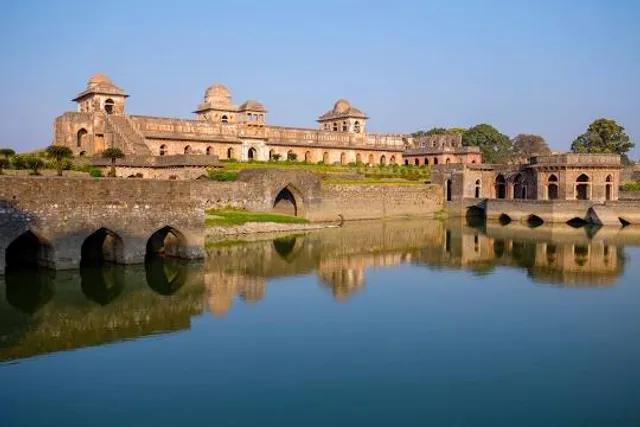
Read moreHindola Mahal – meaning Swing palace is so named due to its sloping side walls. The Hindola Mahal might have been constructed during the reign of Hushang Shah about 1425 C.E. but may date to the end of the 15th century during the reign of Ghiyas al-Din. It is one of a set buildings making up the royal palace complex at Mandu, which consists of the Jahaz Mahal, the Hindola Mahal, the Taveli Mahal, and the Nahar Jharokha. The Hindola Mahal may have been used as an audience chamber.The plan of the Hindola Mahal is a T-shape, though examination of the exterior walls leads to the conclusion that the crossbar was added later. The vertical mast of the plan consists of one main hall measuring 30 by 18 metres (98 by 59 feet) and 12 metres (39 feet) high. Its lateral walls are 3 metres (9.8 feet) thick and further reinforced by massive inclined buttresses that angle over 77 degrees. These highly inclined buttresses give the Hindola Mahal (Swinging Palace) its name. They also neutralize the outward force of five massive arches that once supported the large flat roof of the main hall. On each exterior of the long sides of the main hall are six recessed arches which hold doors in their lower sections and three slabs of open-work stone windows to let in air and light. A high wall holds battlements on the roof of...
Read more