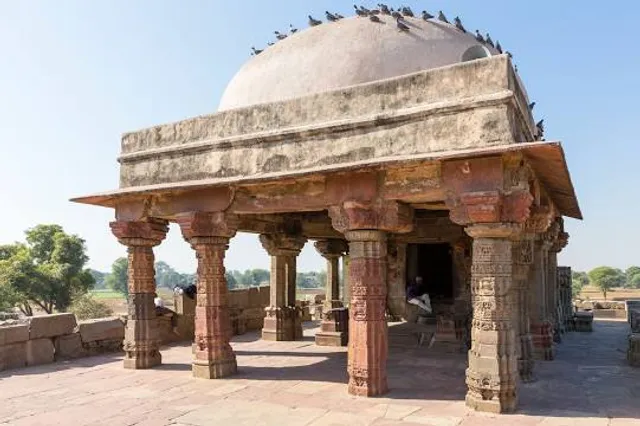
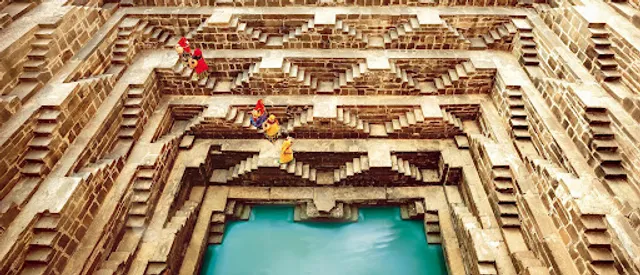
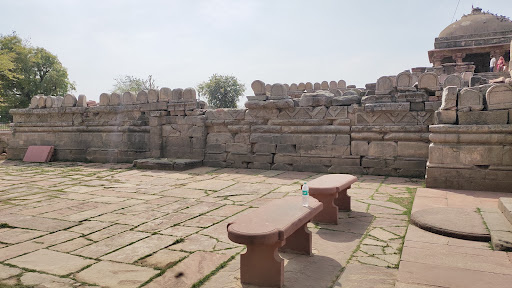
Harshat Mata Temple, also known as the Abhaneri Temple, is an ancient Hindu temple located in the village of Abhaneri, Rajasthan, India. Here are some key pointers about Harshat Mata Temple: Historical Significance: The temple dates back to the 7th-8th century and is dedicated to Harshat Mata, the goddess of happiness and joy. Intricate Architecture: The temple showcases stunning Rajasthani architecture with intricately carved pillars, sculptures, and decorative elements. Stepwell Adjacent: The temple is situated next to Chand Baori, one of India's deepest and most well-known stepwells, enhancing the cultural and historical significance of the site. Ruined State: Like many ancient structures, Harshat Mata Temple is in a state of ruins, but its architectural grandeur is still evident. Archaeological Site: The temple and Chand Baori are recognized as protected archaeological sites, preserving their historical and cultural value. Cultural Heritage: The temple exemplifies Rajasthan's rich cultural heritage and religious devotion during ancient times. Religious Relevance: Devotees visit the temple to seek blessings and offer prayers to Harshat Mata for joy and prosperity. Tourist Attraction: Despite its ruined state, the temple and Chand Baori attract tourists, history enthusiasts, and architecture admirers. Preservation Efforts: The Archaeological Survey of India is actively working to preserve and conserve the temple's architectural heritage. Cultural Exploration: Visiting Harshat Mata Temple allows visitors to delve into Rajasthan's rich history and explore the artistic splendor of ancient temple architecture. In conclusion, Harshat Mata Temple in Abhaneri is a treasure trove of ancient art and culture, with its intricate architecture and religious significance. It stands as a testament to the region's rich past and continues to captivate visitors with its historical allure and...
Read moreJai Mata Di❤️🙏🏻🚩 About 100 meters to the west stands a solitary temple with a dome roof. It is dedicated to Harshat Mata who is also referred to as Harsiddhi Mata in many texts. She is a goddess of happiness and Joy. Now, who would not like her blessings. The Harshat Mata Temple was built by the same king at the same time. In fact, ancient step wells were always located next to a prominent temple. The only exception I have seen is Rani ki Vav in Patan. It is a small temple on a high platform that you need to approach through a flight of stairs. Harshat Mata Temple faces the east and it originally had a Nagar style shikhara also called Mahameru Shikhara. The remains of this can be seen in the form of broken Amlaka pieces around the temple. An Amlaka is the representation of Amla or Gooseberry fruits that sits on top of the temple Shikhara. Dome is obviously a medieval replacement. Within the Nagar Style, it is Panchratha style temple. Notable sculptures at Harshat Mata temple are deities in the upper niches all around the temple. At the bottom level, you can see the Mangal Murtis of couples and Sur Sundaris. Parts of the original temple are profusely and finely carved. There are board games engraved on the floor indicating that this was not just a place of worship but a community space as well. The main idol inside the temple looks like a recent idol from its style.
Information - •Abhaneri is in Dausa district of Rajasthan, about 90 km from Jaipur. It is best to do it as a day trip from Jaipur. •On the way, you can also visit Bhangarh Fort – the most haunted place in India. •You need 30-60 minutes to see this place. I spent about 2 hours as I was exploring all possible sculptures. •Guides are available at the site, but if you have read this post, you would not...
Read moreMust go for all. A very ancient temple. The Harshat Mata Temple (IAST: Harṣat Mātā kā Mandir) is a Hindu temple in the Abhaneri (or "Abaneri") village of Rajasthan, in north-western India. The temple is dedicated to a goddess named Harshat Mata, although some art historians theorize that it was originally a Vaishnavite shrine. The original temple appears to have been built in the panchayatana style, which features a main shrine surrounded by four subsidiary shrines. Only parts of the main shrine now survive and they have been ruined and modified over several centuries, with the tall shikhara tower replaced by a roof-dome. Much of the platform survives, with fragments of carved stones from the original structure, but most of the sculptures have been removed to the museums in Amber and Jaipur.
No epigraphic evidence survives regarding the temple's construction. The analysis of its architectural and sculptural style suggests it was built in the early 9th century, shortly after the construction of the adjoining Chand Baori stepwell. The temple's original builder is unknown, but historians theorize that it may have been built by a Gurjara-Pratihara king, possibly in association with a local Chahamana vassal. The temple is now protected by the Archaeological Survey of India, but remains in...
Read more