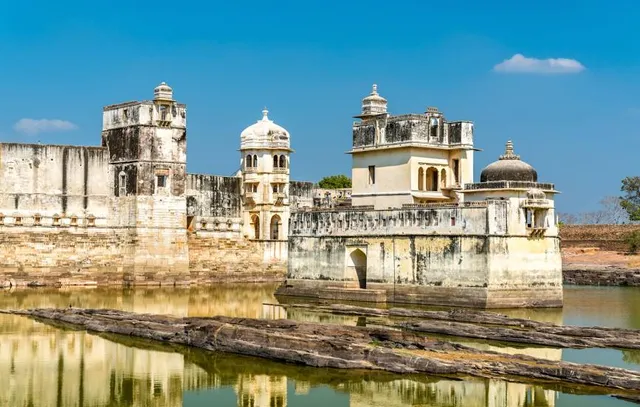
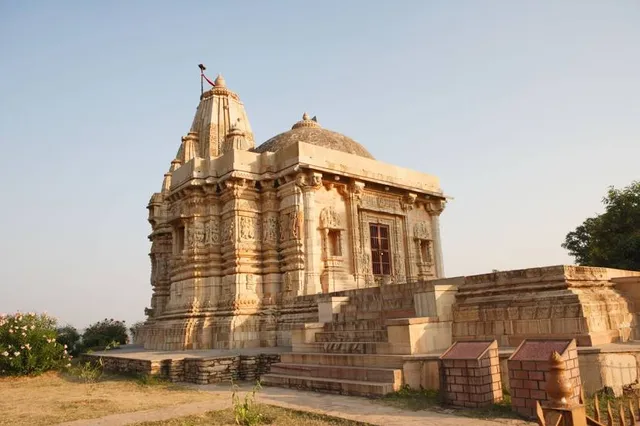
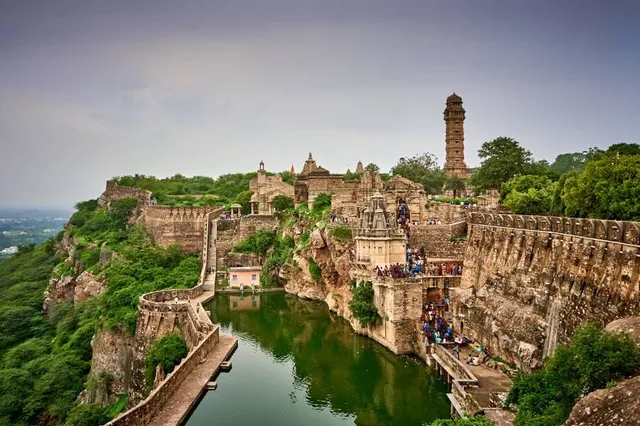
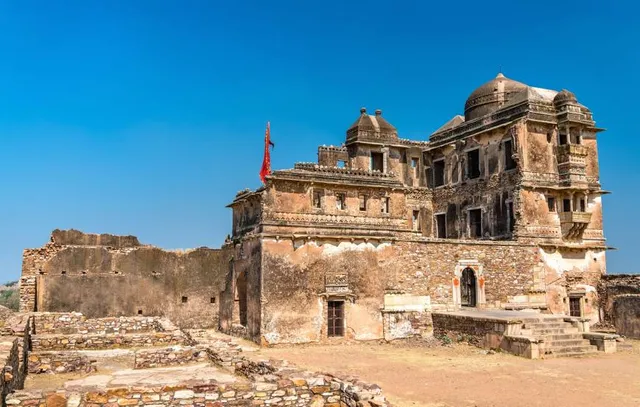
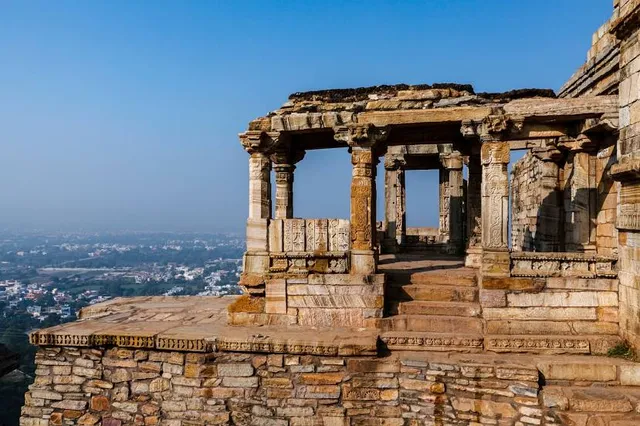
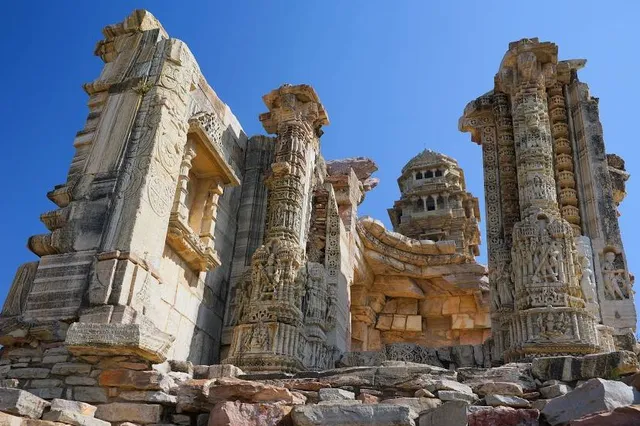
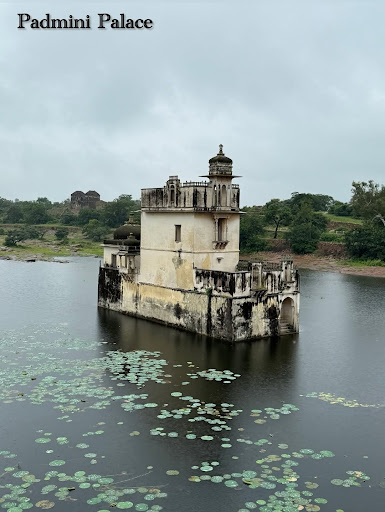
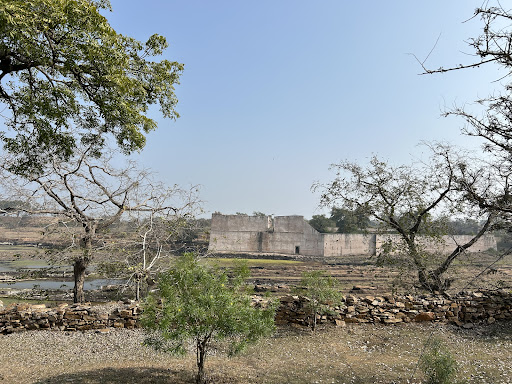
Padmini Mahal is the most talked-about private palace in Chittorgarh Fort. The Palace and the "Padmini Mahal Udyaan" (the beautiful garden around the palace) are more than 700 years old! The presence of a lake in the midst of the palace ensured that the temperature inside was always cool and very comfortable to the inmates. There are separate sections for ladies and gents and a rose garden all around. There are separate balconies for the King and the Queen to give audience to the ordinary public on special occasions. Princess Padmini, married to Ratan Singh, was considered then to be the most beautiful woman in the world! Legend has it that when she drank water, it got reflected on her very tender cheeks! That was her beauty! She was herself a trained swordswoman and she had ensured that she was always protected by a bevy of servants who were equally well-trained in "talwaar-baazi" - ability to wield the sword effectively, stationed in the servant quarters adjoining her own private quarters. In 1905, Lord Curzon as the Governor General of India had gifted to the palace a Belgium Crystal Glass Chandelier, the beauty of it being when the sunlight changes its direction, the crystal glass changes its shades of colours! The historic part of the Palace is a round building the inside walls on which were mounted four mirrors. The building, approachable by boats, has two windows facing each other on opposite sides, on one side of which alone it was possible to see the reflected image of Princess Padmini. The story goes thus: A pre-condition set by the Delhi Sultan Alauddin Khilji against attacking Mewar Kingdom was that he should be shown the Princess in person which was not agreed to by Mewar. Instead, they agreed for a mirror image of the Princess to be shown to the Sultan from one fixed spot inside the round building from where he would not be allowed to step an inch forward in adventure for he would then be instantly killed by the Mewar Guards! The Sultan could not resist the idea, and the rest was history. Sultan Alauddin Khilji did attack Mewar in 1303 AD when, alas! Princess Padmini preferred death to abduction and committed "jauhar" - an act of self-immolation, by leaping into a large pit of fire along with the other ladies of the Fort! The Fort got eventually captured by Alauddin Khilji, when all the Mewar warriors attained martyrdom in the war. Between the period 1300 AD and 1302 AD Mewar fought 30 battles against the Muslims, out of which 27 were won while three were lost! History was not kind to Mewar even after this first major attack that had resulted in the loss of several Rajput men, women and children! There were two more horrible attacks: in 1535 Bahadur Shah, the Sultan of Gujarat besieged the Fort causing immense carnage; 32000 men met martyrdom, while the ladies led by Rani Karnawati committed jauhar; jauhar was again committed the third time after the Moghul Emperor Akbar captured Chittorgarh in 1568 AD…! Chittorgarh thus holds a special place in the history of...
Read moreThe legend of Rani Padmini is one of the most poignant tales in Indian history, and her palace in Chittorgarh Fort stands as a haunting tribute to her story. While the historical accuracy of the tale is debated by scholars, the palace itself remains a powerful symbol of Rajput honor, sacrifice, and the famous 'Jauhar' ritual. A visit to this palace is less about its architecture and more about connecting with the powerful narrative it represents. The palace, a beautiful three-story white structure, is located on the southern part of the fort. It is strategically positioned in the middle of a lotus pool, a design element that adds to its mystique and offers a glimpse into a time of royal privacy and security. The reflection of the palace in the water is a sight to behold, creating a serene and captivating scene that belies its tragic past. The surrounding water body and the intricate Rajput architecture, with its delicate arches and beautiful jharokhas (balconies), make it a fascinating subject for photographs. The most famous part of the palace is a small, elevated pavilion where, according to legend, Alauddin Khilji was allowed to glimpse Rani Padmini's reflection in a mirror. It is said that this single glimpse of her beauty drove his obsession, leading to the devastating siege of the fort in 1303 CE. Today, a guide will still stand at the same spot and demonstrate the angle, allowing visitors to visualize the famous scene. This specific moment of the story, even if a romanticized part of folklore, is what gives the palace its immense emotional weight and draws countless visitors. While the palace is smaller compared to other royal residences within the fort, its significance is unparalleled. It is here that Rani Padmini and thousands of other women are believed to have committed 'Jauhar,' choosing self-immolation over dishonor at the hands of the invading army. The ruined state of the palace adds to this somber atmosphere, making it a place of solemn reflection rather than a cheerful tourist spot. Visiting Rani Padmini's Palace is a unique experience. It’s not just about exploring an old building; it's about standing on the very ground where a monumental act of courage is said to have occurred. The palace serves as a tangible link to a story that has been passed down through generations, symbolizing the unyielding spirit of the Rajputs. It reminds us that history is not just a collection of facts, but a tapestry of human emotions, sacrifices, and legends that continue to inspire and resonate even...
Read moreThere’s a thing about history, we are never sure what exactly happened because often, the facts get mutated with the ravages of time and travel. Similarly, the story of Rani Padmavati, fondly referred to as Rani Padmini, is wrought in various versions, some claiming her to have been defeated by Ratan Sen in sword fighting that made her marry him, others suggesting that it was her talking parrot that led to the union of the two lovers. If we talk about the current era of social media, discourses about history are innumerable and untraceable. Nevertheless, there’s one thing that runs common in all the versions: she was a woman of unprecedented beauty. And the ‘Johar Kund’ in Chittorgarh where Rani Padmavati performed ‘jauhar’ (custom of self-immolation by women) more than seven hundred years ago is a place as significant as, let’s say, the Western Wall or the Ka’bah in Mecca.
The jauhar of Rani Padmini has given her a goddess-like stature in the history of the state because it was among the first three major Sakas of Chittorgarh. The antagonist, hence, is Allauddin Khilji who attacked Chittor and led to Ratan Sen’s execution.
When history begins informing a theocratic identity, sensitivities of people begins to run mountain high. If anything, even seemingly, threatens or distorts the roots, a sense of anger and victimhood is inevitable. Such sentiments have led to the protest against Sanjay Leela Bhansali’s magnum opus, ‘Padmavati’.
However, it isn’t as simple as that. There are many, many versions to the history of Rani Padmini and here we look at all these versions.
It is interesting to note that earlier accounts of Alauddin Khilji’s conquest of Chittorgarh make no mention of Rani Padmavati. The first mention that has been made of the queen is in the epic poem written in Awadhi language by Malik Mohammad Jayasi titled ‘Padmavat’.
‘Padmavat’ by Malik Mohammad Jayasi
She was the daughter of the king of Singhal kingdom, former Sri Lanka, and was close friends with a talking parrot, a friendship that her father resented. So, the parrot was ordered to be executed but it somehow escaped and managed to reach the local king Ratan Sen. The parrot was all-praises for the beauty of Rani Padmavati and so, Ratan Sen determined to marry her. In his pursuance of her, he reached Singhal and a love chase followed. They couldn’t meet but it led to a chain of events that ultimately got them together and married. However, an enmity ensued between Padmavati and the first wife of Ratan...
Read more