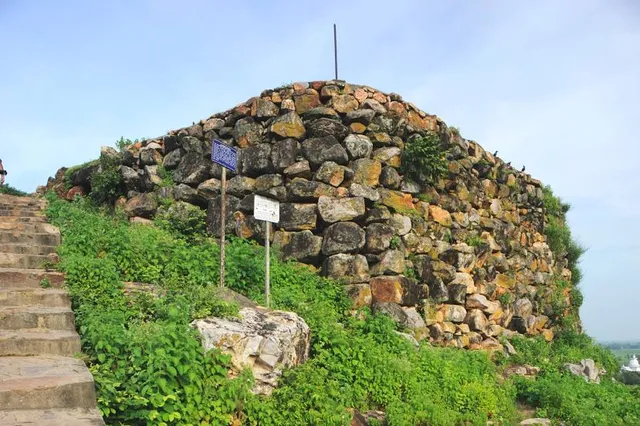
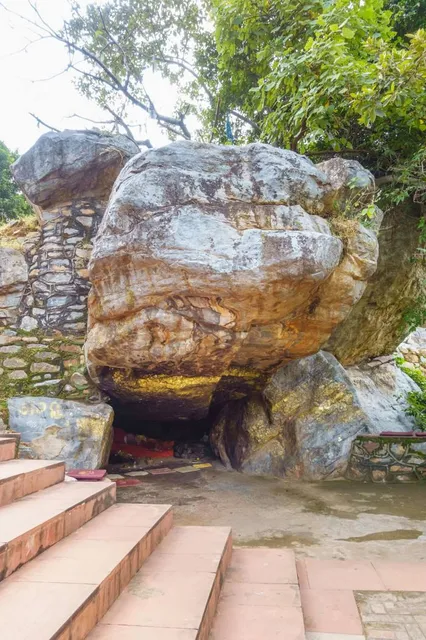
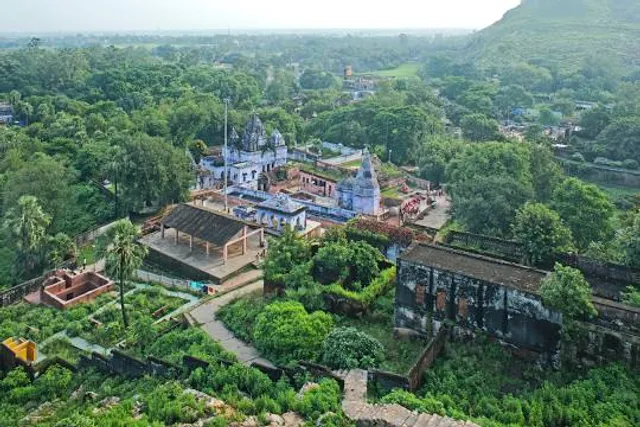
The epic Mahabharata calls it Girivraja and recount the story of its king, Jarasandha, and his battle with the Pandava brothers and their allies Krishna. Jarasandha who hailed from this place, had been defeated by Krishna 17 times. The 18th time Krishna left the battlefield without fighting.[5] Because of this Krishna is also called 'ranachorh' (one who has left the battlefield).[6] Mahabharata recounts a wrestling match between Bhima (one of the Pandavas) and Jarasandha, the then king of Magadha. Jarasandha was invincible as his body could rejoin any dismembered limbs. According to the legend, Bhim split Jarasandha into two and threw the two halves facing opposite to each other so that they could not join. There is a famous Jarasandha's Akhara (place where martial arts are practiced). It is also mentioned in Jain and Buddhist scriptures, which give a series of place-names, but without geographical context. The attempt to locate these places is based largely on reference to them and to other locations in the works of Chinese Buddhist pilgrims, particularly Faxian and Xuanzang. It is on the basis of Xuanzang in particular that the site is divided into Old and New Rajgir. The former lies within a valley and is surrounded by low-lying hills, Rajgir hills. It is defined by an earthen embankment (the Inner Fortification), with which is associated the Outer Fortification, a complex of cyclopean walls that runs (with large breaks) along the crest of the hills. New Rajgir is defined by another, larger, embankment outside the northern entrance of the valley and next to the modern town. It was here that Gautama Buddha spent several months meditating, and preaching at Gridhra-kuta, ('Hill of the Vultures'). He also delivered some of his famous sermons and initiated king Bimbisara of Magadha and countless others to Buddhism. On one of the hills is the Saptparni cave where the First Buddhist Council was held under the leadership of...
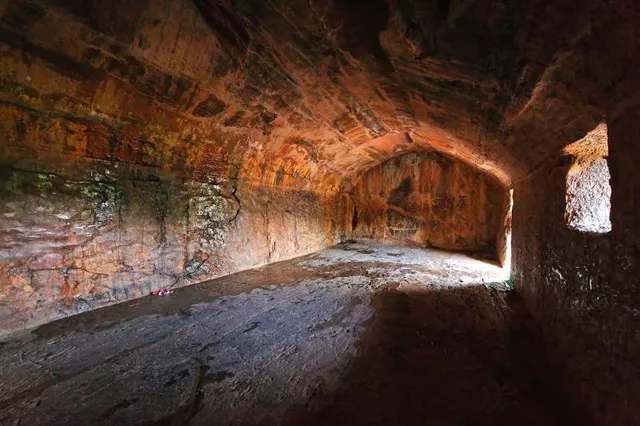
Read moreIf you're visiting Rajgir, Swarn Bhandar (Son Bhandar Caves) is a must-see ancient site that carries immense historical and mythological significance. Here’s why I highly recommend it:
Fascinating History & Legend Believed to be over 2,500 years old, these rock-cut caves are associated with King Bimbisara and even Lord Mahavira. Local legends claim that the caves once held hidden treasures of the Mauryan Empire, protected by an ancient inscription that no one has fully deciphered!
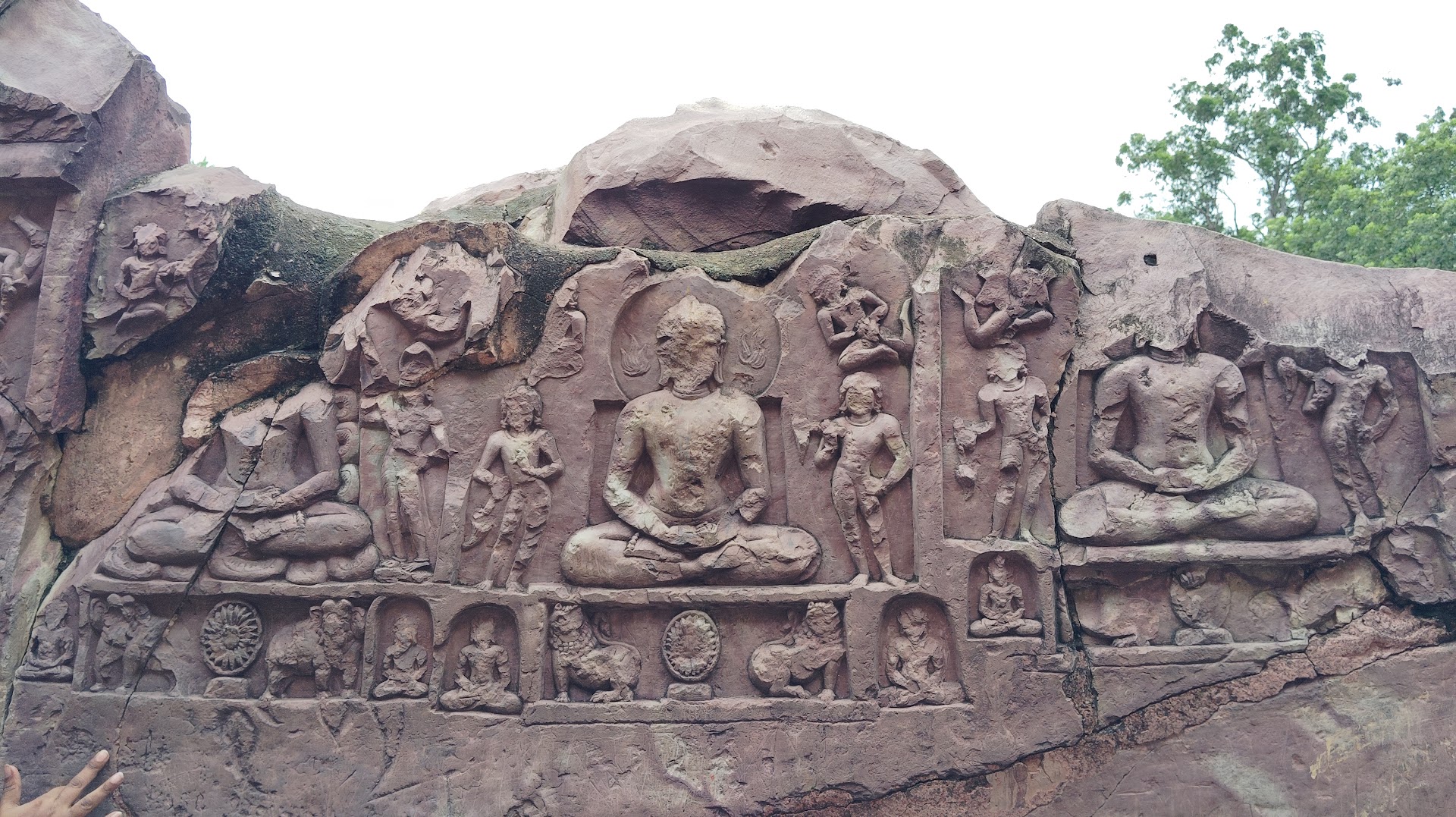
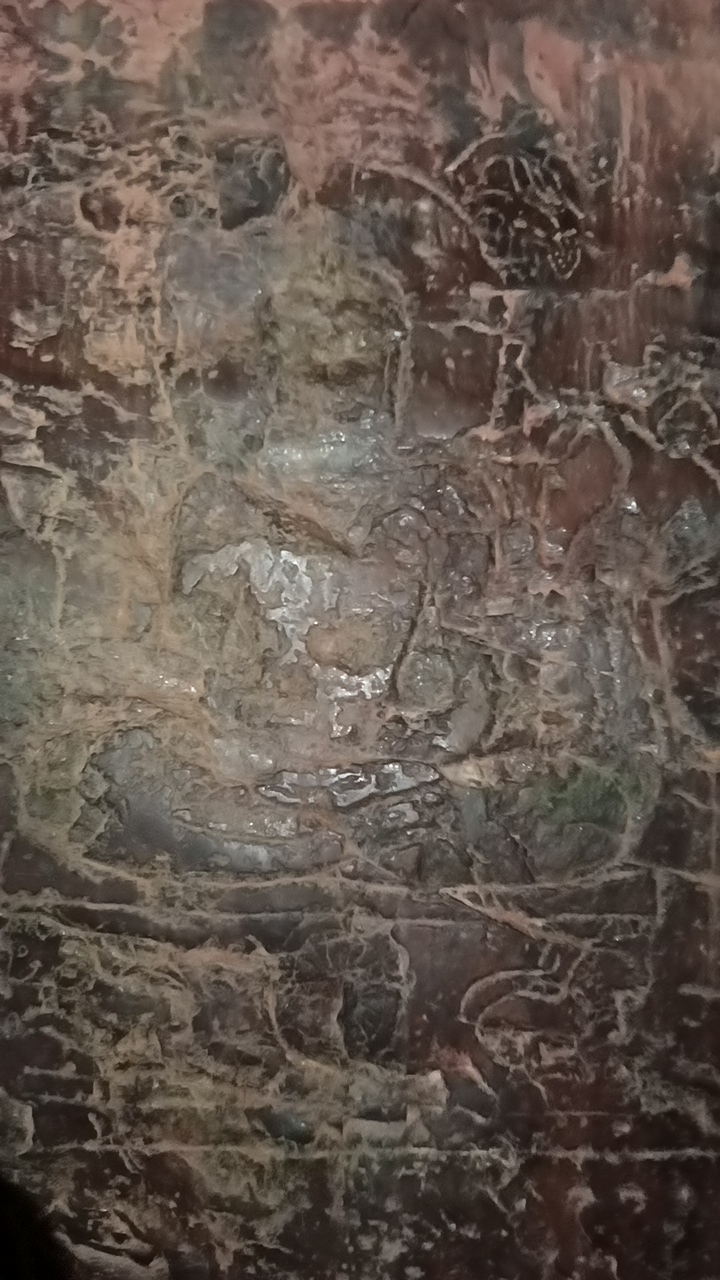
Architectural Marvel The two caves (Swarn Bhandar & Rani Ka Gufa) showcase ancient Jain craftsmanship with intricate carvings and inscriptions. The walls have mysterious markings, adding to the intrigue.
Spiritual & Scenic Vibes Located near Vishwa Shanti Stupa, the site offers a peaceful atmosphere. The surrounding hills and greenery make it a serene escape.
Visitor Tips: ✅ Best time to visit: Early morning or late afternoon to avoid heat. ✅ Entry Fee: Nominal (around ₹10-20). ✅ Guides available (recommended to understand the history). ✅ Wear comfortable shoes—some climbing is involved.
Why Visit? A rare glimpse into ancient Bihar’s heritage. Perfect for history buffs, spiritual seekers, and photographers. Less crowded compared to other Rajgir attractions.
Verdict: A 4.5/5 experience—loses half a point for minimal maintenance. Still, a must-visit for anyone exploring Rajgir’s rich past!
**Have you been here? Share your...
Read moreThe Son Bhandar Caves (also known as the Swarn Bhandar Caves) are two man-made caves carved into the base of the Vaibhar Hills in Rajgir in the state of Bihar in India. Based on the dedicatory inscription found in the largest cave, the caves are generally dated to the 3rd or 4th century CE, although some authors have suggested the caves could actually go back to the period of the Maurya Empire, possibly as early as 319 BCE.
The main cave is rectangular with a trapezoidal entrance and a vaulted ceiling, reminiscent of the structure of the earlier Barabar Caves. The cave is decorated with carvings of Jain symbols, including the swastika, the wheel of law, and the bull.
The smaller cave is located next to the main cave and is similar in structure. The cave is decorated with carvings of a Jain deity, possibly Mahavira.
The Son Bhandar Caves are a popular tourist destination and are considered to be an important archaeological site. The caves are located near the Rajgir hot springs and are easily accessible by car or bus.
Here are some of the key features of the Son Bhandar Caves:
Location: Vaibhar Hills, Rajgir, Bihar, India Date: 3rd or 4th century CE Builder: Jain Muni Vairadeva Features: Two man-made caves Rectangular main cave with trapezoidal entrance and vaulted ceiling Decorated with Jain symbols Smaller cave with carvings of a Jain deity The Son Bhandar Caves are a fascinating example of early Jain architecture. The caves are well-preserved and provide a glimpse into the religious practices of the Jains in the early...
Read more